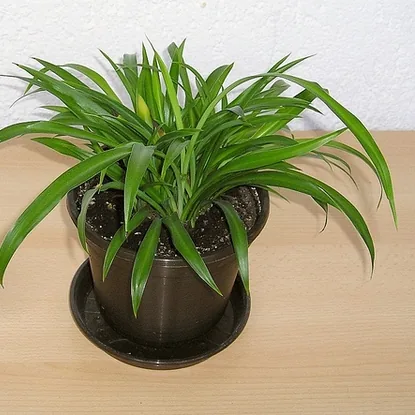
Spider plants bring movement to a room with narrow leaves that arch out from the centre. On mature plants, long stems carry small plantlets, creating a cascading effect that looks especially attractive in hanging baskets. There are entirely green forms as well as varieties with pale stripes. Growing one lets you watch new plants develop up close, making it a rewarding choice for beginner gardeners.
Plant profile
Common names: spider plant, airplane plant. Scientific name:Chlorophytum comosum. Family: Asparagaceae. Origin: tropical and southern Africa. Life cycle: perennial. Growth habit: clump-forming herbaceous plant with arching leaves. Size: approximately 15 to 70 cm, depending on variety and growing conditions. Light: plenty of filtered light. Potting mix: fertile and well drained. Propagation: plantlets formed on long stems. Pet safety: classified by the ASPCA as non-toxic to cats and dogs.
How to grow a spider plant
Position and light
Choose a bright position protected from intense midday sun. A window with filtered light lets you enjoy the striped leaves without exposing the plant to excessive heat. In hanging baskets, leave room for the trailing stems and check that the support can hold the container after watering. Avoid hanging it so high that checking the potting mix becomes difficult.
Watering and the container
Good drainage helps reduce the risk of root rot. Use a pot with drainage holes and water moderately, checking moisture before watering again. Frequency depends on temperature, airflow, plant size and the material of the container. A fixed calendar cannot replace observation.
After watering, empty any water collected inside the outer decorative pot. Brown tips do not point to just one cause: excessively dry potting mix, low humidity and salts in water or fertiliser can all contribute. Check moisture and drainage before increasing watering. If the problem continues, review feeding and try distilled water. Do not apply extra fertiliser to correct the damaged tips.
If leaves are also turning yellow, use our guide to investigating yellow leaves to check the pattern and growing conditions before making several changes at once.
Thick roots and when to repot
Spider plants form fleshy roots and rhizomes that store water. Finding these firm structures when inspecting the root ball is normal. Do not remove them simply because they look thick. These reserves explain some tolerance of irregular watering, but they do not protect a plant left in permanently waterlogged soil.
The University of Wisconsin notes that being slightly pot-bound can encourage growth and plantlet production. This is not a reason to leave a plant crowded indefinitely: when roots become very congested, consider repotting. Large clumps can also be divided. Assess the whole plant rather than assuming that any visible root means an immediate change of pot is needed.
Propagation and routine care
To grow a new plant, rest a plantlet on the surface of potting mix in another pot while leaving it attached to the parent. Cut the connecting stem only after it has rooted. Alternatively, detach a plantlet that already has roots and pot it up. Keep the mix slightly moist, without standing water.
The flowers are small and white, rather than competing visually with the foliage. Remove dry leaves carefully and keep healthy ones. When cleaning or rearranging the pot, support the clump at its base instead of pulling on the long leaves.
Frequently asked questions
Are the hanging plantlets a problem? No. They are part of the species’ characteristic vegetative reproduction and can remain attached as an ornamental feature.
Can it grow in any dark corner? Choose a bright spot. Being a houseplant does not mean it can do without natural light.
Can pets eat the leaves? A non-toxic classification does not make the plant food. Discourage chewing and seek veterinary advice if symptoms occur after ingestion.
Should I feed it more to produce more plantlets? Do not increase fertiliser for this purpose: too much can reduce plantlet formation and burn leaf tips. Check the growing conditions first.
Usamos cookies em nosso site para fornecer a melhor experiência de uso, lembrando suas preferências e visitas repetidas. Ao clicar em “Aceitar”, concorda com a utilização de TODOS os cookies.
Este site usa cookies para melhorar sua experiência enquanto você navega pelo site. Destes cookies, os cookies que são categorizados como necessários são armazenados no seu navegador, pois são essenciais para o

funcionamento das funcionalidades básicas do site. Também usamos cookies de terceiros que nos ajudam a analisar e entender como você usa este site. Esses cookies serão armazenados em seu navegador apenas com

o seu consentimento. Você também tem a opção de bloquear esses cookies. Porém, a desativação de alguns desses cookies pode afetar sua experiência de navegação.
Os cookies necessários são absolutamente essenciais para o funcionamento adequado do site. Esta categoria inclui apenas cookies que garantem funcionalidades básicas e recursos de segurança do site. Esses cookies não armazenam nenhuma informação pessoal.
Quaisquer cookies que possam não ser particularmente necessários para o funcionamento do site e sejam usados especificamente para coletar dados pessoais do usuário por meio de análises, anúncios e outros conteúdos incorporados são denominados cookies não necessários. É obrigatório obter o consentimento do usuário antes de executar esses cookies no seu site.