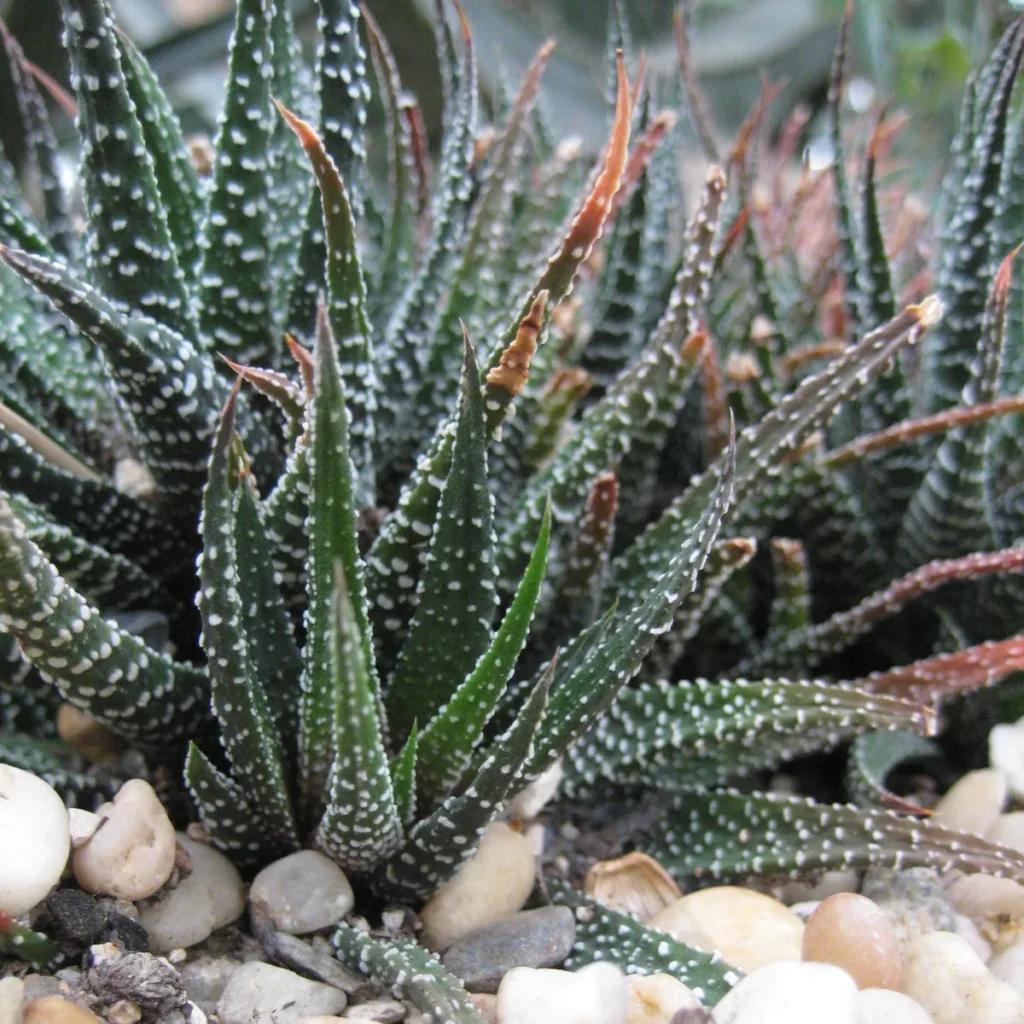
Zebra haworthia forms small rosettes of firm leaves marked with pale, raised bumps. Its geometric pattern is especially attractive up close. This slow-growing succulent suits small pots, provided they drain well and the plant receives enough light.
Plant profile
Scientific name: Haworthiopsis attenuata.
Widely used former name: Haworthia attenuata.
Family: Asphodelaceae.
Origin: the Cape region of South Africa.
Life cycle: perennial.
Habit: a rosette-forming succulent that produces offsets.
Size: small rosettes; the RHS describes plants of about 12 cm.
Light: bright conditions with protection from hot sun.
Potting mix: a well-drained cactus and succulent mix.
Propagation: mainly by separating offsets.
Choosing a position
Place the plant somewhere bright and ventilated. Protect it from intense sunshine without acclimatization and from severe cold. Indoors, a table far from a window may receive less light than our eyes suggest; watch the growth when choosing a permanent position.
The compact rosette makes it easy to follow changes in shape over several weeks. Taking an occasional photograph from the same angle helps distinguish normal growth from a sudden problem.
Pots and watering
Use a container with drainage holes and a porous mix. Water moderately during growth and let the mix dry between waterings. In cold weather or periods of little growth, water requirements decrease. Do not leave the pot standing in water inside a decorative container.
Do not increase the growing-pot size simply to fill a decorative space. A larger outer pot can hold the smaller container, as long as you can remove it for watering and drainage. Check moisture before watering again rather than automatically following a weekly routine.
Routine maintenance and offsets
The plant normally needs no pruning. Inspect the base and the gaps between leaves for mealybugs and scale insects. For propagation, choose a well-rooted offset. Lift the clump carefully, find where the offset joins the parent and separate it while preserving its roots. You do not need to dismantle a healthy clump just because offsets have appeared; keep them together if there is room.
Watering and warning signs
Direct water onto the potting mix, wet it thoroughly and let the excess drain through the holes. Avoid water pooling between the leaves. Soft leaves in a pot that is still wet call for inspection, not another watering: low light and persistent moisture favor root rot. Dry tips after stronger sun exposure are also a reason to reassess the position. Note when the change appeared and whether it affects only the exposed side. Do not treat the color of one leaf as a definitive diagnosis.
Refreshing the mix and checking the pot
Slow growth does not mean the growing mix lasts forever. Penn State suggests refreshing it approximately every two or three years, but this does not necessarily require a larger pot. Use the opportunity to check drainage, roots and available space. If the plant is healthy and has room, keep the same container. Feed only during active growth with a suitable cactus and succulent fertilizer, following its label; do not try to speed up the plant with extra doses.
Common questions
Is it a cactus? No. It is a succulent in the Asphodelaceae family, whereas cacti belong to Cactaceae.
How does it differ from Haworthiopsis fasciata? In common forms of H. attenuata, raised bumps also occur on the upper leaf surface; in H. fasciata that surface is usually smooth. There is variation within H. attenuata, so treat this as a clue rather than a definitive identification. Record where the plant came from and photograph both sides of the leaves.
Does it flower? Yes. It can produce small, white tubular flowers on slender stalks that rise above the rosette.
Sources
North Carolina State University
Royal Horticultural Society: Haworthiopsis attenuata
Penn State Extension: zebra plant as a houseplant
RHS: growing succulents and separating offsets
SANBI: variation in Haworthiopsis attenuata
Photo: Claire H., CC BY-SA 2.0, via Wikimedia Commons and NC State Extension. Square crop and WebP compression, without upscaling.