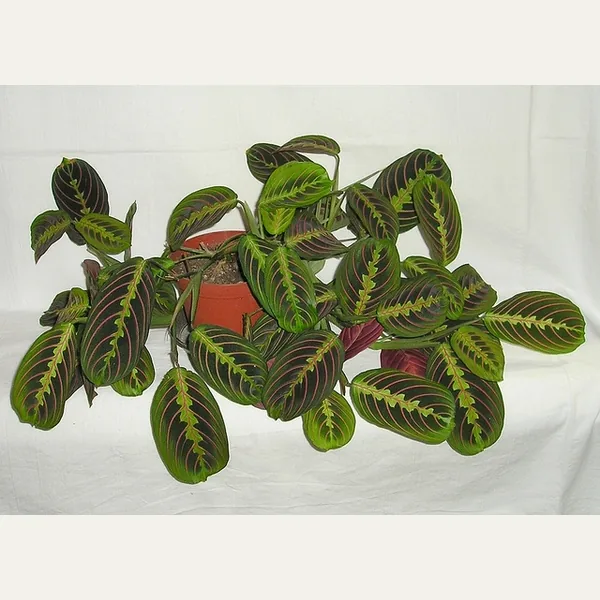
Maranta leuconeura is grown for its patterned leaves, which change position between day and night. This guide covers that species: check your plant’s scientific name before applying the advice.
Plant profile
Scientific name: Maranta leuconeura.
Family: Marantaceae.
Origin: central and eastern Brazil.
Growth habit: spreading herbaceous perennial.
Height: about 15 to 30 cm.
Leaves: oval to oblong, with variable patterns.
Flowers: small, white to purplish.
Light: bright, indirect light.
How to grow Maranta leuconeura
North Carolina State University recommends bright, indirect light and high humidity. Direct sun can damage the foliage’s colouring. Keep the potting mix evenly moist while the plant is actively growing, and reduce watering when growth slows. Low temperatures and cold draughts are unfavourable. Too much fertiliser can scorch leaves, while poor drainage encourages root rot.
The Royal Horticultural Society recommends peat-free potting compost, moderate watering and monthly feeding during active growth, following the product’s dilution instructions. Plants can be propagated by division, basal cuttings or seed. Routine pruning is not required. Watch for spider mites and scale insects. Advice to reduce watering in winter should be interpreted in light of the plant’s actual growing conditions, rather than applying a British greenhouse calendar everywhere.
Humid air is not the same as a waterlogged pot
Separate two decisions: keeping the air from becoming too dry, and deciding when to water. NC State suggests a humid environment for this maranta. That does not mean leaving its roots submerged or adding water whenever a leaf tip dries out. A humidifier may help in a dry room; maintain airflow and follow the manufacturer’s cleaning instructions.
Check the potting mix before reaching for the watering can. During active growth, aim for consistent moisture, avoiding prolonged dryness followed by waterlogging. If the mix is still very wet, wait and check the drainage. When you water, let excess water drain away and empty the outer decorative pot. If growth slows and the pot takes longer to dry, increase the interval between waterings. Watch how new leaves develop instead of trying to repair already-brown tips with extra water or fertiliser.
Common questions
Why do the leaves change position? Night-time leaf movement is part of the species’ normal behaviour. Consider the plant’s overall condition before interpreting a single change as a problem.
Where should I put it in a room? Choose a position with plenty of indirect light and protection from cold. There is no universal distance from a window: its direction, curtains and nearby buildings all affect the light reaching the plant.
How can I propagate it? Division is an option for Maranta leuconeura, according to Iowa State University, which advises propagating only healthy, vigorous plants. Stem sections can also be used. In guidance for the Lemon Lime cultivar, the University of Maryland suggests keeping a node, the small bump on the stem, and trying to root the cutting in water. Use a clean, sharp tool. The cutting needs a node because this is where roots develop.
Why does it have yellow leaves or brown tips? An older leaf turning yellow while new ones emerge may be part of normal renewal. Rapid leaf loss calls for a closer look at growing conditions. The University of Maryland notes that minerals in water and excess fertiliser can contribute to damaged tips, but the symptom alone does not confirm the cause. Check the potting mix’s moisture and empty the saucer after watering. Avoid repeatedly misting the leaves: keeping them wet can encourage disease. Observe how the plant responds before adding fertiliser or applying treatments.
Sources
North Carolina State University.
Royal Botanic Gardens, Kew.
Royal Horticultural Society.
University of Maryland: yellow leaves and brown tips.
University of Maryland: Maranta Lemon Lime cuttings.
Iowa State University: propagating houseplants.
Photo: Maja Dumat, CC BY 4.0. Neutral borders added above and below to preserve all the leaves, without cropping or enlargement; converted to WebP.