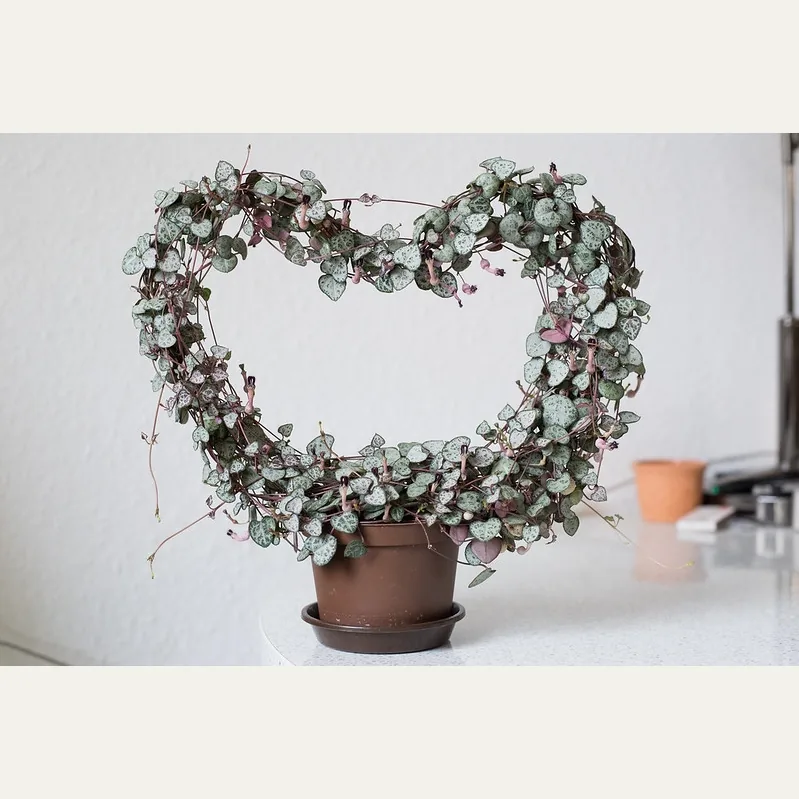
String of hearts combines very slender stems with small patterned leaves, trailing freely over the edges of a pot. Green leaves with silver markings and purplish undersides make it attractive even without flowers. It suits shelves and hanging containers in bright rooms, as long as there is space for the stems.
Plant profile
Scientific name accepted by Kew: Ceropegia woodii.
Synonym: Ceropegia linearis subsp. woodii.
Family: Apocynaceae.
Origin: Zimbabwe to South Africa.
Life cycle: perennial.
Habit: a tuberous plant that can creep, climb or trail.
Size: stems approximately 1 m long or more, depending on growing conditions.
Light: a bright position with filtered light.
Potting mix: light and well drained.
Propagation: stem cuttings and tubers.
Choosing a position
Bright partial shade shows off the leaf patterns without exposing the plant to abrupt changes in light. Protect it from frost and severe cold. Indoors, choose a place where you can inspect the plant and easily touch the mix. A high shelf may look attractive, but makes it harder to check when watering is needed.
Potting mix and watering
Use a suitable cactus and succulent mix and a pot that lets water escape. Water moderately while the plant is growing and reduce the frequency as growth slows. The aim is to avoid persistent moisture around the roots, particularly in cold conditions.
It does not need the same routine as a nearby fern or another neighboring plant. Check each container separately: pots made from different materials can dry at different rates even side by side. Do not leave the base standing in water collected in an outer pot.
Trailing stems and propagation
For a cutting, choose a healthy stem approximately 10–15 cm long and place it in cactus and succulent mix. While it roots, keep the mix slightly moist, not waterlogged, in a warm, bright place. Another option is to rest an aerial tuber on the mix while leaving it attached to the parent plant. Tubers can root where they touch the surface. This also helps fill gaps at the top of the pot. Wait until rooting has occurred before separating the new plant; a stem merely resting on the mix is not yet an established plant.
Untangle stems slowly when rearranging the plant to avoid breakage. Check occasionally for mealybugs and scale insects and other insects, including at stem junctions.
Do not repot just because the stems have grown
Trailing length does not tell you how much space the roots need. The species tolerates a relatively snug container, so delay repotting until there is a reason to do it. During growth, feeding can be light, using a low-nitrogen formula according to its label. Address watering and light problems first.
Yellow, wilted or widely spaced leaves
Yellowing leaves with persistently wet mix call for a review of watering and drainage, not immediate fertilizer. Dark, softened roots are a warning sign. Wilted leaves with dry mix may indicate insufficient water. If new growth has increasing gaps between the hearts, consider low light and move the plant gradually toward a brighter position. Spots after an abrupt move into strong sun call for protection from that exposure. Compare symptoms with recent care before acting.
Common questions
Leaf patterns and cultivar names: silver markings and purple undersides occur in the ordinary form. Silver alone does not confirm the cultivar ‘Silver Glory’. Variegated forms and selections such as ‘String of Arrows’ also exist. Keep the grower’s label and photograph the healthy plant: this reference helps distinguish its usual characteristics from a recent change.
Are the small balls on the stems pests? Not necessarily. Aerial tubers are normal structures in this species. Check whether they are part of the stem before trying to remove them.
Are Ceropegia woodii and Ceropegia linearis subsp. woodii different plants? In this context the names refer to the same taxon. Kew currently accepts Ceropegia woodii; horticultural sources still use the synonym.
Sources
North Carolina State University
South African National Biodiversity Institute (SANBI)
University of Maryland: diagnosing indoor plant problems
Photo: Maja Dumat, CC BY 2.0. Neutral borders added for a square format, without cropping or upscaling; converted to WebP.