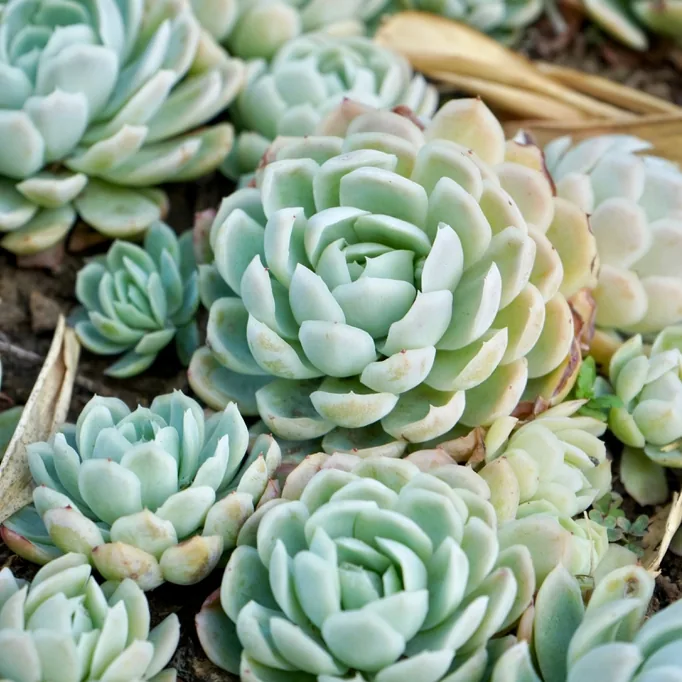
Echeveria elegans has a striking shape even when it is not in flower. Its fleshy leaves form circular rosettes, and side shoots can gradually create compact clusters. It works well in pots and rock gardens, especially where shapes and textures are part of the design. The key is to combine suitable light with efficient drainage. Being a succulent does not mean it needs no attention; it simply needs different care from plants that prefer constantly moist soil.
Plant profile
Scientific name: Echeveria elegans.
Family: Crassulaceae.
Origin: Mexico.
Type: evergreen perennial succulent.
Growth: clustered rosettes that can form low ground cover.
Typical size: about 10–20 cm tall and 20–30 cm wide, according to South Australia’s Botanic Gardens Plant Selector+.
Uses: containers, succulent beds, rock gardens and ornamental displays.
Propagation: leaves, cuttings and offsets, depending on the method and the plant’s stage of growth.
How much light does Echeveria elegans need?
North Carolina State University lists full sun to partial shade. For indoor containers, the Royal Horticultural Society recommends plenty of light and warns about the combination of low light and too much water. Assess the light in your chosen spot and let the plant adjust gradually. If it came from a shaded environment, do not suddenly expose it to strong sun, which can scorch the leaves. Advice about sun or partial shade needs to be interpreted for the conditions at your own window, balcony or garden.
Watering and choosing potting mix
Choose a container with drainage holes and a cactus-and-succulent mix that drains quickly. Before watering again, check that the mix is nearly dry. Do not leave the pot standing in collected water. Plants need less water during periods of slower growth. The RHS highlights persistent moisture combined with cold as unfavourable conditions for echeverias.
The University of Florida also warns against excessive moisture when growing this genus, particularly during cold periods. Alongside their attractive foliage, the plants can produce flower stalks and offsets. Those offsets offer a way to expand your collection, but there is no need to separate them immediately. First decide whether you want a cluster of rosettes or individual new plants.
Growing it in the garden
Keep the plant within the area you have planned for it. The South Australian reference notes vegetative spread and recommends avoiding planting near conservation areas in that setting. This is a regional precaution, not an invasive-species classification for every country. It is also a useful reminder not to discard offsets in natural areas.
Can Echeveria elegans flower more than once?
Yes. North Carolina State University describes slender stalks with pink tubular flowers tipped with yellow, and confirms that the plant can flower repeatedly during its lifetime. Do not confuse a flower stalk with stretching of the leafy stem. A flowering season given by an overseas source does not guarantee the same flowering month in your garden.
Investigating common problems
Use these signs as an initial check, drawing on Iowa State University’s general succulent guide. Compare them with the watering history and any recent move to a different location.
An open rosette with long, thin or pale growth: this can indicate insufficient light. Find a brighter position and make the change gradually, as described above.
Dry patches after moving the plant into sun: these may be scorch marks. Reduce harsh exposure and watch the new leaves. Burned tissue will not regain its original appearance.
Yellowing leaves and soft tissue while the mix is wet: check for overwatering and possible rot. Do not water merely because the plant looks wilted. Inspect drainage holes, water in the saucer and the roots before deciding what to change. Not every plant affected by rot will recover.
Cotton-like clusters: these may be mealybugs, particularly where leaves meet. Inspect the plant and identify the pest before choosing a treatment.
How to propagate Echeveria elegans
North Carolina State University lists division and leaf cuttings for this species. The steps below combine that information with general succulent-propagation advice from Iowa State University and the RHS.
From offsets: look for a side rosette with roots of its own. Move the potting mix aside so you can see where it joins the parent plant. Separate it carefully, preserving its leaves, stem and roots. If the connection needs cutting, use a clean, sharp tool. Plant in a container with drainage holes and a free-draining mix, settle the roots and water lightly. Watch it establish before treating it like a mature plant.
From a leaf: select a healthy, fully developed leaf. Remove it whole, including the base that joins the stem. A broken fragment without that base is not equivalent to a complete leaf cutting. Allow the detached area to dry and callus. Rest the leaf on free-draining mix with its base at the surface, rather than burying the whole leaf.
Keep it in good light, protected from intense direct sun. The mix should be only slightly moist, never waterlogged. Do not seal the container with plastic. Watch for roots and a small rosette, and transplant when the new plant is large enough to handle. Remove leaves that rot. There is no guarantee that every leaf will produce a new plant.
Common questions
Does the common name identify this species reliably? No. In Brazil, for example, the name rosa-de-pedra is used for Echeveria elegans and other species in the Ministry of Agriculture’s ornamental-plant list. Common names help with searches, but they do not replace the scientific name when identifying a plant.
Is there a fixed watering schedule? No single frequency fits the advice gathered here. Use the drying of the potting mix as your guide, rather than watering automatically every day.
Can it get pests? Yes. North Carolina State University recommends watching for mealybugs and aphids, among other problems. A tough-looking plant still needs inspection.
How can I check what I bought? Keep the label with its scientific name and ask the supplier to confirm the identification if you are unsure. Advice for the genus Echeveria may not apply equally to every species.
Sources
Species and care: North Carolina State University. Size and environmental precautions: Botanic Gardens and State Herbarium of South Australia. General guidance for the genus: Royal Horticultural Society (RHS) and University of Florida (UF/IFAS).
Further growing advice: Iowa State University, propagating succulents; RHS, leaf cuttings; Iowa State University, succulent problems.
Photo: Eria Wei, via North Carolina State University, CC BY-SA 4.0. Cropped to a square and converted to WebP without enlargement. Adapted image shared under the same licence.