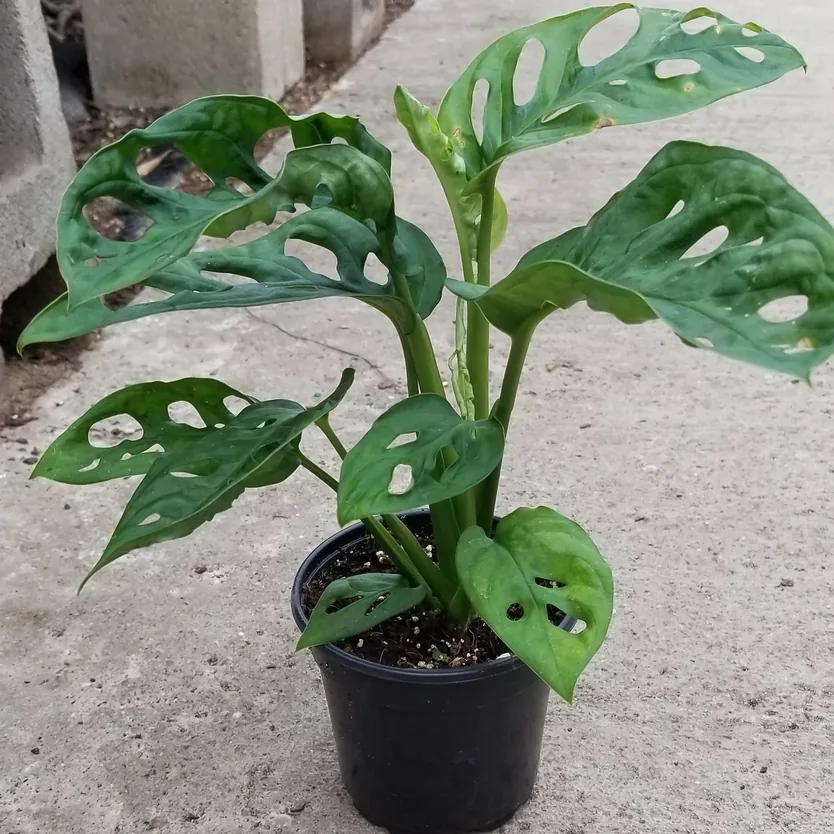
Natural holes in the leaves are the hallmark of Monstera adansonii, often called Swiss cheese vine. This tropical climber can be trained onto a support to show off its vertical growth.
Plant profile
Scientific name: Monstera adansonii.
Common names: Adanson’s monstera and Swiss cheese vine. “Swiss cheese plant” can also refer to other species, so check the scientific name.
Family: Araceae.
Origin: Mexico and tropical America.
Habit: perennial climber. It is not the same species as Monstera deliciosa.
Growing conditions
Provide bright indirect light, warmth and a moist but well-drained mix. Avoid strong sun, waterlogging and cold draughts. A pole or trellis supports growth. Propagate from stem cuttings. Inspect leaves and shoots to spot mites and mealybugs or scale insects early.
Support, growth and feeding
The RHS describes the species as both climbing and trailing. A support is therefore not essential for survival: it lets you choose a vertical display. Without one, stems can hang over the pot’s edge. Plan space before they lengthen and avoid squeezing them against walls or furniture.
The RHS profile recommends peat-free potting mix, indirect light and moderate to high humidity. During active growth, it allows a balanced liquid feed monthly. Follow the product dose and reduce watering when plant activity slows. References to winter come from temperate conditions and are not a fixed calendar for every climate.
Can it grow in a hanging basket? Yes, this is one of the uses listed by the RHS. Make sure you can reach it to inspect the mix and water safely.
Are roots appearing on stems abnormal? No. The species produces adventitious roots associated with its climbing habit.
Training and pruning stems
Use a dedicated support: climbing roots can mark walls. Pruning helps control long stems and encourage a fuller appearance. During routine care, wipe dust from leaves with a soft cloth and inspect the stems. Empty the saucer after watering so the pot does not remain submerged.
Taking a cutting with a node
Pruned stems can provide new plants. Choose healthy material and use clean secateurs. Every cutting needs a piece of stem with at least one node, where leaves and shoots attach. The species can root in water or growing medium. In water, keep leaves out and replace the water regularly. A clear container makes roots easier to observe. Avoid wilted, infested or rotting sections.
What to inspect
Check leaf undersides and the junctions between leaves and stems. Fine webbing and pale stippling warrant checking for mites; white cotton-like masses may indicate mealybugs. Separate an infested plant while identifying and treating the problem. Inspect new purchases before placing them near your collection. These clues are not a definitive diagnosis based on a single photograph.
Natural holes or recent damage?
Natural perforations develop early as the leaf forms. For practical monitoring, compare photographs of the same leaf over time. Tissue loss appearing later alongside spots, insects or webbing needs investigation and should not automatically be attributed to natural holes, or fenestrations. Their possible ecological benefits are still being studied; there is no need to assign them one guaranteed function.
When to water
Do not use a weekly frequency as a rule. Light, temperature, pot size and pot material change water needs. Before watering, feel the mix below the surface. If it is still wet, do not water simply because the planned day has arrived. When needed, wet the entire root ball, let water run through the holes and empty the saucer or outer pot.
Common questions
Do holes mean the leaves are diseased? Regular natural perforations are part of the species’ appearance. Spots and dead tissue require separate assessment.
Can pets reach it? No. It is toxic if eaten and may irritate skin. Keep away from children and animals and wear gloves when handling.
Sources
University of Connecticut: assessing and watering potted plants.
Royal Horticultural Society: Monstera adansonii.
North Carolina State University.
NParks: growing Monstera adansonii.
University of Florida: leaf holes and propagation.
NParks: propagation by cuttings.
NParks: recognising spider mites.
NParks: recognising mealybugs.
University of California Botanical Garden at Berkeley: formation of leaf holes.
Photograph: Cindy Christian, CC BY 4.0. Central square crop and WebP compression without enlargement.