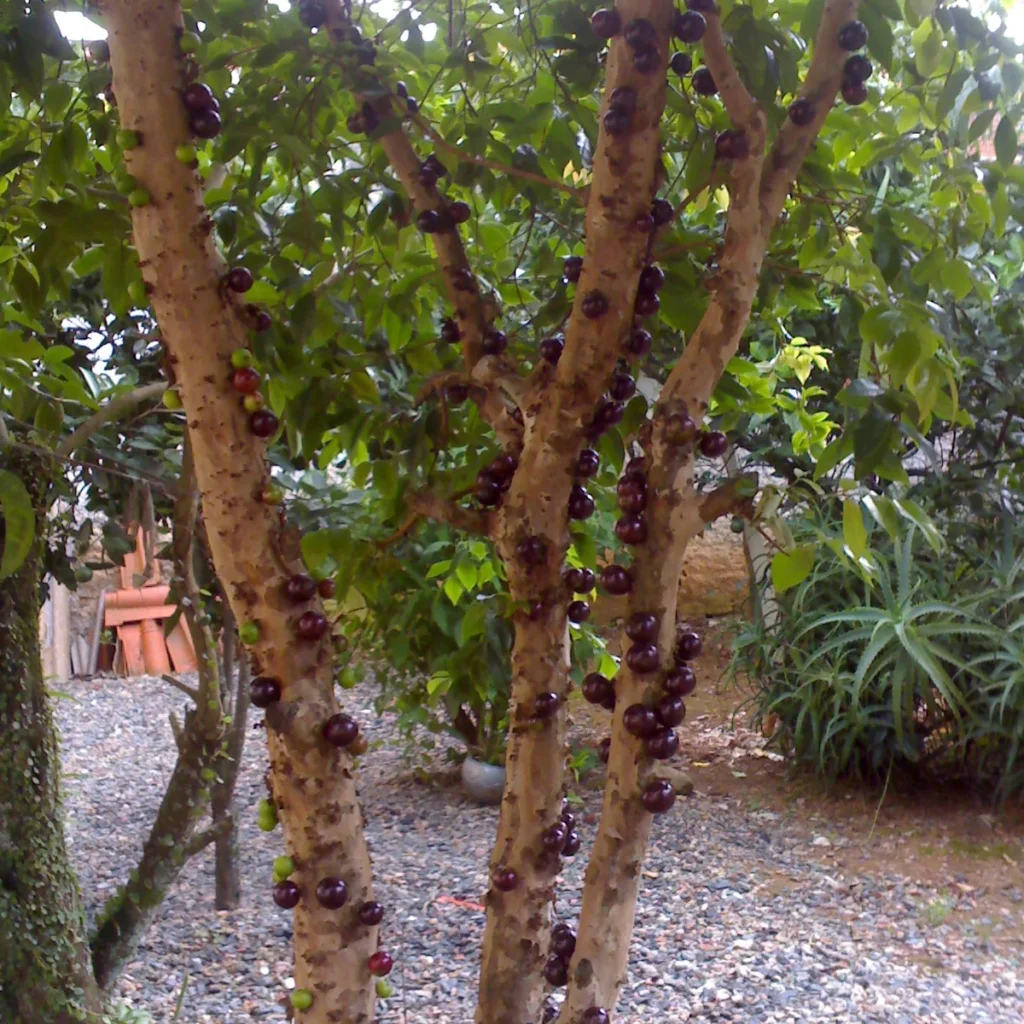
White flowers and dark fruit growing directly from the wood make jabuticaba a striking garden tree. In Plinia cauliflora, they appear on the trunk and larger branches. It is a plant to watch develop over time, with ornamental interest even between harvests thanks to its foliage and bark that flakes away in small patches.
Identification at a glance
Scientific name used here:Plinia cauliflora. Family: Myrtaceae. Name found in older references:Myrciaria cauliflora. Habit: tree or large shrub. Leaves: simple, meaning each leaf is a single blade, arranged in opposite pairs; the tree keeps foliage through the year. Flowers: small and pale, with many pollen-producing stamens. Fruit: rounded, with dark skin when ripe and pale flesh.
ITIS records Plinia cauliflora (Mart.) Kausel as an accepted name. The common name jabuticaba is used for different cultivated plants. When choosing a nursery plant, ask for its species, cultivar if known, and propagation method. Do not assume every plant sold as a “hybrid jabuticaba” is exactly the species described here.
Growing conditions and space
Singapore’s National Parks Board (NParks) recommends deep, fertile, well-drained, slightly acidic soil. It describes a tree that can reach around 15 m (49 ft) in favorable conditions. The size of a nursery specimen is therefore not a prediction of its eventual size in the garden.
NParks specifies full sun. The University of Florida’s jabuticaba guide also allows partial shade and notes that more sun can favor heavier crops. Neither source supports treating a dim indoor room as equivalent to a suitable outdoor site.
The University of Florida highlights shallow roots, attention to wind exposure and a preference for acidic soil. Soil amendments should follow assessment: do not add acidifying products merely because the tree prefers acidic conditions. Check your soil and seek local advice on any amounts needed.
The Florida guide notes that seeds lose viability quickly and should be sown fresh. Grafting and air layering are also used. Grafting joins part of one plant to another plant’s roots; air layering encourages a branch to root before it is detached. The propagation method affects expectations, but it does not justify promising a first harvest on a fixed date.
Planting without damaging the roots
Embrapa highlights jabuticaba’s sensitivity to transplanting. Prefer an overcast day and prepare the planting site before removing the nursery container. Keep the root ball intact: do not wash the roots or break up the soil just to fit the tree into a hole. Set it without burying the base of the trunk, fill around the sides and water after planting.
During the first few days, check both the root ball and the surrounding soil. The surface alone can mislead you: wetting only the edge of a container does not restore a dry root ball. Conversely, standing water points to a drainage problem. Avoid repeated transplanting in response to every fallen leaf.
Growing jabuticaba in a pot
The container needs clear drainage outlets and enough room for the root ball. Choose its position with light and watering access in mind. On a balcony, check load capacity before installing heavy containers. Observe the plant as heat, wind and rainfall change rather than supplying a fixed daily volume of water.
Emater-MG explains that water shortage harms growth and production, while waterlogging can kill roots. Wet the area occupied by the roots rather than concentrating all the water beside the trunk. Watch drainage from pots and do not leave water standing in saucers. If the mix stays wet for a long time, check the holes and growing medium before watering again.
Why has my tree not fruited yet?
Record the plant’s identity, origin and propagation method. Then look for flowers, or establish whether it is still growing without flowering. Species, stage of development and growing conditions must be assessed together. An advertisement for an “early-fruiting hybrid” does not determine the behavior of Plinia cauliflora.
Check light and moisture consistency before looking for a product to “force” fruiting. Do not deliberately drought-stress the tree or cut into its trunk to induce a crop. For persistent leaf drop, spots or dying branches, photograph the whole plant, its container or soil, and the symptoms, then seek local diagnosis. A photograph of a yellow leaf alone cannot tell you which fertilizer to use.
Starting a plant from seed
Use fresh seeds, rinse away remaining pulp and sow promptly. Emater-MG’s guide describes sowing in containers about 1 cm (0.4 in) deep. Label the source and keep the medium moist but drained. Watch for emergence without repeatedly digging up the seeds. Seedlings are not guaranteed to match another plant’s performance or fruit within a fixed time.
Common questions
Do flowers on the trunk indicate a problem? No. They are a characteristic feature of the plant and part of its ornamental appeal.
Does jabuticaba produce fruit all year? Mature trees may have more than one crop, but continuous production is not guaranteed everywhere. Climate, the cultivated plant and its care all matter.
Will a small nursery tree stay small? Do not assume so from its purchase size. Ask about its identity and history before choosing a permanent position.
Usamos cookies em nosso site para fornecer a melhor experiência de uso, lembrando suas preferências e visitas repetidas. Ao clicar em “Aceitar”, concorda com a utilização de TODOS os cookies.
Este site usa cookies para melhorar sua experiência enquanto você navega pelo site. Destes cookies, os cookies que são categorizados como necessários são armazenados no seu navegador, pois são essenciais para o

funcionamento das funcionalidades básicas do site. Também usamos cookies de terceiros que nos ajudam a analisar e entender como você usa este site. Esses cookies serão armazenados em seu navegador apenas com

o seu consentimento. Você também tem a opção de bloquear esses cookies. Porém, a desativação de alguns desses cookies pode afetar sua experiência de navegação.
Os cookies necessários são absolutamente essenciais para o funcionamento adequado do site. Esta categoria inclui apenas cookies que garantem funcionalidades básicas e recursos de segurança do site. Esses cookies não armazenam nenhuma informação pessoal.
Quaisquer cookies que possam não ser particularmente necessários para o funcionamento do site e sejam usados especificamente para coletar dados pessoais do usuário por meio de análises, anúncios e outros conteúdos incorporados são denominados cookies não necessários. É obrigatório obter o consentimento do usuário antes de executar esses cookies no seu site.