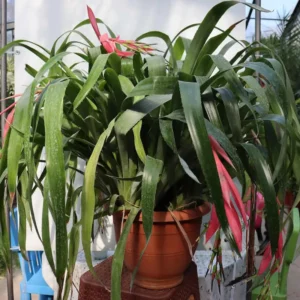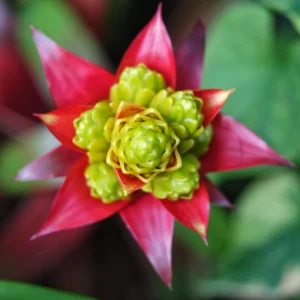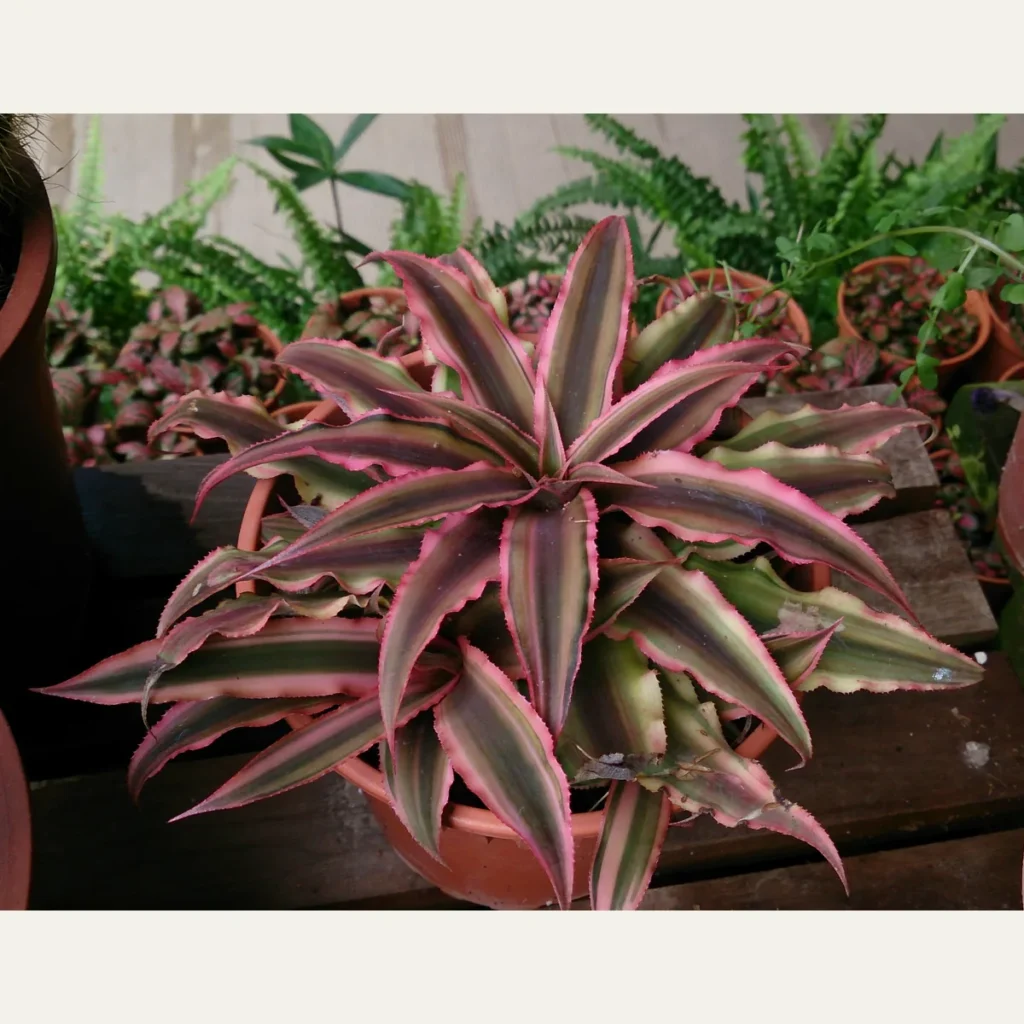
Cryptanthus bivittatus, commonly known as an earth star, stands out for its low rosette and decorative foliage. Its star-like outline brings colour and texture to a small pot, without relying on a showy flower display.
Plant profile
Scientific name: Cryptanthus bivittatus (Hook.) Regel.
Synonym: Cryptanthus nitidus, according to Kew.
Common name: Earth star.
Family: Bromeliaceae.
Origin: Brazil; Kew records its native distribution in Pernambuco.
Size: A low rosette, approximately 30 cm wide according to the RHS. Dimensions vary between plants.
Foliage: Strap-shaped leaves with wavy margins and small teeth; the stripes may include green and pink.
Ornamental uses: Pots, bright indoor spaces and carefully managed terrariums.
How to grow an earth star
Choose bright, filtered light and moderate to high humidity, as recommended by the Royal Horticultural Society (RHS). North Carolina State University warns that too much shade weakens the leaf colours, while strong sunlight can bleach and damage the leaves. Watch how the plant responds after moving its pot.
An earth star grows in a potting medium rather than forming the water-holding tank found in some other bromeliads. Use a humus-rich, well-drained mix. Water the root area when the surface feels dry, rather than following a fixed schedule. This guidance comes from North Carolina State University.
This difference matters when comparing it with Guzmania lingulata: caring for a bromeliad with a central cup is not the same as watering an earth star. Do not apply the same routine to every member of the family.
The RHS recommends diluted liquid feeding during growth and notes the possibility of root rot. Moisture should not become permanent waterlogging. The species does not need shaping by pruning.
Common questions
Does it flower? Yes. Small flowers appear in the centre of the rosette, but the leaves provide the main ornamental interest.
How do I propagate an earth star? For Cryptanthus bivittatus, North Carolina State University recommends pups about one-third of the adult plant’s size. The Bromeliad Society of Houston advises separating Cryptanthus pups when they come away with a gentle tug. If there is resistance, do not force them: wait for further development.
What if the pup has no roots? The University of Florida explains in its general bromeliad guidance that pups can form roots after separation. A lack of roots is not a reason to add excessive water.
How should I pot and care for it at first? Place each pup in a small pot with drainage. For Cryptanthus, use a mix that retains some moisture but lets excess water escape, as the Houston society advises. The RHS bromeliad propagation guide recommends a warm, bright position protected from direct sunlight. Maintain moisture without waterlogging, and do not leave the pot sitting in water in a saucer.
Does the rosette last forever? After flowering, the mother rosette gradually declines. Pups allow the plant to continue growing.
Which pests should I watch for? Scale insects and mites may occur, according to North Carolina State University. Inspect the plant before choosing any treatment.
Sources
Royal Botanic Gardens, Kew: botanical identification.
Royal Horticultural Society (RHS).
North Carolina State University.
Bromeliad Society of Houston: growing Cryptanthus and separating pups.
University of Florida (UF/IFAS): separating bromeliad pups.
RHS: propagating and growing bromeliads.
Photo: Mokkie, CC BY-SA 4.0. Side context cropped while retaining neutral margins; reduced and compressed to WebP without upscaling. Adapted image licensed under CC BY-SA 4.0.