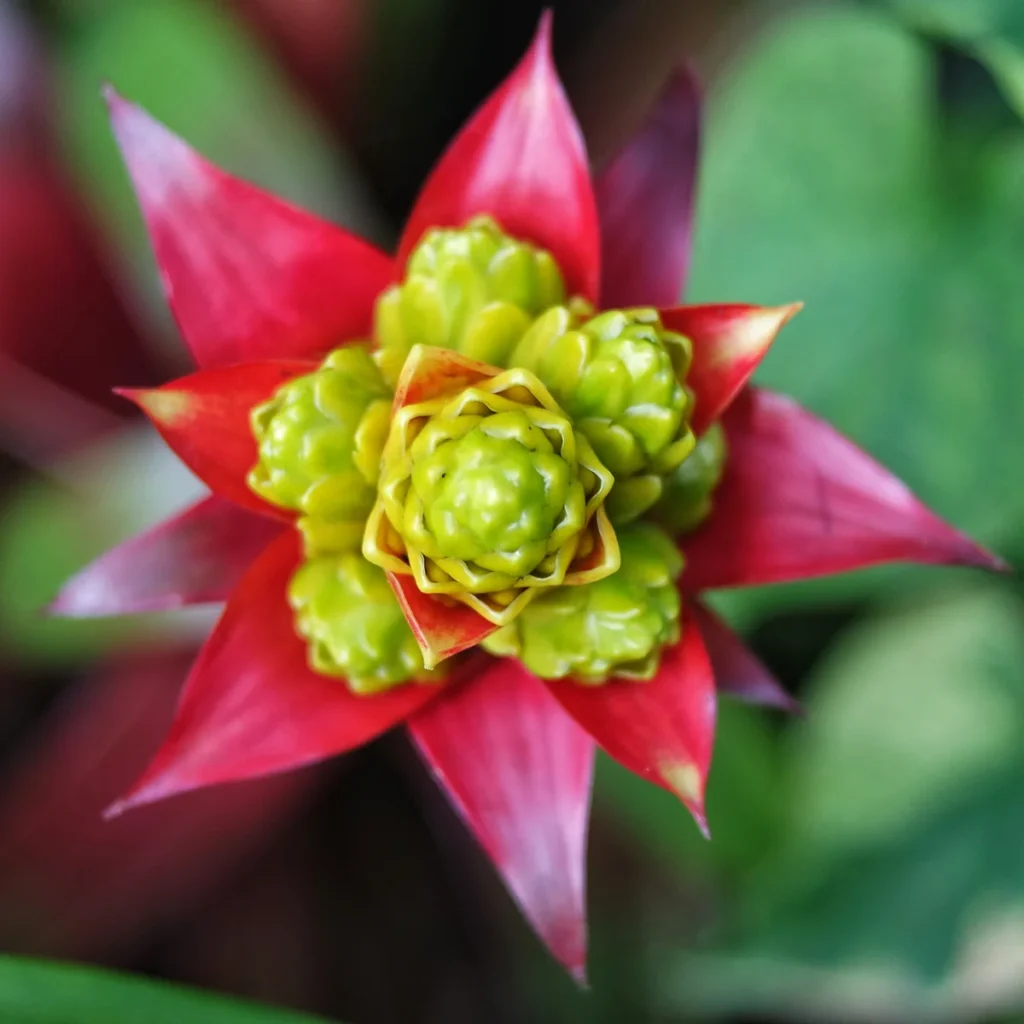
Guzmania lingulata stands out for its colourful centre surrounded by glossy green leaves arranged in a rosette. This ornamental bromeliad suits bright spaces where strong sunlight does not fall directly on the foliage. Much of what we tend to call its “flower” is actually made up of bracts: coloured structures that surround the smaller, true flowers. Knowing the difference makes it easier to follow the plant’s development without expecting every part to last equally long.
Plant profile
Scientific name: Guzmania lingulata (L.) Mez.
Family: Bromeliaceae.
Origin: Tropical America, including Brazil.
Growth habit: A herbaceous plant that can grow on other plants without parasitising them, a habit known as epiphytic growth. Its leaves form a rosette.
Ornamental interest: Foliage and colourful bracts.
Light: Bright indirect light or partial shade.
Propagation: Separating side shoots, also called pups.
Singapore’s National Parks Board (NParks) describes flexible, glossy green leaves and red bracts surrounding small, pale flowers. The species can form clumps. Allow room for both the rosette and the pups that will develop around it, rather than judging the space needed only by the size of a newly purchased plant.
Where to grow it and how to prepare the pot
Choose a spot with plenty of filtered light. Missouri Botanical Garden recommends indirect light, warmth and humid air. A dark room does not become suitable simply because the plant is sold as a houseplant.
Use a porous potting mix and a container that drains freely. Water thoroughly and let the excess escape, rather than keeping the mix waterlogged. Missouri Botanical Garden notes the risk of root rot when the growing medium stays continuously wet. Water requirements decrease in cooler conditions.
Choose a pot in proportion to the root system, with unobstructed drainage holes. An oversized container holds moisture for longer and can encourage rot.
For feeding, follow the dilution instructions on a fertiliser suitable for the plant. Do not increase the dose in an attempt to bring flowering forward.
Watering the potting mix and refreshing the central cup
Watering the roots and changing the water held between the leaves are two different jobs. The potting mix must drain, while the centre of the rosette acts as a reservoir. General guidance for Guzmania is to keep water in this cup and replace it periodically, allowing excess water to run out. Refreshing it means removing the old water, not just topping it up.
Check water trapped between the leaves during routine care. In Brazil, the Zoonosis Control Centre in Mogi das Cruzes recommends flushing bromeliads with a jet of water every week. Empty saucers and outer decorative pots too. Follow mosquito-control advice from your own local health authority, especially if you find larvae.
What happens after flowering?
The ornamental display may last two to four months, according to North Carolina State University’s profile of Guzmania lingulata. After flowering, the mother plant gradually declines and produces pups. These new rosettes carry the plant on; the same rosette does not flower repeatedly.
How to separate and pot the pups
For Guzmania in general, North Carolina State University suggests separating pups when they reach about one-third of the mother plant’s size. Their development is a better guide than a fixed date.
1. Find the point where the pup joins the mother plant. If it is hidden, carefully remove the clump from its pot.
2. Cut the connection with a clean, sharp blade, protecting the base and any roots of the young plant. Do not pull on the leaves.
3. Set the pup in its own pot. The University of Georgia’s general bromeliad guidance explains that well-developed pups can form roots after separation; they do not need a fully rooted root ball before you divide them.
While roots establish, keep the pup in a more shaded position with humid air, without waterlogging the mix. The University of Wisconsin recommends this approach for newly separated bromeliads.
Common problems and what to check first
Potting mix that stays wet: Check the drainage holes and empty water from the outer container. More watering will not repair roots damaged by excess moisture.
Spots or small organisms on the leaves: The species profile lists leaf spots, scale insects and mites among possible problems. Inspect both sides of the leaves and identify the cause before applying a product. A single symptom is not enough to diagnose the plant.
An old rosette losing vigour after flowering: Look for pups before discarding the whole clump. Decline of the mother plant can be part of its life cycle, but you should still check drainage and look for pests. If leaves change colour, our guide to yellow leaves on plants explains how to assess the conditions before choosing a remedy.
Common questions
Can I follow a fixed weekly watering schedule? It is better to check moisture and drainage. The pot, growing medium, airflow and room conditions all matter. The calendar alone cannot tell you whether the roots are still wet.
Does the common name guarantee the identification? No. Check the scientific name and any cultivar name when buying. Photographs of other guzmanias may show colours and shapes different from this species.
Sources
Singapore National Parks Board (NParks).
Bogotá Botanical Garden herbarium.
North Carolina State University: Guzmania lingulata.
North Carolina State University: Guzmania.
University of Wisconsin: growing and propagating bromeliads (general guidance).
University of Georgia: separating bromeliad pups (general guidance).
Mogi das Cruzes municipal government: Zoonosis Control Centre checklist.
Photo: Jörg Fuhrmann (Intermerker) / Wikimedia Commons, CC BY-SA 4.0. Square framing preserved; resized where necessary and compressed as a 1200 × 1200 px WebP without upscaling. Adapted image licensed under CC BY-SA 4.0.