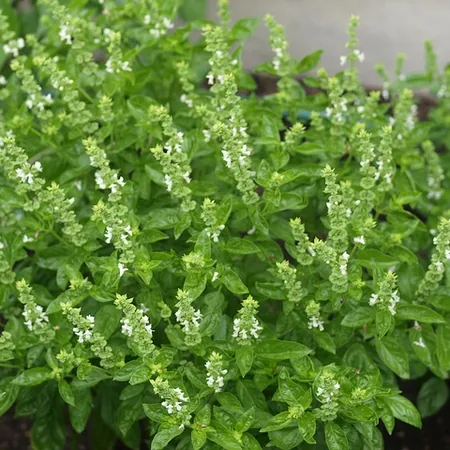
Growing basil brings the herb garden into everyday cooking. Ocimum basilicum includes cultivated varieties, or cultivars, with different leaf sizes, colours and aromas. You can choose one for its flavour as well as its appearance. A well-placed pot is enough to get started. Success depends mainly on light, drainage and careful harvesting, rather than repeatedly stripping the plant bare.
Basil at a glance
Common name: sweet basil.
Scientific name: Ocimum basilicum.
Family: Lamiaceae.
Type: aromatic herb, often grown as an annual.
Leaves: green or purple, depending on the cultivar.
Uses: culinary leaves and ornamental planting in pots or beds.
Light: a sunny position.
Soil: moist but well drained.
Propagation: seeds and stem cuttings.
Choosing a plant: check its cultivar and intended use. Other plants called basil belong to different species, so they should not all be treated as the same plant.
Light, climate and choosing a pot
Choose a sunny spot. The University of Minnesota gives six to eight hours of bright light a day as a useful guide. Indoors, use a genuinely sunny window: a room that looks bright to us may still provide too little light for herbs. Choose a pot with unobstructed drainage holes. Containers dry out faster than garden beds and need checking more often.
Basil is sensitive to frost. Plant it outdoors once the local frost risk has passed. There is no single planting month that suits every region. Spring planting dates in gardening guides refer to the climate where those guides were written.
How to grow basil from seed
Sow in seed-starting mix and cover with a thin layer, about 6 mm deep. Keep the mix moist during germination. Under suitable conditions, seedlings usually emerge in five to ten days, although temperature and cultivar affect the timing. When seedlings have two pairs of true leaves, in addition to their first seed leaves, move each one into a small container. This prevents crowding. Use leaf development as your guide, not simply the number of days since sowing.
For outdoor beds, wait for warm conditions and no risk of frost. Leave room for each plant to develop. The University of Minnesota suggests approximately 15 to 30 cm between plants, adjusted for the cultivar’s size. Do not keep a tightly packed clump together just because it looks fuller when purchased.
How to root basil cuttings
A cutting is a piece of stem that can grow into a new plant. Iowa State University describes rooting herbs, including basil, in water:
1. Prepare the stem. Take a cutting about 5 to 10 cm long and remove the leaves from its lower half.
2. Place it in water. Submerge the base, but keep the remaining leaves above the water. Change the water regularly and watch its level so the new roots do not dry out.
3. Move it into potting mix. Once roots are about 2.5 cm long, transplant into an individual container of potting mix and keep in good light.
Moving from water to soil takes adjustment. Some wilting or leaf drop may occur; this is not a signal to harvest or fertilise immediately. Keep care consistent and wait for recovery before harvesting the young plant.
Watering and feeding without a fixed calendar
Keep moisture reasonably consistent, adjusting watering to the heat, soil and plant size. Too little water can slow growth; intense heat and water stress can also encourage flowering. Do not wait for repeated wilting before reviewing your watering routine. In garden beds, a soil test helps determine whether fertiliser is needed. For pots, follow the potting-mix and fertiliser instructions rather than copying application rates intended for agricultural fields.
Avoid leaving water in the saucer and do not overfeed. Fast growth from excess fertiliser does not necessarily mean better flavour. Always leave enough foliage for the plant to continue growing.
Harvesting and pruning for new leaves
Select a shoot tip and cut just above a pair of leaves. Keep that pair and the foliage below it: new shoots will develop from the nodes left on the plant. Removing the tips encourages branching. Treat harvesting as a light prune, rather than taking all the leaves at once. If your goal is continued leaf production, remove flowers as they appear.
To collect seeds, allow some flower spikes to mature. Different cultivars can cross-pollinate, so saved seed may not reproduce the traits you want. Do not save seed from plants affected by Fusarium wilt or bacterial leaf spot.
Yellow leaves, wilting and other problems
Yellowing between the veins may look like a nutrient shortage, but it can also indicate downy mildew, a leaf disease. Turn the leaf over and look for greyish growth underneath. Iowa State University recommends removing and bagging suspect plants, avoiding overcrowding and improving airflow. Avoid wetting the foliage when watering, and avoid watering at night. When replacing plants, look for downy-mildew-resistant cultivars. Resistance does not replace good growing conditions.
Holes in leaves call for a closer look: slugs and snails may cause damage, particularly in damp, shaded or crowded conditions. Do not assume every symptom means the plant needs fertiliser. Check the leaves, stems and pot conditions before choosing a response.
Replacing plants and storing the harvest
Pruning helps maintain leaf production, but it does not make basil permanent. Start replacement plants when an older one loses vigour instead of relying indefinitely on the same plant.
To preserve a larger harvest, freeze leaves in small portions. You can also chop them, add water in an ice-cube tray and freeze the cubes for soups and sauces. This is a storage method, not a way of keeping leaves fresh indefinitely.
Sources
North Carolina State University: identification and cultivars.
University of Minnesota: light, planting and container growing.
Clemson University: sowing, harvesting and seeds.
Iowa State University: rooting herbs in water.
Utah State University: watering, nutrition and flowering.
North Carolina State University: harvesting basil.
Iowa State University: growing, storage and downy mildew.
Photo: F. D. Richards, CC BY-SA 2.0. Cropped to a square and converted to WebP without enlargement. Adapted image shared under the same licence.