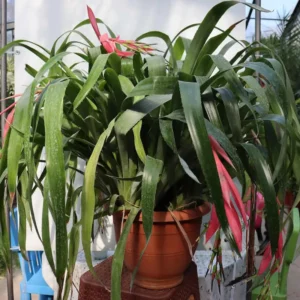
Heliconia bihai brings bold foliage and upright color to a tropical garden. It is better approached as a substantial clump-forming plant than as a small flower to squeeze into a spare corner. Before planting, think about its mature size, the light in that particular spot and how you will reach the clump for maintenance.
The colorful structures are bracts
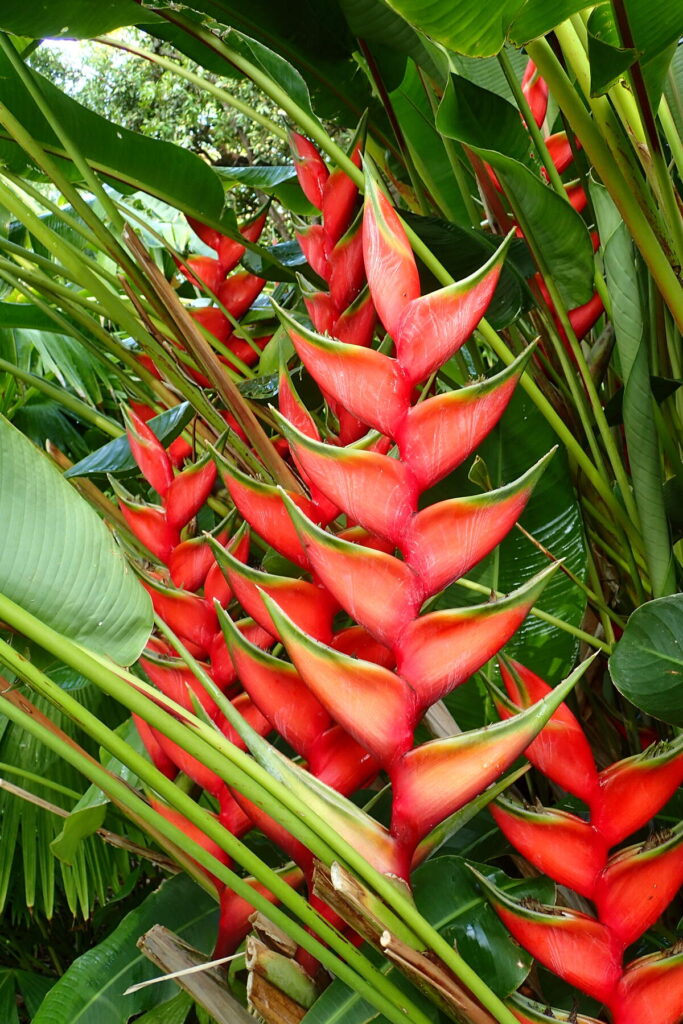
The showy parts commonly called flowers are bracts: modified leaves associated with the smaller true flowers. In this species the flowering structure stands upright. Embrapa describes red bracts with green details, although cultivated selections vary. The banana-like leaves and underground rhizomes belong to an herbaceous plant, not a woody shrub.
Kew recognizes Heliconia bihai as an accepted species native to Mexico, the Caribbean and northern South America, including northern Brazil. It grows primarily in wet tropical environments. A label matters: similar-looking heliconias and hybrids should not automatically be treated as the same species.
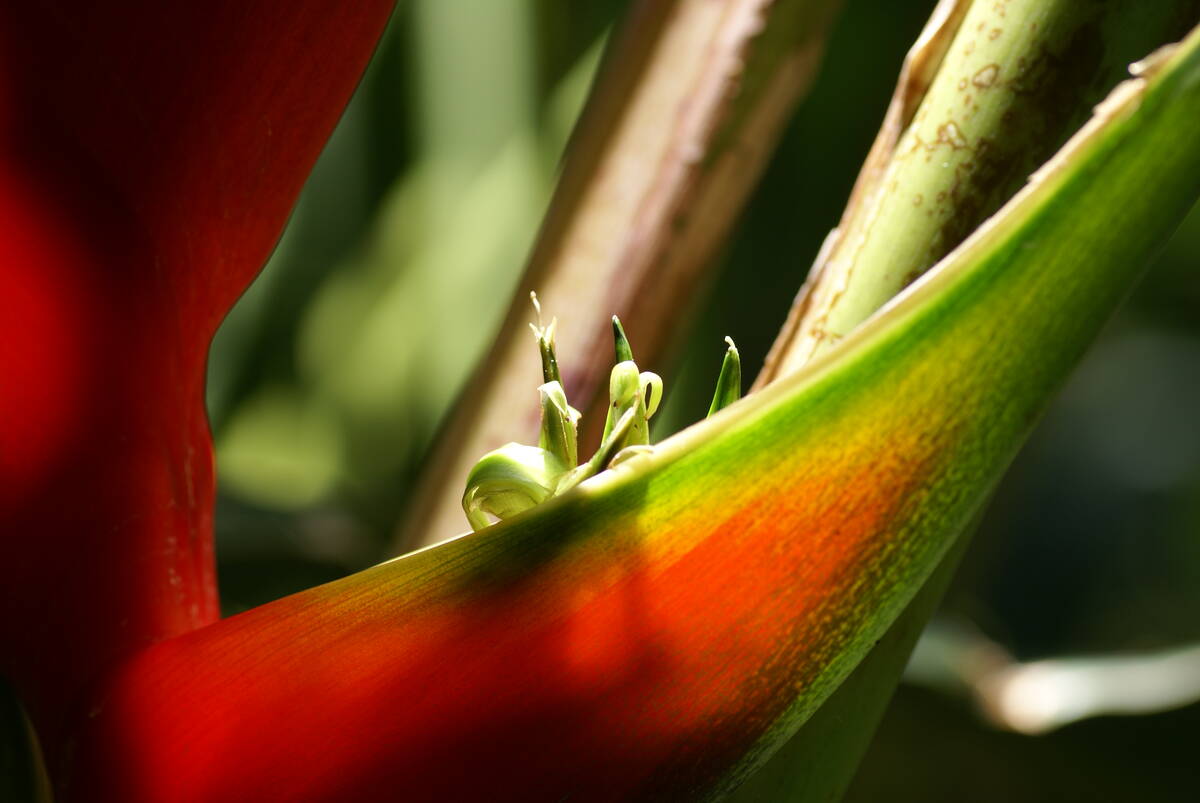
The smaller flowers emerge from the colorful bract. Photo: Rolf Engstrand, CC BY-SA 3.0; resized and compressed.
Sun or shade? Look at the cultivar and location
There is no single shade percentage for every garden. Embrapa’s descriptive guide lists conditions from partial shading to full sun for H. bihai. NParks also lists sun or semi-shade for the cultivar ‘Lobster Claw One’. These references do not support a blanket claim that the species cannot grow in sun.
Embrapa’s 2012 coastal study used 50% shade for ‘Lobster Claw Two’ in Paraipaba, Ceará. This is a local example, not a universal prescription. Ask the nursery about its growing conditions before changing exposure.
Allow room and keep the root zone drained
Reserve room for the clump and keep narrow passages clear. Cultivar size varies: NParks lists ‘Lobster Claw One’ as a large herb reaching five meters.
Use fertile, moist but well-drained soil. Check before watering and avoid permanent saturation. Leave access for inspection and maintenance.
Feeding and propagation
The Embrapa coastal study used monitored irrigation and a specific nutrient program. Commercial rates should not be copied directly into a home pot. Seek advice suited to your soil and planting.
Propagation is by division. Ask a nursery to demonstrate suitable rhizome divisions from healthy, correctly identified stock; a detached leaf is not a rhizome.
Hummingbirds and garden value
Research in the Lesser Antilles documents hummingbirds pollinating H. bihai, with the bird partners varying between places. That is an interesting reason to observe the flowers, but not a promise that the same bird species will visit every garden. It also does not establish that bats pollinate this particular species at night.
Enjoy the plant as an ornamental. This guide does not recommend consuming its parts or using it medicinally. For a broader layout, our landscape planning around pools explains why space, circulation and maintenance should guide plant selection.
Usamos cookies em nosso site para fornecer a melhor experiência de uso, lembrando suas preferências e visitas repetidas. Ao clicar em “Aceitar”, concorda com a utilização de TODOS os cookies.
Este site usa cookies para melhorar sua experiência enquanto você navega pelo site. Destes cookies, os cookies que são categorizados como necessários são armazenados no seu navegador, pois são essenciais para o

funcionamento das funcionalidades básicas do site. Também usamos cookies de terceiros que nos ajudam a analisar e entender como você usa este site. Esses cookies serão armazenados em seu navegador apenas com

o seu consentimento. Você também tem a opção de bloquear esses cookies. Porém, a desativação de alguns desses cookies pode afetar sua experiência de navegação.
Os cookies necessários são absolutamente essenciais para o funcionamento adequado do site. Esta categoria inclui apenas cookies que garantem funcionalidades básicas e recursos de segurança do site. Esses cookies não armazenam nenhuma informação pessoal.
Quaisquer cookies que possam não ser particularmente necessários para o funcionamento do site e sejam usados especificamente para coletar dados pessoais do usuário por meio de análises, anúncios e outros conteúdos incorporados são denominados cookies não necessários. É obrigatório obter o consentimento do usuário antes de executar esses cookies no seu site.