The spindle palm, Hyophorbe verschaffeltii, brings a distinctive silhouette to a warm-climate garden. Its appeal is not just in the feathery leaves: the gently swollen trunk gives the whole plant a sculptural character. Understanding its mature size, need for light and sensitivity to cold matters more than finding a decorative spot for a young specimen.
How to recognize a spindle palm
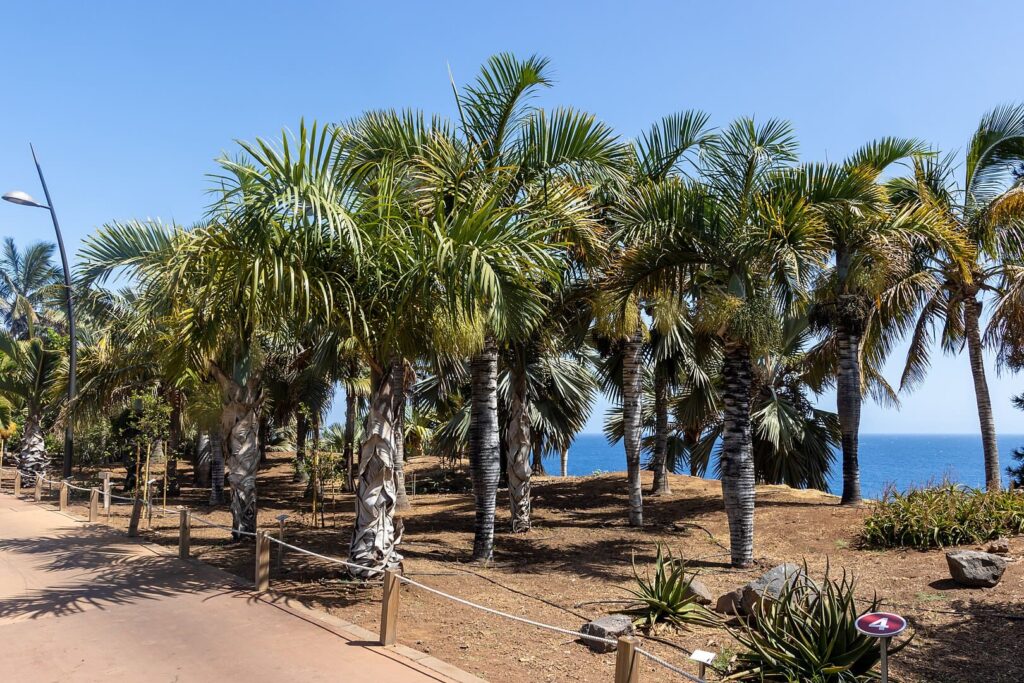
This member of the palm family, Arecaceae, has a single upright stem. The trunk is typically widest around its middle, then narrows toward the green crownshaft below the leaves. That outline explains the name: a spindle is a tool used in spinning thread.
The pale grey trunk carries rings left by fallen leaves. Above it, the smooth crownshaft is formed by the enclosing leaf bases. The leaves are pinnate, meaning that smaller leaflets extend from a central axis, creating a feather-like appearance.
Expect a plant several metres tall, not a permanently small pot specimen. The University of Florida describes a mature height of about 6–7.5 m. Slow early growth can make it manageable for a time, but planting plans should allow for its eventual size and spreading leaves.
Branched flower clusters emerge below the crownshaft. UF/IFAS describes white to cream flowers and fruit that changes from orange to red as it ripens. The plant should be grown as an ornamental, not treated as a food crop on the basis of fruit colour or its common name.
Where it comes from, and why that matters
The spindle palm comes from Rodrigues, in the Mascarene Islands of the Indian Ocean. It is widely cultivated in tropical gardens but severely threatened in its native habitat. A plant being common in nurseries does not mean its wild populations are secure.
Cultivated collections can help maintain the species outside its native range, but they do not replace habitat protection. Obtain plants from responsible cultivated sources rather than collecting from the wild.
Using it in a garden or a container
A single spindle palm can serve as a focal point, while a loose grouping with other tropical plants can create a layered composition. Keep the trunk visible if its shape is the main attraction. Allow space around paths, entrances and other planting rather than crowding the crown.
Young plants can be grown in containers where light and space are sufficient. A dark indoor corner is not suitable simply because the pot fits there. Bright conservatories, sheltered courtyards and large windows may offer better opportunities, depending on the local climate and the light actually reaching the leaves.
Container growing is also useful where winter protection is necessary, but consider how the plant will be moved as it becomes heavier. For a broader plan, see our step-by-step landscape design guide.
Light and temperature
This is a palm for warm conditions. Freezing temperatures can damage it, and covering a plant should not be treated as a guarantee that it will survive a cold winter. In unsuitable climates, choose protected cultivation or a different species for permanent outdoor planting.
Full sun supports good growth in established plants. Young specimens raised under shelter should be introduced to stronger light gradually. Indoors, provide abundant light rather than assuming that ordinary room lighting will meet its needs.
Watering and drainage
Use fertile, well-drained soil with suitable organic matter. Keep the root zone adequately moist while a new plant establishes, but do not leave it continuously waterlogged. Drainage should be addressed before planting, not after roots begin to deteriorate.
Adjust watering to the weather and the soil. A hot, windy period is different from a cool, rainy week. Once established, a spindle palm has some tolerance of dry conditions, but watering during dry spells supports better growth. In a container, make sure excess water can leave and does not remain trapped in a decorative outer pot.
Feeding and maintenance
Use an appropriate fertilizer according to its directions and local growing conditions. Do not assume that every yellow leaf is simply asking for more fertilizer. Check moisture, drainage and the pattern of symptoms before deciding what to change.
Pruning should be limited and purposeful. Remove completely dead leaves carefully, rather than repeatedly stripping healthy foliage to create an artificial shape. If yellowing spreads or new growth deteriorates, seek a diagnosis instead of hiding the symptoms by cutting off more leaves.
The trunk is not a branch that can be shortened to control height. Choose the position with the palm’s future growth in mind, and avoid damaging the growing point at the top.
Spindle palm or bottle palm?
The related bottle palm, Hyophorbe lagenicaulis, also has a swollen trunk, but its swelling is most prominent near the base. In the spindle palm, the bulge is typically higher, around the middle. Looking at the overall stem shape is more useful than relying only on whether the leaves seem yellow-green or dark green.
The species name honours Ambroise Verschaffelt, a nineteenth-century Belgian nurseryman. Its unusual form explains its popularity, but a good result depends on ordinary essentials: enough space, suitable warmth, light and a root zone that drains properly.
Usamos cookies em nosso site para fornecer a melhor experiência de uso, lembrando suas preferências e visitas repetidas. Ao clicar em “Aceitar”, concorda com a utilização de TODOS os cookies.
Este site usa cookies para melhorar sua experiência enquanto você navega pelo site. Destes cookies, os cookies que são categorizados como necessários são armazenados no seu navegador, pois são essenciais para o

funcionamento das funcionalidades básicas do site. Também usamos cookies de terceiros que nos ajudam a analisar e entender como você usa este site. Esses cookies serão armazenados em seu navegador apenas com

o seu consentimento. Você também tem a opção de bloquear esses cookies. Porém, a desativação de alguns desses cookies pode afetar sua experiência de navegação.
Os cookies necessários são absolutamente essenciais para o funcionamento adequado do site. Esta categoria inclui apenas cookies que garantem funcionalidades básicas e recursos de segurança do site. Esses cookies não armazenam nenhuma informação pessoal.
Quaisquer cookies que possam não ser particularmente necessários para o funcionamento do site e sejam usados especificamente para coletar dados pessoais do usuário por meio de análises, anúncios e outros conteúdos incorporados são denominados cookies não necessários. É obrigatório obter o consentimento do usuário antes de executar esses cookies no seu site.