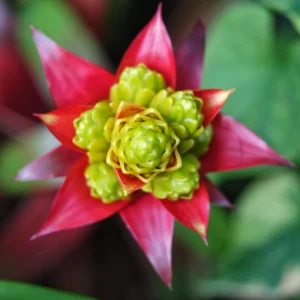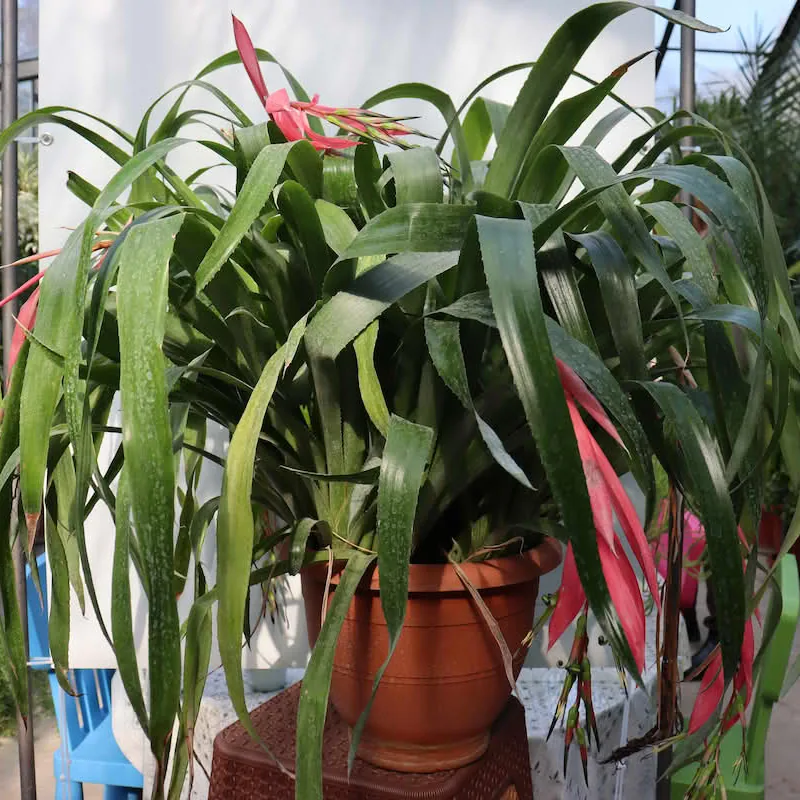
Billbergia nutans, commonly known as queen’s tears, is a bromeliad with narrow, arching leaves and hanging flowers worth a closer look. Pink modified leaves, called bracts, accompany tubular flowers with green parts and purplish edges. Rather than forming an upright, compact flower head, its display hangs loosely, a useful feature when distinguishing it from other ornamental bromeliads.
Plant profile
Scientific name: Billbergia nutans H.Wendl.
Family: Bromeliaceae.
Native range: Southeastern and southern Brazil to northern Argentina, with records in neighbouring countries.
Growth habit: Perennial; it can grow on other plants, a habit known as epiphytic growth.
Typical size: Approximately 10–50 cm, according to the Royal Horticultural Society (RHS).
Light: Partial shade or bright indirect light in a sheltered position.
Propagation: Seeds or separating side shoots, also called pups.
Royal Botanic Gardens, Kew accepts the name Billbergia nutans and places the species mainly in the wet tropical biome. Its botanical record also lists older names. Keep the label when you buy a plant: it makes it easier to find information for the correct species when questions about flowering or care arise.
Where to grow it: light, pots and potting mix
The RHS recommends bright indirect light under protection, a humus-rich, very free-draining growing medium, or cultivation on another plant. Outdoors, choose a frost-free position.
As general guidance for the genus, the University of Florida describes billbergias as having narrow rosettes and the ability to form clumps in suitable garden beds. It also mentions growing them on trees. Plan for this spreading growth rather than the space initially occupied by a single young plant.
The University of Florida’s bromeliad guide recommends loose, well-drained mixes and warns against excess moisture around the roots. A tropical appearance does not mean the pot should stay waterlogged. Check both drainage and stability when choosing a container.
Use a pot that suits the size of the root system. An oversized container takes longer to dry. If extra stability is needed, place the smaller pot inside a heavier outer container, making sure no water collects in it.
How to water Billbergia nutans
For this species, the RHS recommends fresh water in the central funnel, the space between the leaf bases that can hold water. This is not an instruction to keep the potting mix saturated.
During routine care, inspect the water held between the leaves too. In Brazil, the Zoonosis Control Centre in Mogi das Cruzes recommends flushing bromeliads with a jet of water every week. Empty saucers and decorative outer pots. Follow mosquito-control advice from your local health authority, especially if you find larvae.
How to propagate queen’s tears
The plant produces pups that can be separated. The following steps follow the University of Georgia’s general procedure for dividing bromeliads:
1. Wait until a pup reaches about one-third of the mother plant’s size. Do not remove it as soon as it appears.
2. Find the connection between the two plants. Cut it with a clean, sharp blade, preserving the pup’s base and existing roots. Remove the clump from its pot if necessary to see the join clearly.
3. Plant the pup in a separate pot. Roots help, but well-developed pups can also root after separation.
While roots establish, keep the young plant in a more shaded position with humid air, without waterlogging the mix. The University of Wisconsin recommends this general approach for newly separated bromeliads.
Flowering and caring for the clump
In bromeliads, a rosette that has flowered usually declines gradually, while pups keep the clump going. Do not throw away the entire plant simply because one rosette has aged.
Flower clusters in the genus Billbergia typically last only a few weeks, according to the University of Wisconsin. A flower stalk that loses its ornamental appeal quite quickly does not, on its own, mean something has gone wrong. Look at the leaves and pups as well. A flowering clump does not mean permanent flowers on every rosette.
For a comparison with another ornamental bromeliad, see our guide to Guzmania lingulata care and propagation. Its longer-lasting display and different rosette shape help explain why bromeliads should not all be judged by the same flowering pattern.
Problems: what to check first
The RHS lists scale insects as a possible pest and says the species does not require shaping by pruning.
If the plant is losing vigour, first check that water drains from the pot and whether its light conditions have changed. Examine the leaves and base before deciding to water more or apply a product.
Common questions
Do I need to separate every pup? No. The plant can grow as a clump. Divide it when you want more plants or need to reorganise the container. Leave small pups attached until they have developed.
Can I water on the same day every week? Make inspection a routine, rather than applying a fixed amount of water. Check the central tank and the potting mix separately. A pot that is still wet should not be watered just because the calendar says so.
Sources
Royal Horticultural Society (RHS).
University of Florida: general bromeliad guide.
University of Wisconsin: growing and propagating bromeliads (general guidance).
University of Georgia: separating bromeliad pups (general guidance).
Mogi das Cruzes municipal government: Zoonosis Control Centre checklist.
Photo: Dandarmkd, CC BY-SA 4.0. Cropped to a 1:1 ratio and converted to WebP without upscaling. Adapted image distributed under the same licence.