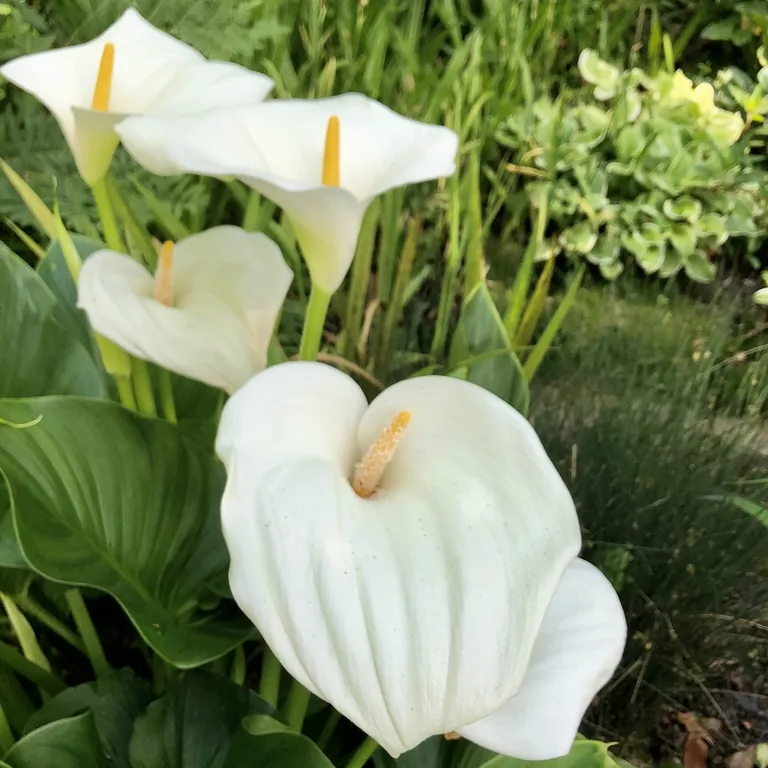
The white arum lily or calla lily (Zantedeschia aethiopica) is a rhizomatous perennial in the Araceae family, native to southern Africa. Its clumps of large green leaves produce stems topped by the familiar white, cup-shaped structure. It is grown in gardens, containers and for floral arrangements. Despite the common name, it is not a true lily.
Plant profile
Scientific name: Zantedeschia aethiopica.
Common names: white arum lily, arum lily, calla lily.
Family: Araceae.
Origin: southern Africa.
Life cycle: perennial, growing from rhizomes.
Height: often 60–100 cm, depending on cultivar and conditions.
Light: sun or partial shade, with protection from intense sun in very hot places.
Flowers: small flowers on the yellow spadix, surrounded by a white spathe.
Recognizing the white arum lily
The white part is a spathe, a modified leaf surrounding the flower cluster. In its center stands the yellow spadix, which carries many small flowers. After pollination, the plant can produce berry-like fruits. It is therefore incorrect to describe it as a plant that does not fruit.
Do not assume that the white species needs exactly the same care as every colorful calla sold by florists. Many colored callas are other species or hybrids, with different requirements for water and dormancy. Identifying the plant first helps avoid damaging its rhizomes by following the wrong routine.
Light, climate and planting position
Choose a bright spot in sun or partial shade. Where summers are very hot, shelter from the strongest sun can help prevent scorching. Too much shade, however, may reduce flowering. Plants often reach around 60–100 cm, but their final size varies with the cultivar and growing conditions.
White arum lilies appreciate moisture and can be used in deliberately managed damp gardens and suitable pond margins. That does not mean every ordinary pot should sit in stagnant water. For normal containers, use an organically rich growing medium and drainage holes, and monitor the condition of the rhizomes.
Before planting outdoors, check local guidance on invasive plants: NC State notes that this species can become weedy in some habitats. Keep it out of natural wetlands and waterways, and do not discard rhizomes or garden waste there. Cold tolerance also depends on climate and cultivar; outdoor survival in one region is not a guarantee in another.
Watering and feeding
No watering frequency suits every garden. Check the growing medium, rainfall, heat and the plant’s growth stage. During active growth, maintain moisture rather than letting the root ball dry out completely. Small pots can lose water more quickly than beds.
Take existing soil fertility into account before feeding. In fertile, well-prepared soil, repeated strong doses are not a sensible way to force flowers. Follow the fertilizer label, and use soil testing to guide amendments in beds. If the plant becomes dormant and loses leaves, reassess watering rather than continuing the same calendar.
Maintenance, division and cut flowers
Remove spent flowering structures and damaged leaves. Very dense clumps can be divided, leaving healthy rhizomes and growing buds in each section. Use clean tools and avoid unnecessary injury. Propagation from seed is also possible, but takes longer to reach flowering.
The flowering stems are valued in bouquets and vases. In the garden, retain healthy leaves during growth because they help build the plant’s reserves. If leaves yellow, the plant wilts or flowers fail to appear, assess light, moisture and rhizome health before simply adding water or fertilizer.
If you are deciding where to place a clump, start with its mature spread and access for care rather than the flower color alone. Our garden planning guide explains how to match planting to the available space and conditions.
Handling safely
This is an ornamental plant and must not be eaten. It contains calcium oxalate crystals that can cause irritation. Keep it away from children and animals. Wear gloves when handling it, and avoid getting sap in the eyes or mouth. Do not use the leaves, flowers or fruits in food or home remedies.
Sources
NC State Extension: Zantedeschia aethiopica
Royal Horticultural Society: Zantedeschia
RHS growing guide
RHS: Calla aethiopica, a synonym of Zantedeschia aethiopica
Featured photograph: Cathy DeWitt, via NC State Extension, CC BY 4.0. Cropped square and compressed as WebP.