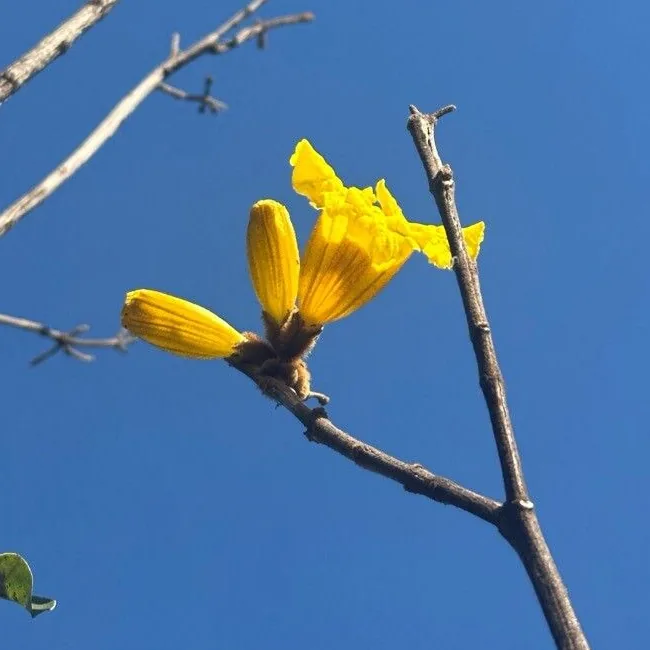
Yellow ipê transforms the landscape when its clusters of flowers appear among temporarily leafless branches. Handroanthus chrysotrichus is one of the species known by this common name, which is shared by several Brazilian trees.
Plant profile
Scientific name: Handroanthus chrysotrichus (Mart. ex DC.) Mattos.
Synonym: Tabebuia chrysotricha.
Family: Bignoniaceae.
Origin: Brazil and northeastern Argentina.
Type: tree that often loses its leaves for part of the year.
Size: may exceed 10 m; dimensions vary with climate and local conditions.
Flowers: yellow and trumpet-shaped.
Identification and flowering
The common name yellow ipê does not identify a single species. In this guide, the accepted name is Handroanthus chrysotrichus; Tabebuia chrysotricha appears in older literature. Each leaf is divided into smaller parts, called leaflets, arranged like fingers. Golden hairs on new growth, leaves and fruits help with recognition, but the plant you buy should come with a botanical identification.
In Curitiba, the city authority describes winter flowering on a leafless tree and even records young plants flowering in a nursery. This does not establish a compulsory age for flowering. Observe correctly identified specimens in your region: the timing and intensity of flowering depend on local conditions, and seasonal leaf loss may be part of the normal cycle.
Size and space: plan for the mature tree
The University of Florida’s landscaping reference describes height and crown spread commonly in the range of 7.6 to 10.7 m, with some trees growing taller. These are reference dimensions, not a guaranteed limit for a Brazilian garden. Do not choose the location solely by the young tree’s height or the description “small ipê”.
Before buying, check the space for the crown, the area of open soil, buildings, driveways and underground services. Consider strong winds too: the University of Florida notes susceptibility to branch breakage. Do not plan to use repeated pruning as the solution for a tree that does not fit.
Sidewalks and power lines: consult the municipal tree-management department and the responsible utility before deciding on the position. A species being recommended in one city does not amount to permission or suitability for every sidewalk. This guide provides no universal clearance distance that can replace a site assessment.
How to plant a rooted young tree
Choose full sun and well-drained ground. The following instructions are general principles for establishing trees, supplementing the species’ requirements; they are not a recipe for transplanting a mature tree.
1. Inspect the young tree. Ask to check the root ball, the mass of roots and soil, before buying. Avoid a plant with tightly circling roots or a damaged trunk. Keep the roots moist until planting and move the tree by its container or root ball, without pulling on the trunk.
2. Prepare the hole. Make it at least twice the width of the root ball. To determine the depth, locate the first main roots near the flared base of the trunk and measure from them to the bottom of the root ball. The hole must be no deeper than that measurement: the first roots should be close to ground level, not buried under an extra layer of soil. Do not bury the area where the trunk widens and begins to produce roots.
3. Position and backfill. Remove the container, position the young tree and fill around it with the soil from the site. Do not create an isolated pocket of very different growing medium. If the area is compacted or poorly drained, address the problem before planting, with technical guidance.
4. Water and protect. Water to settle the soil around the roots. Mulch helps retain moisture but must be kept away from the trunk. Stake only if needed for stability, without tying the stem rigidly.
Watering, fertilizing and pruning
An established tree and a newly planted one do not need the same care. The moderate drought tolerance described for the species does not remove the need for attention during establishment. Check moisture in the root ball and surrounding soil below the surface before deciding when to water next. If they are still very wet, do not add water just because the calendar says so.
Fertilizing depends on the soil and the young tree’s development, not simply on the desire to bring flowering forward. Avoid universal formulas and doses. Record growth, new shoots and the response to watering so you can take the information to the nursery or a professional if the tree does not develop.
Training and pruning should respect the tree’s structure and the purpose of the planting. Do not prune drastically to encourage flowers or keep a crown artificially small. Broken branches, problematic forks and conflicts with structures need professional assessment; do not work near power lines yourself.
How to grow young trees from seed
Embrapa describes collection, seedling emergence and transfer to individual containers under the synonym Tabebuia chrysotricha. For covering the seeds, Apremavi’s guide recommends a thin layer of light growing medium.
1. Obtain correctly identified seeds. Fruits can be collected when they begin to open naturally and left in the sun to finish opening. Do not climb trees or remove material from areas where collection is not permitted.
2. Sow without a dormancy-breaking treatment. Sanding or scalding is not necessary. Choose fresh seeds from a known source, as poor storage can compromise the result. Use a seed bed or seed tray and keep the batch labelled. Spread the seeds and cover only with a thin layer of light growing medium.
3. Monitor emergence. The reference records emergence beginning between 8 and 15 days, not a guarantee for every batch. If seeds fail to germinate, check their origin, storage and the seed bed’s conditions before trying harsh treatments.
4. Transfer to individual containers. The reference indicates 25 to 30 days after germination, when seedlings are 5 to 8 cm tall, using nursery bags or large forestry tubes. Preserve the roots; assess development, not just the calendar.
Problems: what to check before acting
A leafless tree: compare it with the cycle of nearby ipês and look for new shoots or buds. Seasonal leaf loss alone does not prove that the tree is dead. Drying branches, lesions or persistent decline, however, need assessment.
A young tree wilting after planting: examine moisture inside and outside the root ball and check whether the root collar, where the trunk meets the roots, has been buried. Do not automatically assume a lack of water: persistent excess also harms the roots.
Spotted or distorted leaves: Embrapa records problems in Brazilian plants. Photograph the tree and seek a diagnosis before applying products; the species is not immune.
Photo: Lucas Batistela, CC BY-SA 4.0. Cropped to 1:1, resized when necessary and converted to WebP; no upscaling. Adapted image under the same licence.
Usamos cookies em nosso site para fornecer a melhor experiência de uso, lembrando suas preferências e visitas repetidas. Ao clicar em “Aceitar”, concorda com a utilização de TODOS os cookies.
Este site usa cookies para melhorar sua experiência enquanto você navega pelo site. Destes cookies, os cookies que são categorizados como necessários são armazenados no seu navegador, pois são essenciais para o

funcionamento das funcionalidades básicas do site. Também usamos cookies de terceiros que nos ajudam a analisar e entender como você usa este site. Esses cookies serão armazenados em seu navegador apenas com

o seu consentimento. Você também tem a opção de bloquear esses cookies. Porém, a desativação de alguns desses cookies pode afetar sua experiência de navegação.
Os cookies necessários são absolutamente essenciais para o funcionamento adequado do site. Esta categoria inclui apenas cookies que garantem funcionalidades básicas e recursos de segurança do site. Esses cookies não armazenam nenhuma informação pessoal.
Quaisquer cookies que possam não ser particularmente necessários para o funcionamento do site e sejam usados especificamente para coletar dados pessoais do usuário por meio de análises, anúncios e outros conteúdos incorporados são denominados cookies não necessários. É obrigatório obter o consentimento do usuário antes de executar esses cookies no seu site.