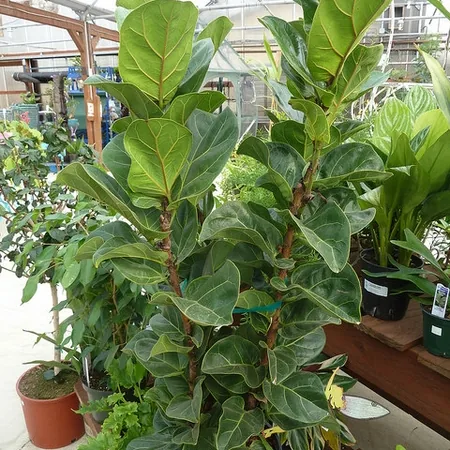
Fiddle-leaf fig has large, firm leaves with a distinctive outline. Indoors, it can be an eye-catching focal point, provided it has good light and room to grow.
Plant profile
Scientific name: Ficus lyrata.
Common name: fiddle-leaf fig.
Family: Moraceae.
Origin: tropical western and central Africa.
Growth habit: an evergreen tree; indoors, it may reach approximately 0.6–3 m.
Basic care
Provide bright, indirect light, a well-drained potting mix and protection from strong afternoon sun. Check moisture before watering: both too much and too little water can cause leaf drop. Avoid cold drafts and air vents that cause sudden temperature changes. Propagation is possible through stem cuttings.
Getting watering and drainage right
Water according to conditions in the pot, not a rigid schedule. Light, temperature, plant size and container material all influence drying. Check the moisture before watering again. When needed, water evenly until the excess flows through the drainage holes, then empty the saucer or outer pot. A nursery pot can sit inside a decorative container, but its base must not remain submerged.
Adapting to a change in light
When moving a fiddle-leaf fig, consider the light its leaves are used to. Taking it straight from a shaded corner into strong sun can scorch them. Make changes gradually and watch the response, rather than interpreting every falling leaf as a need for water. Indoors, light decreases with distance from a window: a room that looks bright to us may still be too dark for the plant at its far end.
When to repot
A tightly packed root ball, roots emerging from the drainage holes, smaller new leaves and frequent wilting are reasons to assess the pot, alongside watering and light. A newly bought plant does not necessarily need an immediate transplant. When repotting is necessary, choose a period of active growth, a draining pot only slightly larger and fresh potting mix. Keep the same planting depth and reassess watering after the move.
Spots and falling leaves: what to check
Leaf spots and leaf drop call for investigation; they are not diagnoses on their own. Overwatering, sun scorch and diseases can cause similar damage. Check drainage, recent changes in location or temperature, and the undersides of leaves for pests. Brown tips may also be linked to excess fertilizer. Avoid choosing a treatment just from the color of a spot. These general houseplant-care principles help organize the checks without replacing identification of the cause.
Mature size and suitable surroundings
The RHS describes Ficus lyrata as a tree capable of exceeding 5 m in suitable conditions. Indoor height depends on space, the container and care. A small young plant is not necessarily a naturally dwarf species.
The same institution distinguishes outdoor growing in a frost-free, wind-sheltered position from protected cultivation with full or filtered light. Advice about sunshine for an acclimatized garden tree should therefore not be applied abruptly to a plant accustomed to a shaded interior.
Its main ornamental appeal is the large, prominently veined foliage. Flowers and fruit should not be the main expectation for a potted specimen.
Which pests are worth checking for? Mites, thrips, mealybugs and scale insects are among those listed by the RHS for protected cultivation.
Does “ficus” identify the species? No. Ficus is a large genus. Check the species name lyrata before using a care guide or comparing leaf size.
Preparing a stem cutting
Texas A&M lists cuttings among the propagation methods for fiddle-leaf fig. Follow general houseplant-cutting precautions: choose a healthy shoot and use clean tools and a clean container. Remove the leaves from the section that will be buried, and place at least one node, the point where a leaf joins the stem, in the propagation mix. Keep it moist but not saturated until enough roots have formed for transplanting. If you use a clear cover to retain humidity, keep the setup out of direct sunlight, which could overheat the container.
Common questions
Does leaf drop always mean too little water? No. Excess water can also cause it. Check the potting mix before increasing watering.
Is it safe around children and pets? It should not be eaten. The sap can irritate skin; keep the plant out of the reach of children and animals, and wear gloves when pruning.
Sources
Texas A&M: fiddle-leaf fig propagation methods
University of Nebraska–Lincoln: propagating houseplants
Royal Horticultural Society: Ficus lyrata
North Carolina State University
University of Missouri: healthy houseplants
University of Illinois: repotting houseplants
University of Illinois: houseplant troubleshooting
University of Florida: houseplant care
Purdue University: houseplant growing conditions
Photo: NC Cooperative Extension, CC BY 2.0. Centered square crop and WebP compression, without upscaling.