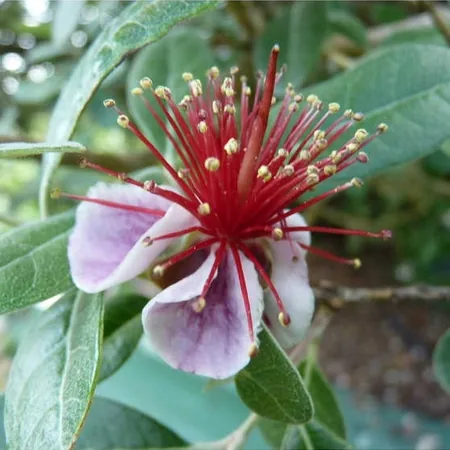
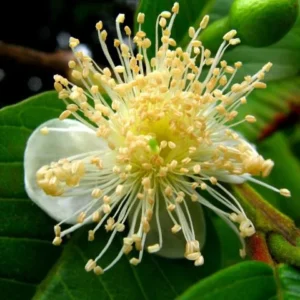
Feijoa combines leaves with silvery undersides, flowers with red stamens and aromatic fruit. It can be part of a home orchard or grown as a hedge, provided it has room to grow.
Plant profile
Scientific name accepted by the Royal Botanic Gardens, Kew: Feijoa sellowiana.
Widely used synonym: Acca sellowiana (O.Berg) Burret.
Family: Myrtaceae.
Type: evergreen shrub or small tree.
Size: can reach approximately 6 m.
Light: sun to light shade.
Soil: well drained.
Where to plant: climate, sun and space
Feijoa is a subtropical fruiting plant. Embrapa recommends deep, fertile, well-drained soil for cultivation. The cold tolerance of established plants does not mean that every young plant will crop well in any region: before buying, find a nursery familiar with how the variety performs in your area.
For fruit production, choose full sun: North Carolina State University associates this exposure with better flowering and fruiting. Light shade may be tolerated, but should not be considered an equivalent condition for an orchard. Allow room for the mature canopy and for moving around during harvest. A clipped hedge and a fruit tree trained for cropping have different management goals.
Choose varieties that can crop together
Some varieties are self-fertile, capable of setting fruit with their own pollen; others need cross-pollination, the transfer of pollen between compatible plants. Two plants grown from cuttings of the same parent plant do not necessarily make two compatible pollination partners. Before buying, ask for the cultivar names and whether their flowering periods overlap. Birds and insects can both contribute to pollination, and the importance of each group varies with the environment.
Planting and watering
Water the young plant before removing its container. Dig a hole wider than the root ball, but no deeper than the roots. Keep the root collar, where the stem meets the roots, level with the ground, gently settle the soil and water.
An established plant’s drought tolerance does not remove its need for water while fruit is developing. For good-quality fruit, keep moisture levels relatively stable and water the root zone, not just the surface. Organic mulch helps protect the shallow roots. Do not use one fixed schedule for every soil: observe the root ball, rainfall and how quickly it dries.
In a pot, check moisture below the surface, especially in hot or windy weather. If water does not drain out, check the holes and growing medium. Roots filling the entire container are a sign that repotting should be considered.
Pruning without compromising production
Before cutting, decide whether you want a free-growing shrub, a small tree or a hedge. Ornamental plants do not automatically need heavy pruning. For routine tidying, remove dead, damaged or poorly placed branches; in cold areas, avoid encouraging new growth before the risk of frost has passed.
In an orchard, do not confuse a smaller canopy with a larger harvest. A study by Epagri and partners, carried out with Alcântara and Nonante in São Joaquim, found larger fruit on pruned plants, but fewer fruit overall. The result does not justify applying the experiment’s pruning intensity or schedule to every cultivar. Prefer light interventions and local advice for pruning aimed at fruit production.
Flowering, pollination and harvest
The Chauá manual brings together flowering records for spring in Brazil, between September and November. For fruit production in southern Brazil, CETAP material made available by the Rio Grande do Sul State Environment Department gives February to May, with regional variation. Use these periods as a reference, not as a fixed calendar for the whole country.
To follow ripening, observe the plant frequently. The Chauá manual uses the start of natural fruit drop as a signal for collecting fruit intended for seed extraction. For eating, watch for the first healthy fruit to fall and for fruit that detaches from the branch with little force. Slight softening and a change to a lighter green can also indicate ripeness, according to the UF/IFAS growing guide. Consider these signs together and handle the fruit carefully: it bruises easily. Do not assume that all fruit drop means normal ripening if there is also damage or rot.
How to propagate feijoa
Choose the method to suit your goal. Seeds can produce new plants, but do not guarantee fruit that matches a particular variety. For an orchard with known characteristics, look for vegetatively propagated plants of an identified cultivar, and also check whether they need a pollination partner.
1. Separate the seeds. Use ripe fruit of known origin. The Sociedade Chauá manual recommends removing the gelatinous pulp with a sieve and running water, then leaving the seeds to dry in an airy place. There is no need for a dormancy-breaking treatment.
2. Prepare for sowing. Embrapa allows for either a seedbed or individual containers. Use a container with drainage holes and a seed-sowing medium, space the seeds without crowding, cover lightly with fine growing medium and label with the date. As a general nursery practice, water gently to avoid moving the seeds and maintain moisture without flooding.
3. Monitor and transplant. Embrapa reports emergence in approximately 30–50 days and slow growth in the nursery; these are reference figures, not guaranteed deadlines. Sociedade Chauá recommends transferring seedlings from the seedbed to individual containers, a process called pricking out, when they reach about 10 cm. Move them carefully, preserving the roots and the growing medium clinging to them.
What about cuttings? They offer a way to retain the parent plant’s characteristics, mentioned by North Carolina State University for material collected in summer. Rooting requires specific care; simply burying a branch from a mature tree does not guarantee a new plant. If your priority is to harvest a particular variety, buying an identified plant reduces uncertainty about what you are planting.
Frequently asked questions
Are Acca sellowiana and Feijoa sellowiana the same plant? Yes. Kew treats Acca sellowiana as a synonym of Feijoa sellowiana, which is why both names appear in nurseries and publications.
Why does it flower but produce very little fruit? Check the variety, whether a compatible partner is present, whether their flowering periods overlap and whether pollinators are available. Also assess light and water before blaming a disease or applying fertiliser.
Can I grow it in a pot? Yes, but allow room for the shrub and monitor water and root growth. A container does not guarantee a small plant or a crop equivalent to that of a plant in the ground.
When does it start producing fruit? There is no single reliable timeframe without knowing the plant’s origin, cultivar, age and growing conditions. Ask the nursery for an expectation specific to the material being sold, rather than relying on a generic number.
Which parts are edible? Ripe fruit and petals are described as edible. This does not make every part edible. Confirm the identification and do not eat ornamental material treated with products unsuitable for food crops.
Usamos cookies em nosso site para fornecer a melhor experiência de uso, lembrando suas preferências e visitas repetidas. Ao clicar em “Aceitar”, concorda com a utilização de TODOS os cookies.
Este site usa cookies para melhorar sua experiência enquanto você navega pelo site. Destes cookies, os cookies que são categorizados como necessários são armazenados no seu navegador, pois são essenciais para o

funcionamento das funcionalidades básicas do site. Também usamos cookies de terceiros que nos ajudam a analisar e entender como você usa este site. Esses cookies serão armazenados em seu navegador apenas com

o seu consentimento. Você também tem a opção de bloquear esses cookies. Porém, a desativação de alguns desses cookies pode afetar sua experiência de navegação.
Os cookies necessários são absolutamente essenciais para o funcionamento adequado do site. Esta categoria inclui apenas cookies que garantem funcionalidades básicas e recursos de segurança do site. Esses cookies não armazenam nenhuma informação pessoal.
Quaisquer cookies que possam não ser particularmente necessários para o funcionamento do site e sejam usados especificamente para coletar dados pessoais do usuário por meio de análises, anúncios e outros conteúdos incorporados são denominados cookies não necessários. É obrigatório obter o consentimento do usuário antes de executar esses cookies no seu site.