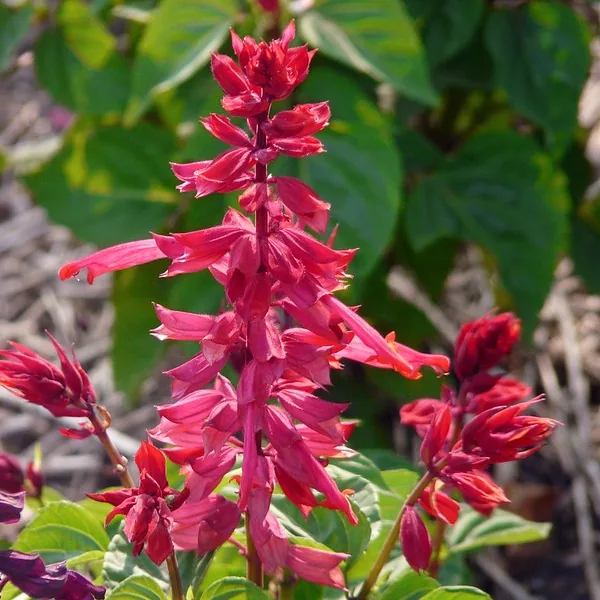
Scarlet sage, Salvia splendens, adds patches of color to garden beds. Its flower clusters, or inflorescences, rise on upright stems above the green leaves and can attract visitors such as birds and butterflies.
Plant profile
Scientific name: Salvia splendens Sellow ex Nees.
Family: Lamiaceae.
Native range: Brazil, with records in Rio de Janeiro according to the Royal Botanic Gardens, Kew.
Type: Ornamental subshrub.
Height in cultivation: Around 20 to 90 cm, depending on the cultivar.
Light: Full sun.
Water: Moderate; moist, well-drained soil.
Colors, size and choosing plants
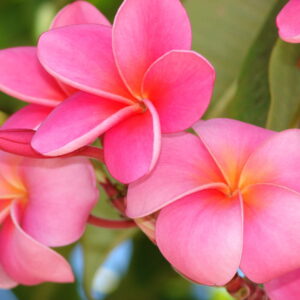
Despite its common name, scarlet sage also comes in pink, white, purple and salmon shades. The cover photo shows a coral-pink form; red flowers are not a requirement for identifying Salvia splendens. Check the label: compact cultivars work best at the front of a border, while larger ones need more room.
The showy flowers may attract hummingbirds and butterflies, but they do not guarantee abundant food. North Carolina State University notes that many cultivars bred for bedding produce no nectar. If you want to attract pollinators, check the cultivar.
Where to plant and how to prepare the bed
Choose a sunny spot with fertile, moist, well-drained soil. Scarlet sage also tolerates partial shade. Avoid keeping it in a dim room: an Embrapa technical publication reports leaf drop in those conditions. The same publication suggests spacing plants 30 to 40 cm apart; check the cultivar’s size too so that larger plants do not get crowded.
In pots, use a suitable potting mix and containers that drain freely. A compact cultivar is easier to fit into a small space, but it still needs good light.
Watering, fertilizing and keeping plants in bloom
Water in dry spells so moisture reaches the roots without waterlogging the soil. If the plant wilts, check the growing medium before watering again. More water will not solve the problem if the soil is still wet. Adjust how often you water according to rainfall and how quickly the pot or bed dries out rather than applying a fixed amount every day.
To encourage branching, the Royal Horticultural Society (RHS) recommends pinching out young growth. Remove the shoot tip just above a pair of leaves, keeping the leaves and the points where new shoots can form. Snip off spent flower spikes rather than cutting the whole plant back hard. Keep healthy stems and remove dry material with a clean tool.
Do not fertilize simply because the plant is not blooming. First check light, moisture and root condition. If fertilizer is needed, Clemson University recommends using a soil test to guide amendments. It suggests a slow-release fertilizer used according to the label for bedding salvias grown as annuals. This is not a universal NPK rate.
How to sow scarlet sage
1. Prepare small, clean containers with drainage holes. Fill them with a light seed-starting mix and moisten it before sowing. Label the tray with the species, cultivar and date. Individual cells keep roots from tangling and make transplanting easier.
2. Sow the seeds on the surface without burying them: light helps Salvia splendens germinate. Clemson gives an emergence time of about 12 to 15 days; the Embrapa publication gives one to two weeks for conditions in Campinas, Brazil. These are estimates, not guarantees for every seed lot or temperature.
3. Keep the mix moist without letting water collect. Water gently so you do not dislodge the seeds, and check moisture below the surface. When more than one seedling grows in a cell, wait for true leaves, which follow the first pair of seed leaves and begin to look like typical sage leaves. Snip off the extras, leaving the strongest seedling, rather than pulling them out and disturbing the roots.
4. Transplant seedlings once they can be handled. Do not move a plant raised under cover straight into strong sunlight. Introduce it gradually to outdoor light and wind, starting in a sheltered spot. When removing a seedling from the tray, support its root ball and avoid squeezing the stem.
Embrapa notes that sowing can take place year-round under the conditions in Campinas; that does not make it a schedule for all of Brazil. Where frosts occur, wait until the risk has passed before planting outdoors. Clemson suggests starting seeds six to eight weeks before the planned planting date.
Problems to watch for
The RHS lists slugs, powdery mildew, wilts, and root or stem-base rots as possible problems. Chewed leaves, a white coating and persistent wilting are signs to investigate before choosing any treatment. Also check drainage and crowding. Do not apply pesticides as a routine measure.
Frequently asked questions
Is it an annual or a perennial? It is a tender perennial often grown as an annual. How long it lasts depends on local climate and care. Do not assume it will regrow after every winter.
Is it the sage used in cooking? No. The culinary sage cited by Clemson is Salvia officinalis. Do not use Salvia splendens in tea, salads or seasoning just because it shares the common name.
Is it drought-tolerant like other sages? Do not assume so. North Carolina State University’s species profile does not consider it drought-tolerant.
Sources
Royal Botanic Gardens, Kew: scientific name and distribution
Singapore National Parks Board: size and features of scarlet sage
North Carolina State University: cultivars and pollinators
Embrapa: growing annual flowers, section on scarlet sage
Clemson University: sowing and growing problems
Royal Horticultural Society (RHS): growing and pruning Salvia splendens
University of Minnesota: preparing and managing seed trays
Photo: Carl Lewis, CC BY 2.0. Cropped to a square and compressed as WebP; not enlarged.