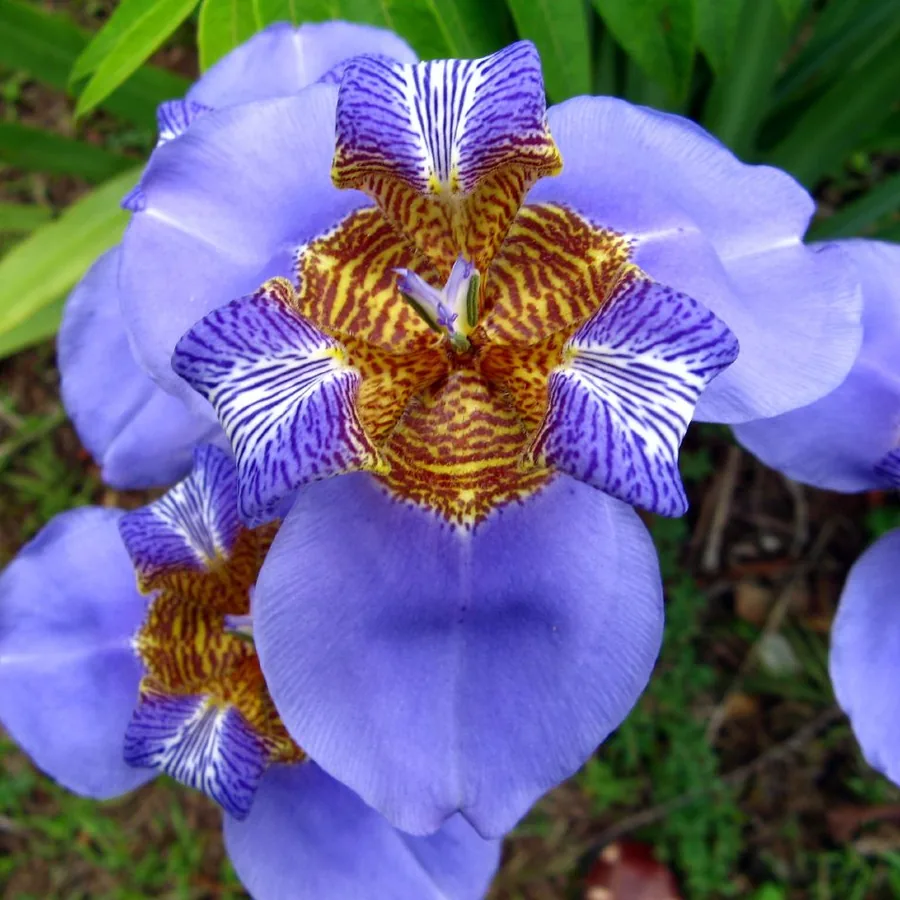
The plant known as Neomarica caerulea pairs long leaves with striking blue-violet flowers. Even out of bloom, its upright foliage adds contrast to partly shaded beds.
Plant profile
Horticultural name: Neomarica caerulea, also listed as Neomarica coerulea.
Name accepted by the Royal Botanic Gardens, Kew: Trimezia coerulea (G.Lodd.) Ravenna.
Family: Iridaceae.
Type: Herbaceous perennial with a horizontal stem called a rhizome, from which shoots and roots emerge.
Native range: Southeastern and southern Brazil to Paraguay.
Height: Around 1 to 1.5 m, depending on growing conditions.
Light: Partial shade or morning sun.
How to check the plant’s identity
The label may say Trimezia coerulea, Neomarica coerulea or use the horticultural spelling Neomarica caerulea. The profile above lists all three for easy reference. The change in name does not change what the plant needs.
Where to plant: light, space and cold
The City of São Paulo’s nursery guide lists partial shade or full sun and notes flowering in spring and summer. A bed with morning sun and shelter from the strongest sunlight is a good starting point for seeing how the plant adapts. A flowering calendar from another country will not necessarily match your garden.
Leave space for the mature clump, not just the small root ball you bought. The upright leaves contrast with low plants but can also spread into walkways. In a University of California, Davis (UC Davis) trial, the plant reached about 1 m high and 1.25 m wide in two years. Those figures help with planning but do not set a universal mature size.
A Brazilian origin does not guarantee frost hardiness. UC Davis reported serious damage without full recovery in one of the trial gardens. Where winters are very cold, choose a sheltered spot or grow it in a container you can protect.
Soil, containers and watering
Singapore’s National Parks Board (NParks) recommends moist but well-drained soil and deep containers. Choose a pot with drainage holes deep enough to hold the roots rather than opting for a shallow one just for its looks. Check moisture more closely while the plant is flowering.
Water needs depend on the site. Under 50% shade in the UC Davis trial, the plants looked good with little irrigation, while those that received the most water scored better for flowering. Overall appearance and flowering may respond differently to watering; the trial does not set a schedule for every garden. At home, feel the potting mix below the surface and check that excess water drains. If the mix is still wet, wait rather than watering on a schedule. If it dries quickly, adjust watering and watch the leaves. Check newly divided plants separately.
How to propagate by dividing a clump
The Royal Botanic Gardens Victoria’s HortFlora lists division for the Neomarica group. The steps below combine that recommendation with Iowa State University’s general technique; adapt them to your plant. Use a healthy, well-established clump large enough to split into sections with their own roots.
1. Get the new bed or pot ready before lifting the plant. Dig around the root ball and lift it with as many roots intact as possible. Separate sections that have both shoots and roots, using a sharp knife or spade if needed. Loose leaves alone are not divisions.
2. Replant promptly at the same depth as before. Settle the soil around the roots and water. If you cannot replant straight away, temporarily keep the divisions in containers in a sheltered, shady spot and do not let the root balls dry out.
3. Check moisture while the divisions establish. Larger sections tend to recover faster than very small ones. A healthy clump does not need dividing every year; it depends on the space available and whether you want more plants.
NParks also lists propagation by seed, but it does not provide a germination protocol. There is not enough information here to specify a depth, temperature or timeframe. When buying seeds, ask for instructions for that species and the botanical identification of the seed lot.
Flowering, tidying and common problems
Each flower lasts about a day, but more buds can open in succession. A flower that wilts at the end of the day is not by itself a sign the plant needs water. Snails can also damage the leaves. If you see chewed edges, look for the culprit before choosing a control.
For tidying up, follow the Royal Horticultural Society’s general guidance for evergreen perennials: remove dead leaves and leave the green ones. Do not cut the entire plant back to force flowering. If you suspect disease or cold damage, assess the plant rather than relying on routine tidying.
The sources specific to this plant do not give a fertilizer rate suitable for every Brazilian soil. Avoid fixed formulas; consider the growing medium, the plant’s condition and the directions on the product label.
Do not expect every plant to produce plantlets at the tips of its flower stalks. The University of Florida notes that plants known as walking irises vary by species. The fact that other Neomarica propagate this way is no reason to cut or bury a stalk of this blue iris unless a plantlet has actually formed.
Frequently asked questions
Is it an orchid? No. It belongs to the Iridaceae family, though the elaborate flower can resemble an orchid.
Does it need twelve leaves to bloom? The twelve-leaf story is associated with the common name “apostle plant.” It is not a growing rule given by the University of Florida. Do not use leaf count to diagnose a lack of flowers.
Can it grow indoors? The University of Florida’s general guidance for Neomarica allows for a bright indoor location, not a dark corner. For this tall iris, check the actual light and make sure the leaves have room.
Sources
Royal Botanic Gardens, Kew: Trimezia coerulea and its synonyms
Singapore National Parks Board: growing, flowering and problems of the blue walking iris
City of São Paulo: blue walking iris nursery profile
University of California, Davis: blue walking iris irrigation trial
Royal Botanic Gardens Victoria: description and propagation of Neomarica
Iowa State University: general guidance on dividing perennials
Royal Horticultural Society (RHS): tidying evergreen perennials
University of Florida: differences among walking irises
Photo: mauroguanandi, CC BY 2.0. Cropped to a square, resized where necessary and converted to WebP; not enlarged.