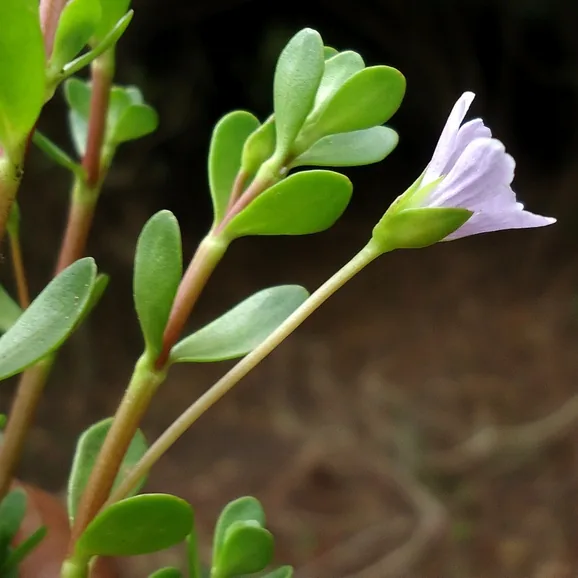
Bacopa monnieri forms a mat of creeping stems, fleshy leaves and small, pale flowers. Its place in the garden is close to water: pond margins, moist containers and bog-style plantings with very wet soil make the most of its low-growing habit.
Plant profile
Scientific name: Bacopa monnieri (L.) Wettst.
Family: Plantaginaceae.
Type: creeping herbaceous perennial.
Distribution: tropical and subtropical regions.
Light: full sun; tolerates partial shade.
Water: high requirements; tolerates waterlogged soil.
Flowers: white, bluish or purplish.
Which bacopa is this?
Small, fleshy, opposite leaves and stems that spread across the soil help identify Bacopa monnieri. The name “bacopa” is also used for different plants: Bacopa caroliniana is another species, while trailing bacopa, Chaenostoma cordatum, also found under the name Sutera cordata, is a different plant from the one covered in this guide. Do not automatically apply the advice to keep the soil continuously moist to that plant. Check the two-part scientific name on the label before following the growing advice.
In B. monnieri, flowers appear where a leaf meets the stem, a point called the axil, and may be white or slightly bluish or purplish. The stems root at the nodes, the points where leaves grow. This explains both the formation of mats and the ease of producing new plants. Flowering may continue for a long period in favourable conditions; there is no single flowering calendar for all of Brazil.
Where to plant: a pot, a moist border or a waterside garden
Use it as ground cover in a damp area, along the shallow edge of an ornamental pond or in a container whose moisture you can easily monitor. Its horizontal growth can soften edges. Hanging baskets are also possible, but only where you can prevent the growing medium from drying out. Thick leaves do not mean drought tolerance.
Choose a bright position, in full sun or partial shade. Singapore’s National Parks Board (NParks) describes fertile soil and tolerance of waterlogging. A dry bed shared with cacti, however, does not suit its water needs. The practical approach is to separate plants with very different requirements rather than trying to give them all the same watering routine.
For a rooted young plant, prepare the container and moisten the growing medium first. Settle the roots into place, keep the leafy part above the surface and firm gently around it. For freshly cut stems, follow the cutting method below. You do not need to submerge the whole plant to create a bog-style planting; university extension guidance describes growth in wet soil or shallow water.
Watering and monitoring growth
Keep the growing medium continuously moist. Check it more closely in small pots or hanging containers, especially on hot, windy days. If it is drying out, add water before the plant wilts. A fixed schedule, such as “water twice a week”, cannot suit an exposed pot and a pond margin equally well.
If the plant loses vigour, first check moisture and exposure: repeated drying calls for a change to the container or watering routine. Yellow leaves or damaged stems alone do not identify a cause. Note when the problem began and whether the plant was moved; do not try to compensate for every symptom with fertilizer. In a pond with fish, avoid improvised chemical treatments.
How to propagate from cuttings
NParks and Texas A&M University recommend propagation by cuttings for this species. The steps below adapt the UK Royal Horticultural Society’s (RHS) general principles for softwood cuttings to bacopa’s moist growing conditions, without promising a fixed rooting time.
1. Choose a stem. Select a healthy, non-flowering tip and use a clean tool. Cut a section with several nodes, making the lower cut just below one of them.
2. Prepare the base. Remove leaves that would be buried. Make a small hole in the pre-moistened growing medium, insert the base and leave the remaining leaves above the surface.
3. Care for the cutting as it establishes. Do not let it wilt. While roots are forming, provide bright light without strong direct sun and maintain moisture. Once it has rooted and is sustaining new growth, gradually acclimatize it to its final position.
4. Make use of stems that have already rooted. Another option is to separate a portion with roots already growing from its nodes and immediately replant it in a prepared, moist area. Collect leftover fragments; do not let them enter drains or waterways.
Managing spread and problems
Check the edges of the mat and trim excess growth when it moves beyond its allotted space. Texas A&M University warns that the plant can regrow from seeds and remaining plant parts, so a single removal may not resolve unwanted spread. Do not discard trimmings in natural habitats.
North Carolina State University’s species profile does not list major recurring problems, but this does not guarantee that damage will never occur. Caterpillars of Anartia jatrophae feed on the plant. If you find chewed leaves, identify the culprit before deciding whether to intervene, and preserve wildlife when the damage is tolerable.
Frequently asked questions
Does it need to be fully submerged? No. This guide focuses on ornamental growing in moist soil and shallow margins. Aquariums have their own lighting, water and management conditions; aquarium care instructions should not automatically be transferred to a garden pot.
Can I use it for tea or treatment? This is a gardening article, not a recommendation to consume the plant. Traditional uses do not establish the safety of homemade preparations. Do not take this guide as advice to use ornamental plants or plants collected from ponds as a treatment.
Sources consulted
Singapore National Parks Board: identification, environment and cuttings
North Carolina State University: growing conditions and wildlife
North Carolina State University: the other plant called bacopa
PROSEA: rooting at the nodes and moist cultivation
RHS: general softwood-cutting technique
Texas A&M University: propagation and physical control
Photo: Alex Popovkin, CC BY 2.0. Square crop and WebP compression, without upscaling.