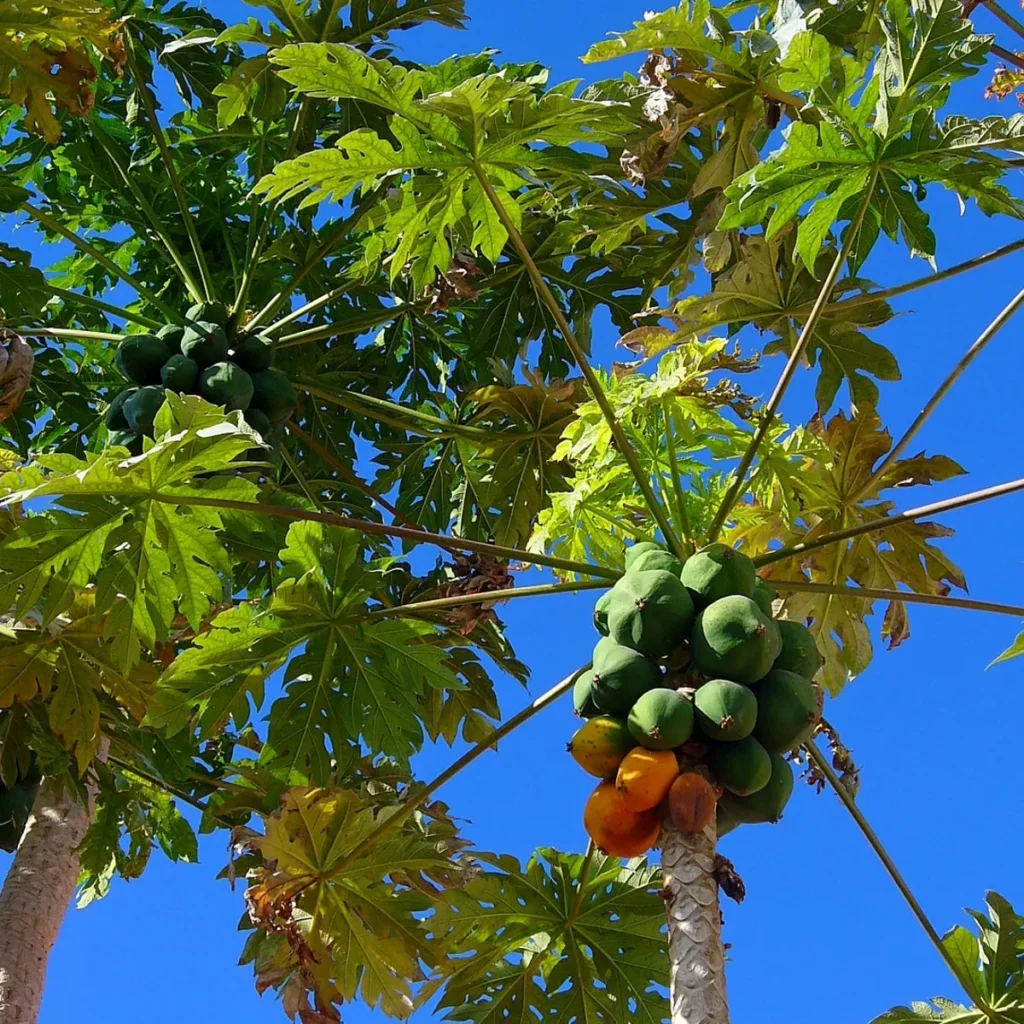
Papaya has large leaves clustered near the top of its stem, with fruit developing close below them. This distinctive shape makes an eye-catching plant, but it also calls for planning: a small nursery specimen can grow tall. Sun, drainage and protection from unsuitable weather matter before you start thinking about the first harvest.
Plant profile
Scientific name: Carica papaya L.
Family: Caricaceae.
Origin given in horticultural references: Central America.
Habit: a tree-like herbaceous plant.
Height: variable; Singapore’s NParks gives approximately 2–10 m (6.5–33 ft).
Light: full sun.
Most common propagation: seeds.
The New York Botanical Garden recognizes Carica papaya as an accepted name. NParks classifies it as herbaceous, although it is often called a tree. Its leaves are palm-shaped, and flowers may be male, female or bisexual. This matters for fruit production: not every seedling will have the same reproductive behavior.
Recognizing flowers and planning for fruit
Male flowers usually occur in clusters on long stalks. Occasional, often misshapen fruit may develop.
Female flowers sit close to the stem and need compatible pollen.
Hermaphrodite flowers contain male and female structures and can self-pollinate.
Photograph open flowers and where they attach to the stem. Identifying a plant’s sex requires looking at its flowers, not its seeds. Sex types vary with the planting material, and flower expression can change with environmental conditions. Do not remove plants before confirming their type.
Planting papaya in a backyard
Choose full sun and space away from overhead wires and buildings. Before buying, check the cultivar’s expected height, its suitability for your climate, and available information about flowering and fruiting. Avoid large plants confined to small pots, tightly circling roots, wounded stems or signs of pests.
1. Prepare a well-drained site. If the ground is compacted or holds water after rain, deal with that before planting.
2. Keep the root ball intact. Remove the container carefully and set the root collar, where stem meets roots, at ground level. Do not bury the stem.
3. Fill, firm gently and water. Check moisture as the plant establishes without turning the planting area into a puddle.
Embrapa recommends basing planting fertilizer on soil analysis. There is no single dose of manure, lime or NPK fertilizer that suits every backyard.
Watering, feeding and pruning
Check the soil and recent rainfall before watering. Water shortage can cause flowers and young fruit to drop, while excess water damages roots. Mulch helps retain moisture, but keep it away from the stem. Cutting off the top is not a routine pruning practice recommended for stimulating production.
Papaya in pots and an introduction to growing from seed
A nursery container is for raising a young plant; it does not prove that the same papaya will fruit well in a pot for years. For a small space, ask the supplier about the cultivar’s size and actual experience growing it in containers. Without that information, do not count on regular balcony harvests.
The following is an introduction, not a complete sowing guide. Use seed from a known source and a suitable seed-raising mix in containers with drainage. Incaper recommends avoiding competition between several young seedlings in one container and gradually acclimatizing them to outdoor conditions before final planting. Saving seed from a fruit you enjoyed does not guarantee that every characteristic will be repeated.
Problems: what to observe before acting
If papaya wilts after rain, first check for waterlogging rather than automatically watering more. Green-and-yellow mottling on new leaves, distortion and rings on fruit call for assessment. Incaper describes these signs in papaya mosaic or ringspot disease, a viral problem without a curative treatment. Photograph leaves, fruit and the whole plant and seek local technical advice before deciding on management. A single spot is not a diagnosis. For a wider look at symptoms, see our guide to yellow leaves and possible causes.
When to harvest papaya
For local consumption, Embrapa recommends fruit with approximately half the skin yellow. Avoid dropping or bruising it, and wear gloves to limit contact with the latex. Timing varies with cultivar, climate and care; a fixed calendar cannot replace observing the fruit.
Sources
Singapore National Parks Board (NParks)
New York Botanical Garden
University of Florida: papaya growing manual
University of Florida: papaya gardening guide
Embrapa: Papaya, 500 questions and answers (Portuguese PDF)
Incaper: technical recommendations for papaya cultivation, 2024 (Portuguese PDF)
Photo: H. Zell / Wikimedia Commons, CC BY-SA 3.0. Square framing preserved, resized where necessary and compressed as a 1200 × 1200 pixel WebP without upscaling. Adaptation shared under CC BY-SA 3.0.