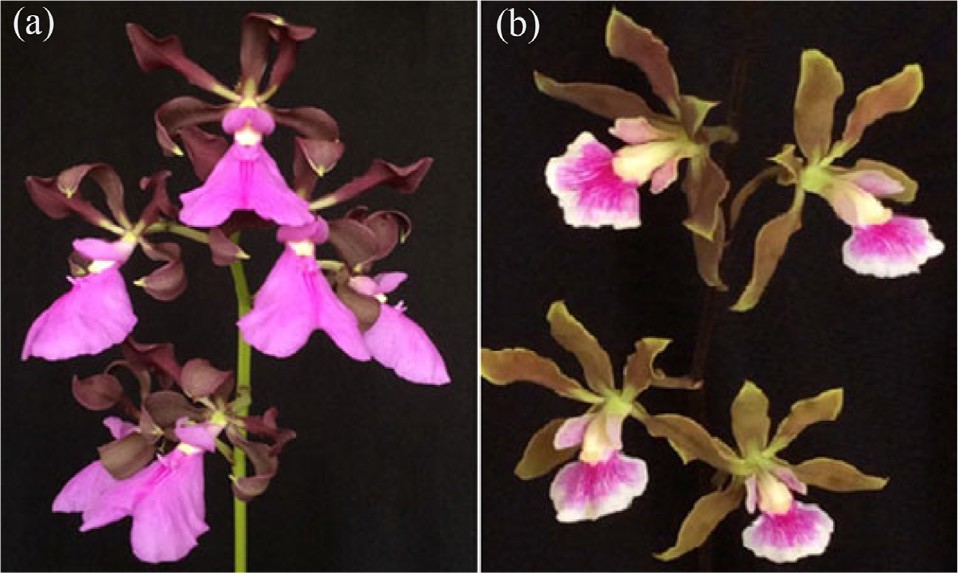
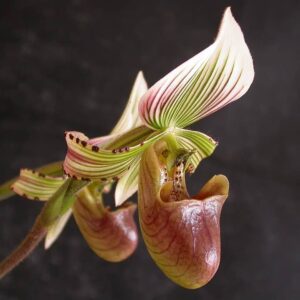
About the featured photograph: the study compares E. cordigera on the left (a) with E. randii on the right (b). They are different species.
Encyclia randii brings together dark-toned petals and a contrasting pale lip, but its appeal goes beyond colour. This Amazonian orchid is also a useful reminder that identification comes before cultivation: similar-looking flowers are sometimes sold under different names, and a generic orchid recipe does not explain everything about a particular plant.
Origin and identity
Kew recognises Encyclia randii as an accepted species, native from Peru to northern Brazil. It is a pseudobulbous epiphyte of wet tropical environments. In plain language, it grows on other plants for support and has thickened stems that help it store reserves; it is not an orchid for ordinary compact garden soil.
The Flora do Brasil treatment by the Rio de Janeiro Botanical Garden records it in Amazonas, Pará and Rondônia. It also explains a common confusion with E. cordigera: the middle part of the lip is smaller and kidney-shaped to roughly square in E. randii, rather than the larger oval form of E. cordigera. Flower colour alone is not enough to settle the identification.
What the scent tells us, and what it does not
A Brazilian study published in 2022 analysed compounds extracted from flowers of E. randii and E. cordigera. Their chemical profiles differed; the authors associated the former with likely woody and fruity notes. This research gives a sound basis for discussing floral fragrance. It does not establish that this species mimics female bees or induces males to mate with its flowers.
For a grower, that distinction matters: an attractive explanation should not be repeated as a biological fact without evidence. Observe the flower and its scent, but keep a nursery label, a botanical identification and a claim about pollination as separate pieces of information.
A sensible starting point for cultivation
The American Orchid Society’s guidance for the genus calls for bright light, intermediate-to-warm conditions and an airy epiphytic medium. During active growth, water regularly while allowing roots to dry slightly between applications; reduce watering once the season’s pseudobulbs mature. Avoid both repeated root disturbance and decomposed potting material. These are starting principles, not a species-specific prescription for every climate.
Ask the nursery how your plant has been grown. Before changing its position, check the actual light and heat rather than relying only on a compass direction or a percentage printed on shade cloth. In a hot climate, the same window or bench can behave very differently from one described in an overseas guide.
Likewise, inspect the pot instead of watering by the calendar. Consider the state of the roots and medium, the current growth and the time the pot takes to dry. Change one factor at a time when possible. That makes it easier to understand whether a problem comes from the growing environment rather than assuming every yellow leaf means too much sun.
Propagation is not a kitchen fertiliser recipe
A 2012 study in Acta Scientiarum. Agronomy examined in-vitro seed propagation of this species using a prepared nutrient medium and supplements. Its results concern controlled laboratory culture. They are not evidence that pouring coconut water or adding banana pulp to a household orchid pot will reproduce the same effect.
For a home collection, obtain correctly identified nursery-propagated plants and discuss division with an experienced grower before cutting a small specimen. Do not split a plant merely because it has reached an arbitrary number of pseudobulbs: each future plant must have enough viable growth and roots to recover.
A useful approach to problems
Keep notes on new growth, watering and changes of position. If damage appears, photograph it and examine the plant before choosing a treatment. Leaf marks alone do not reliably distinguish a virus, an insect, a watering problem or physical injury. A careful diagnosis is more useful than applying a general insecticide to every symptom.
Image credit
Featured comparison: Vasconcelos et al. (2022), Figure 1, Journal of the Brazilian Chemical Society, CC BY 4.0. Complete figure converted from TIFF to JPEG without cropping. The study documents the E. randii specimen with herbarium voucher MG 205037.
Usamos cookies em nosso site para fornecer a melhor experiência de uso, lembrando suas preferências e visitas repetidas. Ao clicar em “Aceitar”, concorda com a utilização de TODOS os cookies.
Este site usa cookies para melhorar sua experiência enquanto você navega pelo site. Destes cookies, os cookies que são categorizados como necessários são armazenados no seu navegador, pois são essenciais para o

funcionamento das funcionalidades básicas do site. Também usamos cookies de terceiros que nos ajudam a analisar e entender como você usa este site. Esses cookies serão armazenados em seu navegador apenas com

o seu consentimento. Você também tem a opção de bloquear esses cookies. Porém, a desativação de alguns desses cookies pode afetar sua experiência de navegação.
Os cookies necessários são absolutamente essenciais para o funcionamento adequado do site. Esta categoria inclui apenas cookies que garantem funcionalidades básicas e recursos de segurança do site. Esses cookies não armazenam nenhuma informação pessoal.
Quaisquer cookies que possam não ser particularmente necessários para o funcionamento do site e sejam usados especificamente para coletar dados pessoais do usuário por meio de análises, anúncios e outros conteúdos incorporados são denominados cookies não necessários. É obrigatório obter o consentimento do usuário antes de executar esses cookies no seu site.