Vanilla does not begin as an extract in a bottle. It starts with a climbing orchid, Vanilla planifolia, whose long fruits become the familiar aromatic spice after processing. Growing the vine and producing good vanilla beans are two different projects: the second also requires pollination, a long wait for the fruits to develop, and careful curing.
For a gardener, the plant is interesting in its own right. It has fleshy green stems, elongated leaves and aerial roots that attach to supports. Unlike a compact windowsill orchid, it needs room to climb and a way to keep its growth accessible.
A climbing orchid, not a bean plant
Although its fruits are called beans or pods in everyday language, they are the capsules of an orchid, not legumes. The name Vanilla planifolia identifies a species; “vanilla” can also refer to other species and the products obtained from them. It should not be treated as the only orchid capable of supplying an aromatic ingredient.
The flowers are pale greenish yellow. Each flower has a short life, which matters when the aim is fruit production. A vigorous vine with attractive leaves is not a promise of an immediate harvest.
Choose the site before planting
Vanilla suits warm, humid conditions, partial shade and a light, freely draining growing medium rich in organic matter. In cold regions, a protected growing space may be necessary. Give it a stable support from the beginning, rather than waiting until long stems become tangled.
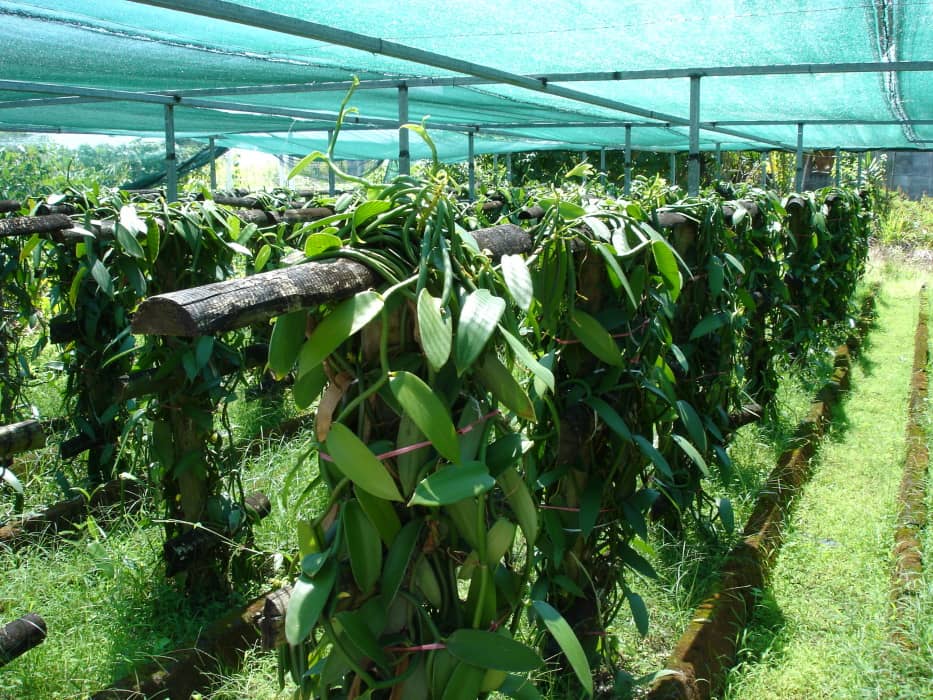
A sheltered trellis or a suitable living support lets the vine climb. Strong winds can damage growth. Arrange the support so you can inspect the plant and reach future flowers without needing to dismantle it. The plantation in the cover photograph illustrates trained vines under shade, not a requirement to build a commercial structure at home.
Watering and everyday care
Keep moisture available without leaving the roots waterlogged. There is no universal “every two or three days” schedule: the pot, growing medium, weather and plant size all change how quickly water is used. Check the growing medium rather than watering simply because a fixed interval has passed.
A container must have drainage holes. Gravel at the bottom is not a substitute for an appropriate medium and unobstructed drainage. Empty standing water from a decorative outer pot. Use clean tools when removing damaged growth, and inspect roots and stems if the plant declines instead of assuming that more fertiliser will solve the problem.
For pest identification, see our guide to mealybugs and scale insects. Avoid automatic pesticide treatments or unlabelled homemade mixtures.
Propagation and flowering
Vanilla is commonly propagated from healthy stem cuttings. The lower part is placed in a suitable moist growing medium and the stem secured to a support while it establishes. Seeds are not the straightforward home-sowing option they are for many vegetables. Wear gloves when handling cut stems, as the plant’s sap can irritate skin.
Flowering depends on maturity and growing conditions. Commercial cultivation commonly uses manual pollination. Embrapa advises checking plants daily during flowering and pollinating newly opened flowers, preferably in the morning. Flowers are receptive for only one day. The procedure brings pollen into contact with the stigma; it is not simply a matter of moving pollen between any two flowers.
Harvesting is not the end of the process
After successful pollination, fruits take months to develop. The IAC guidance identifies yellowing at the tips of fully developed fruits as a harvest cue. Do not use calendar months from another region as a universal harvest schedule.
The dark, supple beans sold for cooking are a processed product. Curing and drying develop their characteristic aroma and colour; a freshly picked green fruit is not equivalent. This is also why describing vanilla extract as coming only from the black seeds is misleading: the cured fruit is used.
For food production, follow a validated processing method and appropriate hygiene rather than improvising a brief sun-drying recipe. Embrapa’s cultivation manual covers post-harvest handling as well as growing. For a home gardener, understanding these extra stages is the best way to set realistic expectations before treating a healthy vine as a future supply of kitchen vanilla.
Cover: vanilla cultivation in Bras-Panon, Réunion, photographed in November 2004 by Bouba. Wikimedia Commons photograph, released by its author into the public domain.
Usamos cookies em nosso site para fornecer a melhor experiência de uso, lembrando suas preferências e visitas repetidas. Ao clicar em “Aceitar”, concorda com a utilização de TODOS os cookies.
Este site usa cookies para melhorar sua experiência enquanto você navega pelo site. Destes cookies, os cookies que são categorizados como necessários são armazenados no seu navegador, pois são essenciais para o

funcionamento das funcionalidades básicas do site. Também usamos cookies de terceiros que nos ajudam a analisar e entender como você usa este site. Esses cookies serão armazenados em seu navegador apenas com

o seu consentimento. Você também tem a opção de bloquear esses cookies. Porém, a desativação de alguns desses cookies pode afetar sua experiência de navegação.
Os cookies necessários são absolutamente essenciais para o funcionamento adequado do site. Esta categoria inclui apenas cookies que garantem funcionalidades básicas e recursos de segurança do site. Esses cookies não armazenam nenhuma informação pessoal.
Quaisquer cookies que possam não ser particularmente necessários para o funcionamento do site e sejam usados especificamente para coletar dados pessoais do usuário por meio de análises, anúncios e outros conteúdos incorporados são denominados cookies não necessários. É obrigatório obter o consentimento do usuário antes de executar esses cookies no seu site.