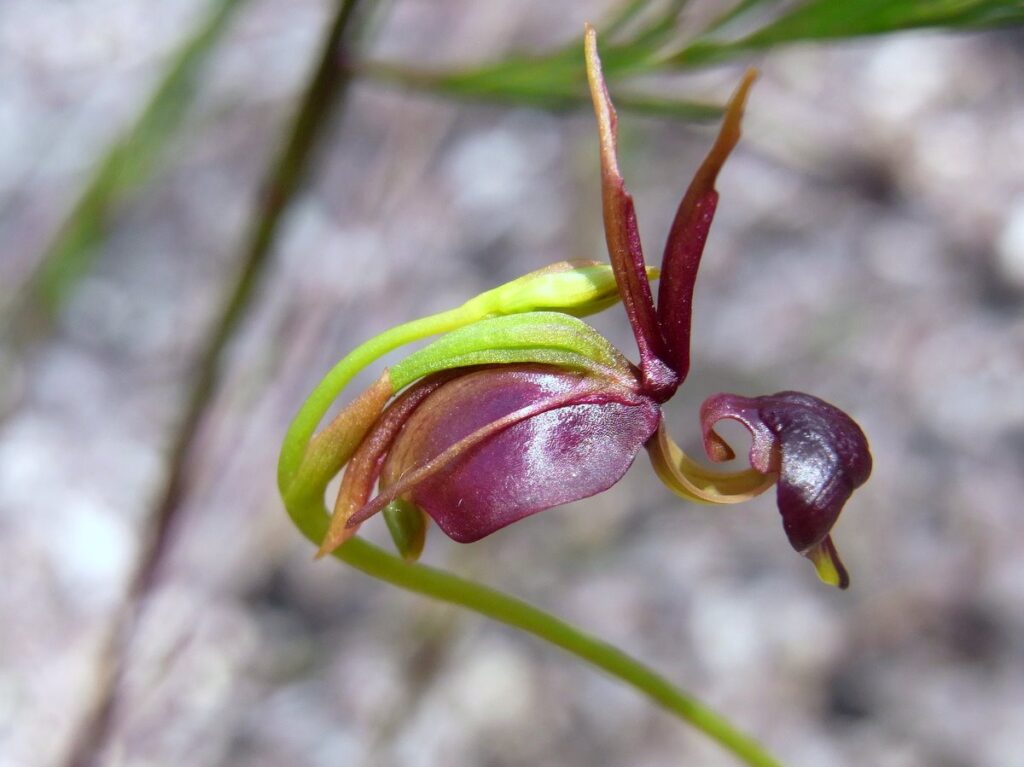
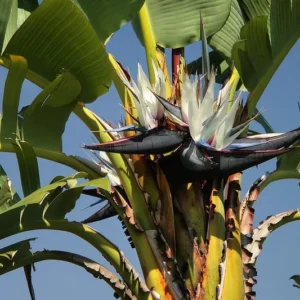
At first glance, the flower looks like a tiny duck taking flight. Look again and the “head,” “beak” and “wings” resolve into the parts of an orchid. Caleana major, known as the flying duck orchid or large duck orchid, is a real Australian plant, not a digitally invented curiosity.
A small orchid growing at ground level
Unlike orchids that grow on tree branches, this species is terrestrial. It grows in the ground in parts of eastern and southern Australia, including Tasmania. Botanical records describe woodland, forest and heathland habitats, often with sandy or gravelly soils.
The slender flowering stem reaches about 40 cm and can carry several flowers. Their colors range from reddish brown to glossy purple, rather than the bright yellow or white often associated with garden orchids. A narrow leaf grows close to the ground. These modest dimensions explain why a spectacular close-up does not necessarily make the plant easy to spot on a walk.
Why does the flower look like a duck?
The resemblance comes from the arrangement of its floral parts. The labellum, a specialized petal also called the lip, forms the most recognizable head-and-beak outline. Other parts complete the impression of a body and wings. It is a useful visual comparison, but the flower’s job is reproduction, not imitation of a bird for our benefit.
The Australian National Botanic Gardens describes a touch-sensitive flower capable of temporarily trapping insects as part of pollination. The movement helps bring an insect into contact with the reproductive structures. The orchid guide for Tasmania identifies male sawflies of the genus Pterygophorus as pollinators. The important distinction is that this is a pollen-transfer mechanism, not a reason to treat the orchid as an insect-eating plant.
When does it flower?
Flowering dates depend on the region. VicFlora records September to January in Victoria, while the New South Wales flora gives September to February. These periods correspond mainly to the Australian spring and summer. They are not a universal timetable that can be transferred to another country.
The plant also has a seasonal cycle. Yarra Ranges Council describes summer–autumn dormancy, so a perennial orchid should not automatically be pictured as carrying green leaves and flowers throughout the year.
Can you grow it at home?
A striking photograph is not a reliable cultivation guide. Yarra Ranges Council does not recommend introducing these orchids into gardens and warns that removing wild orchids commonly results in their death. If they already occur naturally on a property, its advice is to protect them where they grow.
For this reason, a generic recipe of weekly watering, fertilizer and a pot of orchid bark would be misleading. This article is an introduction to the species in nature, not a promise that it can be grown like a supermarket orchid. Do not dig up wild plants or buy material of uncertain origin because an online listing promises an easy result.
A better way to enjoy the discovery
Observe and photograph without picking flowers, disturbing the soil or stepping on nearby plants. The small flower is only the visible part of a living habitat. Its real appeal goes beyond its duck-like silhouette: it shows how detailed and unexpected the relationship between a plant, its environment and its pollinators can be.
Usamos cookies em nosso site para fornecer a melhor experiência de uso, lembrando suas preferências e visitas repetidas. Ao clicar em “Aceitar”, concorda com a utilização de TODOS os cookies.
Este site usa cookies para melhorar sua experiência enquanto você navega pelo site. Destes cookies, os cookies que são categorizados como necessários são armazenados no seu navegador, pois são essenciais para o

funcionamento das funcionalidades básicas do site. Também usamos cookies de terceiros que nos ajudam a analisar e entender como você usa este site. Esses cookies serão armazenados em seu navegador apenas com

o seu consentimento. Você também tem a opção de bloquear esses cookies. Porém, a desativação de alguns desses cookies pode afetar sua experiência de navegação.
Os cookies necessários são absolutamente essenciais para o funcionamento adequado do site. Esta categoria inclui apenas cookies que garantem funcionalidades básicas e recursos de segurança do site. Esses cookies não armazenam nenhuma informação pessoal.
Quaisquer cookies que possam não ser particularmente necessários para o funcionamento do site e sejam usados especificamente para coletar dados pessoais do usuário por meio de análises, anúncios e outros conteúdos incorporados são denominados cookies não necessários. É obrigatório obter o consentimento do usuário antes de executar esses cookies no seu site.