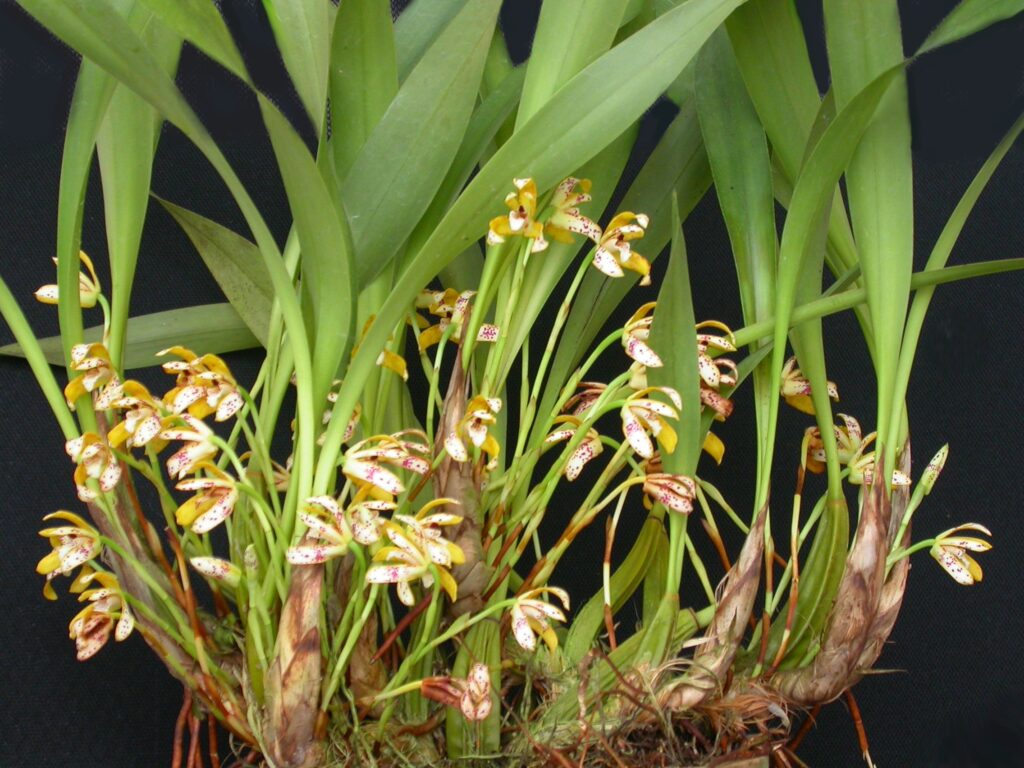
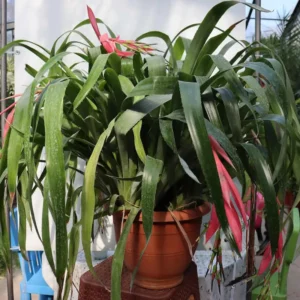
The painted maxillaria is an orchid worth looking at closely. Its small yellow-and-white flowers carry reddish-purple spots, especially on the outside, as if someone had added tiny brushstrokes. In Brazil, the name pintora-brasileira celebrates that painted appearance.
You may find it labelled Brasiliorchis picta or Maxillaria picta. These names refer to the same species: Kew’s Plants of the World Online currently accepts Maxillaria picta and treats Brasiliorchis picta as a synonym. Keeping both names in mind helps when checking a nursery label or looking for reliable care information.
Where it grows and what to look for
This South American orchid occurs in southeastern and southern Brazil, Paraguay and northeastern Argentina. It can grow on trees or rocks. On a tree, an epiphytic orchid uses the branch as support rather than drawing food from the tree like a parasite.
The plant forms a clump of elongated pseudobulbs, the thickened stems that store reserves, with long green leaves. Individual flower stalks arise near their bases. The spotted flowers are about 5 cm across and do not open as flat as those of many familiar moth orchids. Some plants are fragrant, although scent should not be treated as a guarantee for every specimen.
Light and a suitable place
Choose bright, filtered light and protection from strong direct sun. A sheltered orchid-growing area or a bright window with softened sunlight is a better starting point than an exposed, hot windowsill. The aim is useful light without overheating the leaves.
Good ventilation matters as well. Avoid a stagnant, permanently wet corner, but do not place the plant directly in the drying blast of an air conditioner. If you grow it outside, adapt its position to local weather rather than assuming that its Brazilian origin means it tolerates every tropical or subtropical condition.
Roots need air as well as water
Use an open orchid mix that drains freely, such as an appropriate bark-based medium. Ordinary compact garden soil is not a good substitute for the airy conditions around epiphytic roots. The pot must have drainage holes, and water should never remain trapped in a decorative outer container.
Water thoroughly when the medium is almost dry, then let the excess drain. Do not turn that guidance into a rigid weekly timetable: bark size, pot material, ventilation and temperature all change the drying rate. Check the medium itself before watering again.
During active growth, use an orchid fertiliser according to its label rather than increasing the dose in hopes of forcing flowers. If the medium has broken down and stays wet for too long, improving the root environment is more useful than adding extra fertiliser.
Dividing an established plant
A mature, well-developed clump can be propagated by division. Keep several healthy pseudobulbs together in each section instead of separating every new growth. The RHS recommends divisions with three or four healthy pseudobulbs. Use clean tools and avoid unnecessary damage to roots.
Seed propagation is not the usual home shortcut: orchid seedlings have specialised requirements. For most gardeners, a legally propagated nursery plant or a division from a cultivated specimen is the practical choice. Do not remove orchids from wild trees or rocks.
A flower that also feeds visitors
Its spots and fragrance are not only decorative. A 2022 study of Brazilian populations investigated tiny food hairs produced by the flowers and their relationship with stingless bees. Those structures can provide a floral reward. It is a useful reminder that an orchid’s beauty is connected to the living relationships around it, not just its value in a collection.
Usamos cookies em nosso site para fornecer a melhor experiência de uso, lembrando suas preferências e visitas repetidas. Ao clicar em “Aceitar”, concorda com a utilização de TODOS os cookies.
Este site usa cookies para melhorar sua experiência enquanto você navega pelo site. Destes cookies, os cookies que são categorizados como necessários são armazenados no seu navegador, pois são essenciais para o

funcionamento das funcionalidades básicas do site. Também usamos cookies de terceiros que nos ajudam a analisar e entender como você usa este site. Esses cookies serão armazenados em seu navegador apenas com

o seu consentimento. Você também tem a opção de bloquear esses cookies. Porém, a desativação de alguns desses cookies pode afetar sua experiência de navegação.
Os cookies necessários são absolutamente essenciais para o funcionamento adequado do site. Esta categoria inclui apenas cookies que garantem funcionalidades básicas e recursos de segurança do site. Esses cookies não armazenam nenhuma informação pessoal.
Quaisquer cookies que possam não ser particularmente necessários para o funcionamento do site e sejam usados especificamente para coletar dados pessoais do usuário por meio de análises, anúncios e outros conteúdos incorporados são denominados cookies não necessários. É obrigatório obter o consentimento do usuário antes de executar esses cookies no seu site.