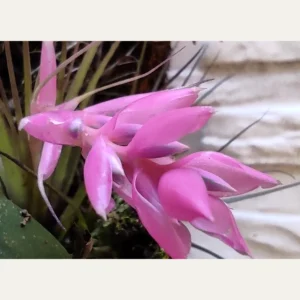
Flowers arranged along upright canes, often with a dark central eye, make Dendrobium nobile instantly memorable. In Brazil it is known as orquídea-olho-de-boneca, or doll’s-eye orchid. The display is striking, but successful care depends less on a special trick than on understanding its seasonal growth.
This guide covers the species and the general habits of nobile-type orchids. A named hybrid may have different requirements, so keep its label and ask the grower about its background. Do not apply the same winter rest to every plant sold as a Dendrobium.
Origin, canes and flowers
Kew records the native range of D. nobile from Nepal to southern China and Indo-China. It can grow on trees as an epiphyte or on rocks as a lithophyte. Trees provide support; the orchid is not feeding parasitically on them.
Its long, thickened stems are pseudobulbs, usually called canes. They carry leaves and store reserves. Flowers emerge at nodes along mature canes rather than only at the tip. White, pink and lilac tones with a darker lip are familiar, while cultivated nobile-type hybrids offer a wider range of combinations.
Older canes may lose their leaves without being dead. Do not remove a firm, living cane simply because it looks bare: it can still hold useful reserves and may flower.
The annual cycle: growth first, then rest
Active growth: new shoots and roots need water, nutrients and good light to build strong canes. Keep the bark mix from staying saturated, but do not impose drought while the plant is actively growing.
After the canes mature: nobile-type orchids generally benefit from a cooler, drier rest before flowering. Reduce feeding and watering as growth slows, adapting to the actual plant and conditions. This is not a rule to stop watering immediately after the flowers fall.
New growth returns: gradually resume the growing-season routine as new shoots and roots become active. Seasons differ between hemispheres and climates, so watch the plant rather than copying months from an overseas calendar.
Light, temperature and air
Provide bright, filtered light, with protection from intense midday sun. A bright window or a sheltered growing area can work; the compass direction alone does not determine whether the exposure is suitable. Acclimatise the plant gradually when moving it into stronger light.
Cooler nights are part of the flowering signal for nobile types, but cool does not mean frost. Protect the plant from freezing conditions and abrupt changes. Avoid trying to force buds by exposing an unidentified hybrid to temperatures it may not tolerate.
Humidity should come with air movement. Do not enclose the orchid in a stagnant, constantly wet space. If using an outer pot or humidity tray, keep the bottom of the growing pot out of standing water.
Watering and feeding
During active growth, water thoroughly when the mix has dried somewhat, then allow the excess to drain. Lift the pot to learn the difference between wet and dry weight. Bark size, pot material, temperature and ventilation all change the interval.
During the rest, give less water but continue inspecting the canes and roots. Severe shrivelling is a warning to reassess the conditions, not a target to achieve. Plants on mounts or in open baskets can dry much faster than potted specimens.
Use a suitable orchid fertiliser according to its label during active growth. Reduce or stop feeding during the rest. Fertiliser cannot compensate for poor light, rotten roots or the wrong seasonal routine.
Potting and repotting
Use an airy orchid mix, usually based on bark, rather than compact garden soil. Choose a pot with drainage holes and only modest room for growth. An oversized pot can stay wet long after the roots have used the available water.
Repot when the mix deteriorates or the plant genuinely outgrows its container. The appearance of new roots is a useful timing signal. Carefully remove the old mix, inspect the roots, and trim only dead or rotting tissue with clean tools. Keep the base at its previous level and secure the plant without crushing the roots.
Repotting is not an annual requirement, and a bare aerial root is not automatically a problem. Unnecessary disturbance can set an orchid back.
Propagation: keikis and division
A keiki is a young plant that develops on a cane. Leave it attached until it has established its own roots and sufficient leaves to support independent growth. Separate it carefully with clean tools and plant it in a small container with an appropriate orchid mix.
A large, healthy clump can also be divided, leaving several mature canes and a viable growing point on each part. Dividing a small or weak plant into tiny pieces usually sacrifices vigour rather than creating strong new plants.
Young plants need time to establish before flowering. Keep them sheltered from harsh sun and monitor their smaller pots closely, without keeping the roots continuously wet.
A keiki attached to a Dendrobium nobile cane. Photo: Nave do Conhecimento, CC0; resized site copy.
Common problems: diagnose before treating
Yellow leaves: seasonal leaf loss on mature canes is different from sudden, widespread yellowing with soft roots. Check the cycle, watering and root condition. See our guide to yellow leaves for a practical first assessment.
No flowers: review light, cane maturity and the rest period before changing fertilisers. Healthy new growth is progress, but constant warm, wet growing conditions may not provide the signal a nobile-type plant needs.
Pests or spreading lesions: isolate the plant and identify the cause. Examine leaf joints, cane bases and buds. Our mealybug and scale guide helps distinguish common pests. Do not treat every dark spot as a fungus or assume an “organic” insecticide is harmless. Choose any treatment only after diagnosis and according to local authorisation and the label.
A note on traditional uses
The species appears in accounts of traditional Asian medicine, but that is not an instruction to consume an ornamental orchid or use it as a treatment. This article concerns cultivation, not medical use.
Usamos cookies em nosso site para fornecer a melhor experiência de uso, lembrando suas preferências e visitas repetidas. Ao clicar em “Aceitar”, concorda com a utilização de TODOS os cookies.
Este site usa cookies para melhorar sua experiência enquanto você navega pelo site. Destes cookies, os cookies que são categorizados como necessários são armazenados no seu navegador, pois são essenciais para o

funcionamento das funcionalidades básicas do site. Também usamos cookies de terceiros que nos ajudam a analisar e entender como você usa este site. Esses cookies serão armazenados em seu navegador apenas com

o seu consentimento. Você também tem a opção de bloquear esses cookies. Porém, a desativação de alguns desses cookies pode afetar sua experiência de navegação.
Os cookies necessários são absolutamente essenciais para o funcionamento adequado do site. Esta categoria inclui apenas cookies que garantem funcionalidades básicas e recursos de segurança do site. Esses cookies não armazenam nenhuma informação pessoal.
Quaisquer cookies que possam não ser particularmente necessários para o funcionamento do site e sejam usados especificamente para coletar dados pessoais do usuário por meio de análises, anúncios e outros conteúdos incorporados são denominados cookies não necessários. É obrigatório obter o consentimento do usuário antes de executar esses cookies no seu site.