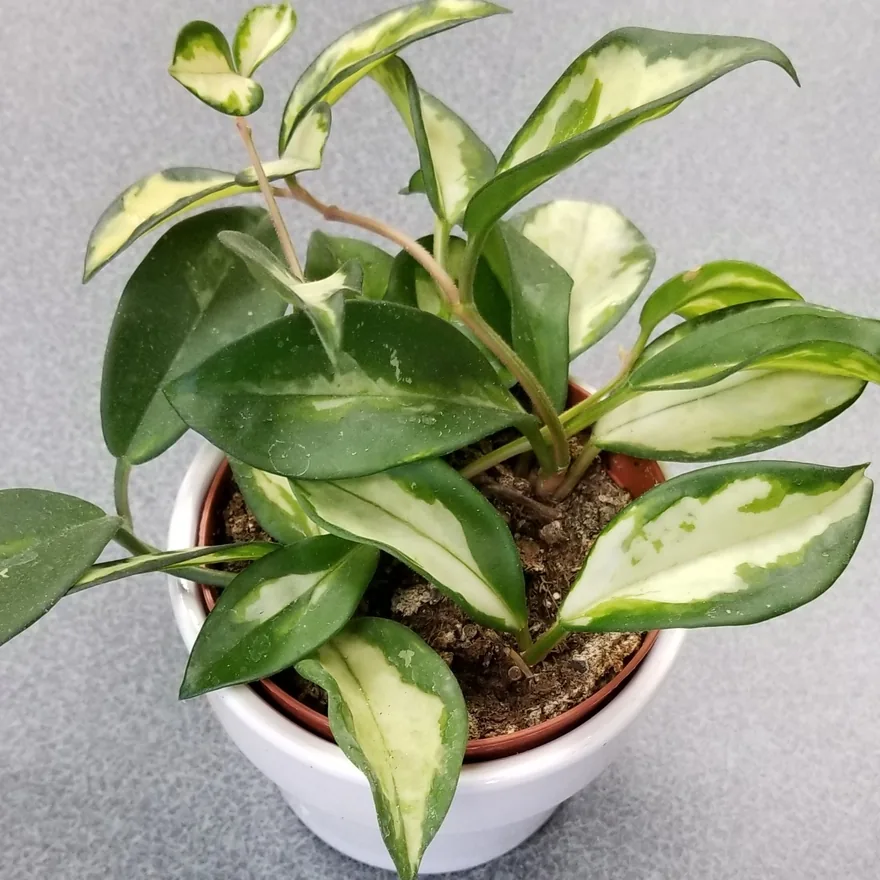
The wax plant, Hoya carnosa, is a long-lived climber with thick leaves. In suitable conditions it produces clusters of fragrant, star-shaped flowers that look as though they have been made from wax. Good light and steady care matter more than attempts to force a quick bloom.
Plant profile
Scientific name: Hoya carnosa.
Common names: wax plant, wax flower, porcelain flower.
Family: Apocynaceae; older classifications may list Asclepiadaceae.
Origin: parts of Asia.
Habit: a climbing plant with epiphytic growth, meaning it can grow supported on other plants rather than rooted in ordinary ground soil.
Light, potting mix and everyday care
Provide plenty of bright, indirect light and a light, organically rich mix that drains quickly. Allow the mix to dry between waterings, without leaving the plant dry for excessive periods. Grow it on a support or in a hanging container, with enough room for the stems to extend.
Take cuttings from stems rather than relying on an isolated leaf. Most importantly, do not cut off the short flowering spurs, known as peduncles, after the flowers fade: they can produce more flowers later.
Supporting the stems
A small trellis, hoop or stakes can help accommodate growth. If the plant trails from a pot, leave room beneath and around it. Untangle intertwined stems gently. A long, bare-looking stem is not necessarily dead: Hoya carnosa can extend a stem before producing leaves along it.
Stem cuttings: keep the nodes
Choose a stem cutting with one or two nodes, the points where leaves attach. Remove the lower leaves and place a node in water, moist sphagnum or a light propagation medium. Rooting may take several weeks and varies with conditions. Once roots have formed, move the cutting into a small, freely draining container.
A detached leaf may form roots without developing into a new vine if no stem node is attached. Preserving a node is therefore an important distinction between making a growing plant and keeping a rooted leaf alive.
Healthy growth but no flowers
Look at the light actually reaching the leaves. Insufficient light is a common reason for a lack of flowers, but age matters too. There is no universal deadline for the first bloom, and fertilizer cannot replace suitable conditions.
Keep a simple record of light, growth and recent care before changing several things at once. That makes it easier to recognize what helped. A young plant may simply need more time to mature.
Use pot weight as a watering clue
Compare the weight of the pot after watering with its weight when the mix has dried. The difference helps you judge water needs without relying on a fixed interval. Wrinkled leaves can indicate a lack of water, but weak leaves over wet soil can also point to damaged roots.
Check the whole picture before watering again. Automatically adding water may make a waterlogged-root problem worse. If yellowing is the main symptom, our guide to investigating yellow leaves explains why context is more useful than a single symptom.
Helping buds reach flowering
The RHS emphasizes consistent light and watering for hoyas. Once buds develop, moving the plant to a location with different light can cause them to drop. A mix that stays too wet or becomes excessively dry can also interfere. Before moving a plant about to bloom, consider whether the change is necessary.
In sheltered cultivation, provide filtered light and a support that suits the eventual length of the stems. A well-grown Hoya carnosa can become a vigorous climber, much larger than the young specimen sold in a small pot.
Indoors, avoid intense hot summer sun and keep the plant in comfortable growing conditions. When growth slows, reduce watering to match its needs rather than allowing the mix to remain permanently bone dry.
Does the scent vary through the day? The flowers’ fragrance can be particularly noticeable in the evening or at night.
Do unusual leaves mean it is a different species? Cultivars differ in appearance. Identify the cultivar before applying one particular description of leaf color or size to your plant.
Common questions
Is it toxic to cats and dogs? The ASPCA lists Hoya carnosa as non-toxic to both. That does not make an ornamental plant food; discourage chewing.
Is liquid on the flowers normal? It can be nectar. The University of São Paulo’s plant systematics material describes abundant nectar that can overflow. Check whether liquid is coming from the flowers before treating it as a sign of pests.
Why has my young plant never flowered? Flowering can take several years. Both maturity and growing conditions influence the result.
Does it need frequent repotting? Not necessarily. Repot when it has outgrown its container, avoiding the period when buds or flowers are developing.
Sources
ASPCA: Hoya carnosa
RHS: Hoya carnosa
RHS: hoyas
NC State Extension: Hoya carnosa
NC State Extension: Hoya
Iowa State University: All About Hoyas
University of Florida: hoya
Clemson University: indoor waxflowers
University of São Paulo: Hoya carnosa
Photograph: Matt Stevens (Pitt County), via NC State Extension, CC BY 4.0. Centered square crop and WebP compression, without enlargement.