A good lawn starts before the first piece of turf arrives. Measuring the space, choosing suitable grass and preparing the ground are easier to do in the right order than to fix later. This guide follows that sequence, from a bare plot to regular watering and mowing.
The aim is a lawn that suits your garden and the time you can give it, not a promise of a perfect green carpet in a fixed number of days. The examples use square metres and include the warm-season grasses commonly grown in Brazil. In another climate, ask for locally appropriate species and planting dates rather than copying a Brazilian calendar.
1. Measure only the area that will be grassed
Draw a simple plan with beds, paths, trees and buildings. Use a tape measure long enough for the job and record every dimension in the same unit. Subtract spaces that will not receive grass. The result will help you compare turf quotations and calculate products that have an application rate per square metre.
For a rectangle, multiply length by width. For a square, multiply one side by itself. A triangle uses base × perpendicular height ÷ 2; a circle uses π × radius². The radius is half the diameter. With measurements in metres, each result is in square metres.
For an irregular garden, divide the drawing into shapes that do not overlap, calculate each area and add them together. For example, a rectangle 8 m long and 5 m wide covers 40 m². Subtracting a 2 m × 3 m planting bed leaves 34 m² of lawn. Discuss cutting waste separately with the supplier; do not hide it inside the measured area.
Google Earth can help estimate a larger site: use its measurement tool and close a polygon around the area. Google’s instructions warn that measurements are not perfectly accurate and do not account for elevation changes. Confirm important dimensions on the ground before ordering.
2. Choose grass for the site, not just its colour
Make a short description of the garden before visiting a grower. Is it sunny or shaded for much of the day? Will children play on it, or is it mainly ornamental? How often can you mow? What happens in the dry season? What species and cultivar is actually being sold? These questions make comparisons more useful than a photograph of a flawless sports field.
Brazilian names such as esmeralda, bermudas, batatais, São Carlos and Santo Agostinho describe different choices, not interchangeable products. Keep the grower’s identification and care instructions. For a closer comparison, see our guides to Zoysia japonica and Brazilian esmeralda and bermudagrass. A narrow shaded strip, a heavily used play area and a sunny ornamental lawn may need different solutions. Do not assume that one grass will perform equally well in every part of the property.
3. Prepare the ground before arranging delivery
Remove rubbish, construction debris and unwanted vegetation. Plan the final levels, edges and irrigation route before planting. A lawn should not conceal a drainage problem. If earthworks, buried utilities or steep slopes are involved, get competent local help rather than treating the job as ordinary surface gardening.
UF/IFAS guidance on site preparation stresses soil testing and suitable grading. Correct compaction and incorporate amendments where indicated, without turning the surface into a deep, loose bed that will settle unevenly. Water should not be directed toward the house. The exact drainage solution depends on the property.
Lime and fertilizer are not universal recipes
Even a small lawn benefits from knowing its soil. Lime addresses acidity; it is not something every plot needs at the same dose. In Embrapa’s chapter on ornamental lawns and gardens, recommendations depend on soil properties and analysis. Have the results interpreted for your region, grass and chosen product. This is more useful than applying a fixed quantity to every square metre regardless of the starting conditions.
4. Understand sod, plugs, sprigs and seed
Ask the supplier to specify exactly what a quotation includes: grass identity, quantity, unit dimensions, delivery and installation. Pieces and rolls vary in size and weight. Large rolls may need machinery; smaller pieces can suit a modest garden. Check access and handling before a loaded vehicle arrives.
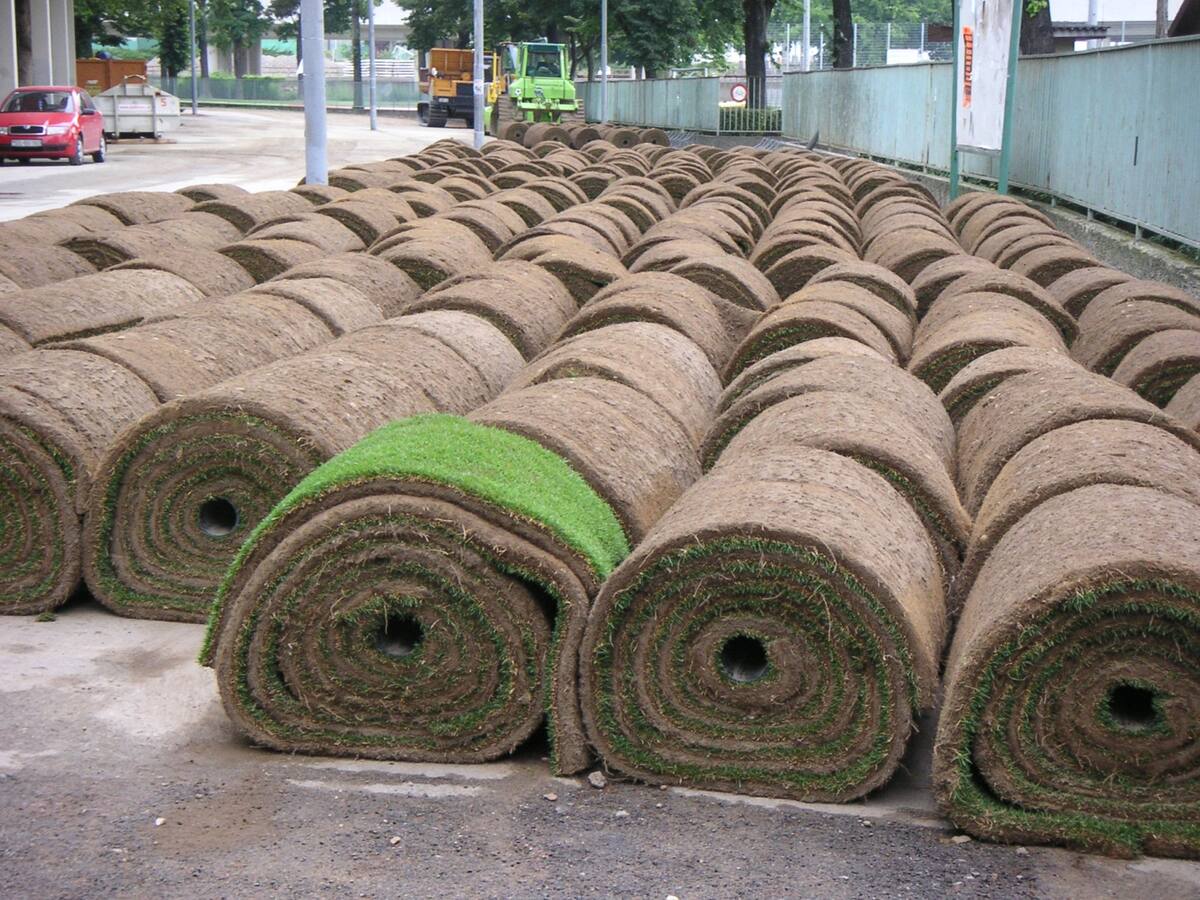
Sod provides immediate surface cover, but still has to root. Plugs are small rooted pieces or tray-grown plants that spread into the spaces between them. Sprigs are stem sections, typically without adhering soil. Seeds are another option, but not every warm-season cultivar is available or reproduced faithfully that way. The UF/IFAS establishment guide distinguishes these methods. Choose the one appropriate to the grass, budget and care you can provide.
5. Lay turf with good contact between roots and soil
Organize the prepared site, water supply and labour before delivery. Inspect the material and lay it promptly rather than leaving it stacked while the ground is still being prepared. Work from a clear edge, fitting adjoining pieces without stretching them. Trim around beds and paths carefully with suitable tools; keep hands away from cutting edges.
University of Minnesota Extension describes laying sod on slightly moist soil with staggered joints and firm contact underneath. Keep it moist, not saturated, during rooting. Its local planting calendar is for Minnesota, not Brazil. Progress should be checked by actual rooting and growth, not the colour of the lawn alone.
6. Change watering as the lawn establishes
A new lawn and an established one do not need identical routines. At first, pay close attention to the planting material and the soil directly beneath it. As roots develop, reassess frequency rather than maintaining the same schedule indefinitely. Account for rainfall, wind, heat, shade and the speed at which the soil drains. There is no reliable universal instruction to run every sprinkler for the same number of minutes.
For established turf, UF/IFAS recommends watering according to need, watching for folded leaves, a blue-grey cast and footprints that remain visible. Check the soil and irrigation coverage as well. Early morning is generally a useful time. Adjust each zone, avoid unnecessary watering after rain and follow local restrictions. These signs should prompt assessment, not an automatic conclusion that every brown patch needs more water.
7. Feed according to growth and the soil
Keep a record of the fertilizer used, its rate and the area treated. Follow the product directions and the local recommendation based on soil analysis. Organic material also adds nutrients; using it alongside mineral fertilizer does not make the total dose irrelevant. More feeding is not a substitute for correcting shade, drainage or damaged roots.
The right timing depends on the grass and its growing season. Avoid importing a northern-hemisphere month-by-month schedule unchanged. A new lawn also needs a different assessment from established turf. Ask the grower or an agronomist when feeding should begin, rather than assuming all the products must be applied on planting day.
8. Mow for the grass you have
Use the recommended height for the species and cultivar. UF/IFAS mowing guidance advises avoiding removal of more than one-third of the leaf height at one cut. Frequency follows growth, not a fixed fortnightly appointment. Small, evenly dispersed clippings can return nutrients; heavy clumps should not be left smothering the lawn. Clear stones and debris first, maintain the equipment and follow its safety instructions.
A useful routine beats a promise of perfection
Walk the lawn regularly. Look for uneven growth, persistent wet patches, bare areas and places worn by foot traffic. Record what changed before adding water, fertilizer or a treatment. When a problem keeps returning, diagnose it before replacing the turf: otherwise the new grass may face exactly the same conditions.
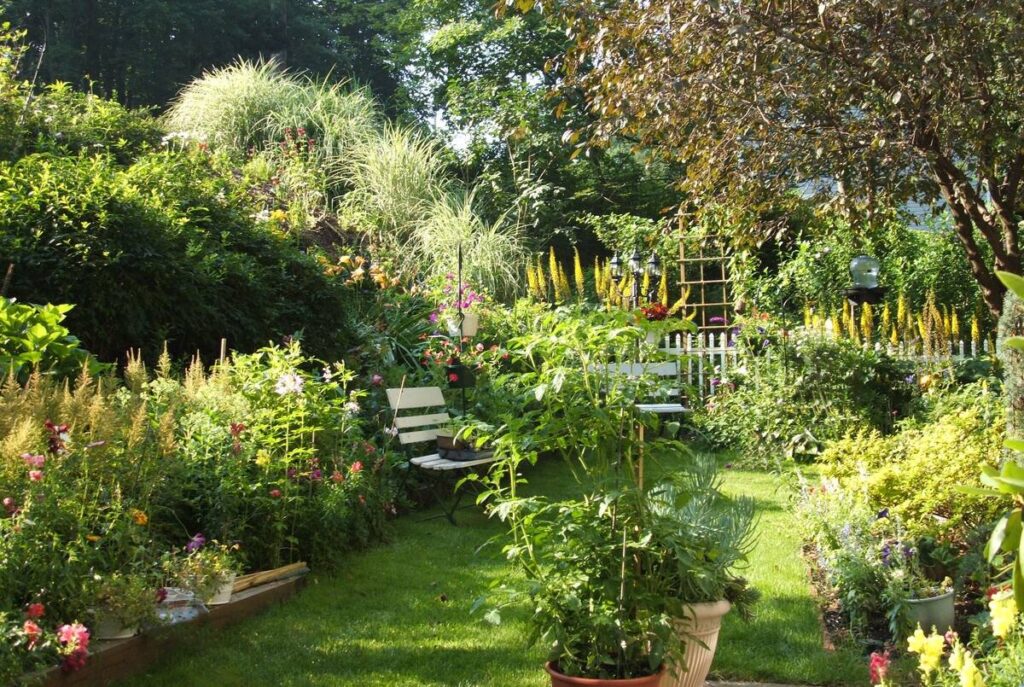
Cover: lawn integrated with planted beds in a residential garden. Lou Sander / Wikimedia Commons, public domain. Resized and compressed; grass species not specified.