The triangle palm has a shape that makes sense as soon as you look at the base of its crown. Its leaves emerge in three rows, creating a triangular arrangement above a single trunk. This is the palm widely sold as Dypsis decaryi; Kew now accepts the name Chrysalidocarpus decaryi. Both names refer to the same species, native to southeastern Madagascar.
What makes it distinctive
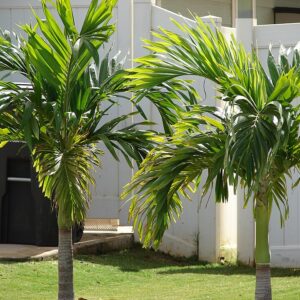
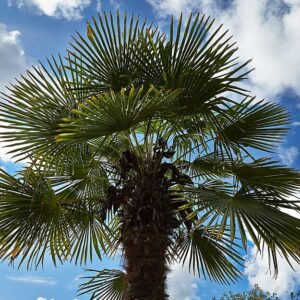
Long, feather-shaped fronds curve outward from overlapping leaf bases. The foliage has a blue-green to silvery tone, rather than the flat fan shape of a California fan palm. The trunk itself is rounded; the familiar triangle is formed by the arrangement of the leaves near its top.
This is not a small accent plant for a narrow bed. UF/IFAS describes a height of roughly 8–11 m and a crown around 4.5 m wide in cultivation, while NParks lists a maximum height of 15 m. These are guides to its potential scale, not a guarantee of the exact dimensions it will reach in every garden.
Choose the place before choosing the plant
A sunny, open position allows the crown to develop and its unusual structure to be seen. Full sun is the preferred condition listed by NParks; UF/IFAS also notes tolerance of partial shade. It should not be presented as a palm that needs indirect light to avoid normal outdoor sunshine.
Before planting, consider overhead wires, roof edges and the space used by people. Leave room for the mature fronds, not just the nursery pot. In a group planting, use the expected adult crown to plan spacing rather than placing young palms close together for an immediate effect.
The triangular crown works especially well as a focal point against a simple background. Lower plants can frame it without hiding the leaf bases. Choose companions suited to the same light and drainage conditions, instead of combining plants only because their colors look attractive together.
Water and drainage
The species comes from a seasonally dry tropical region, but drought tolerance is not the same as needing no care. A newly planted palm needs attention while its roots establish. Check soil moisture and adjust watering to rainfall, heat and drainage rather than following a fixed weekly schedule.
Avoid leaving the root zone waterlogged. If the planting area drains poorly, assess the whole site before putting the palm into a hole filled with a different soil mix. A handful of sand is not a universal cure for drainage problems. For local irrigation and nutrition decisions, advice based on your soil is more useful than a fertilizer recipe copied from another climate.
Do not prune every yellow leaf
A yellowing palm frond is a reason to investigate, not an automatic instruction to cut. UF/IFAS warns that removing partly green or nutrient-deficient leaves can make a palm’s condition worse. Keep healthy foliage and avoid pruning simply to make the crown look tighter or more upright.
Remove fully dead fronds when necessary and safely accessible. Work on a tall crown should be left to a qualified professional. Never cut the top to reduce the palm’s height or damage the growing point. If there are spots, holes or declining growth, identify the cause before choosing a treatment; an insecticide is not a remedy for every leaf problem.
A garden plant with a wild origin
Buy nursery-grown material with a traceable origin. A palm can be familiar in landscaping while its natural populations occupy a much smaller area. Its presence in gardens should not be mistaken for proof that there are no conservation concerns in Madagascar.
References and photograph
Kew, Plants of the World Online; NParks: Chrysalidocarpus decaryi; UF/IFAS: Triangle Palm; UF/IFAS: Pruning Palms.
Cover photograph: Forest & Kim Starr, triangle palm in Maui, via Wikimedia Commons, CC BY 3.0. The site uses a resized WebP version.