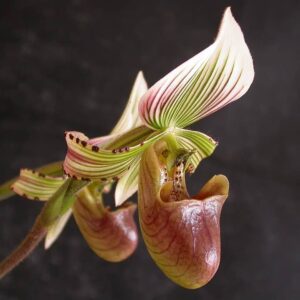
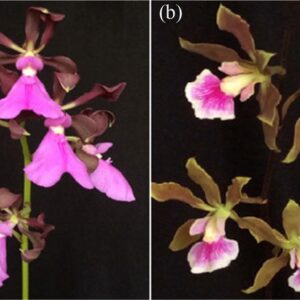
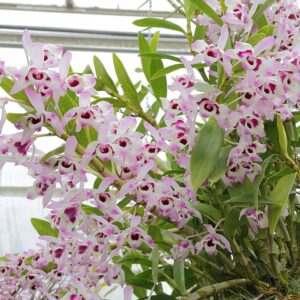
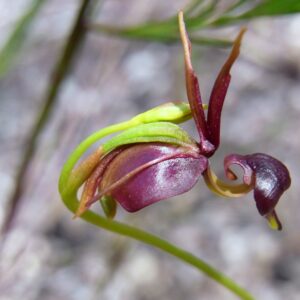
The pineapple orchid is named for a cluster of flowers, not for a fruit. In Robiquetia cerina, many small, fleshy flowers crowd together along a hanging stem. Seen from a distance, the compact arrangement can suggest a miniature pineapple. Up close, its appeal lies in the individual flowers and their changing colours.
Where it comes from
Kew lists Robiquetia cerina as native to the Philippines, growing as an epiphyte in wet tropical environments. The genus has a wider Asian and Pacific distribution, but that should not be confused with the native range of this particular species. An epiphyte uses another plant as support; the name does not mean a parasite or a plant for ordinary garden soil.
A hanging display with colour variation
The American Orchid Society’s 2023 feature describes tightly packed flowers in hanging clusters and records colours in R. cerina from yellow through red-orange and reddish purple to bright purple. The flowers do not all open widely. Leave room below the plant for the display instead of pressing the flower stems against a shelf or a neighbouring pot.
A photograph of one colour form is therefore not a promise that every plant sold under the name will flower identically. Keep the label, and ask for a photograph of the actual flowering parent or clone when colour is important to your choice.
Light, roots and water need to work together
The AOS genus guide recommends warm conditions, bright light, regular year-round watering and a medium-to-coarse epiphytic mix in pots or baskets. Its 2023 feature specifies bright light without full exposure. Start from those principles, then adapt to the actual growing space rather than copying a fixed weekly timetable.
Regular watering does not mean sealing the roots into a dense, permanently wet mass. Check how quickly your chosen medium dries, how much air reaches it and whether excess water can escape. A basket in moving air and a pot in a still room will not behave in the same way.
When buying a plant, ask what medium it is already growing in and how it has been watered. Avoid changing its container, light and watering routine all at once without a reason. If it then struggles, several simultaneous changes make the cause harder to identify.
Do not divide it like a clumping orchid
The AOS specifically notes that R. cerina can root only at the base of its stem and become lanky with age. That makes a casual instruction to cut a mature plant into several leafy pieces particularly unhelpful. Do not assume that every section will already have roots capable of supporting it.
For propagation, seek species-specific guidance from an experienced orchid grower before making an irreversible cut. A long stem is not, by itself, a reason to prune. Plan the support and hanging space around the living plant rather than cutting it to fit a decorative arrangement.
Inspect before treating
Look regularly at the roots, leaves and developing flowers. If something changes, record when it started and check the growing conditions before applying a product. A damaged leaf does not by itself identify a pest, and a product described as natural is not automatically suitable for every orchid. Correct identification and steady observation are more useful than routine spraying.
Usamos cookies em nosso site para fornecer a melhor experiência de uso, lembrando suas preferências e visitas repetidas. Ao clicar em “Aceitar”, concorda com a utilização de TODOS os cookies.
Este site usa cookies para melhorar sua experiência enquanto você navega pelo site. Destes cookies, os cookies que são categorizados como necessários são armazenados no seu navegador, pois são essenciais para o

funcionamento das funcionalidades básicas do site. Também usamos cookies de terceiros que nos ajudam a analisar e entender como você usa este site. Esses cookies serão armazenados em seu navegador apenas com

o seu consentimento. Você também tem a opção de bloquear esses cookies. Porém, a desativação de alguns desses cookies pode afetar sua experiência de navegação.
Os cookies necessários são absolutamente essenciais para o funcionamento adequado do site. Esta categoria inclui apenas cookies que garantem funcionalidades básicas e recursos de segurança do site. Esses cookies não armazenam nenhuma informação pessoal.
Quaisquer cookies que possam não ser particularmente necessários para o funcionamento do site e sejam usados especificamente para coletar dados pessoais do usuário por meio de análises, anúncios e outros conteúdos incorporados são denominados cookies não necessários. É obrigatório obter o consentimento do usuário antes de executar esses cookies no seu site.