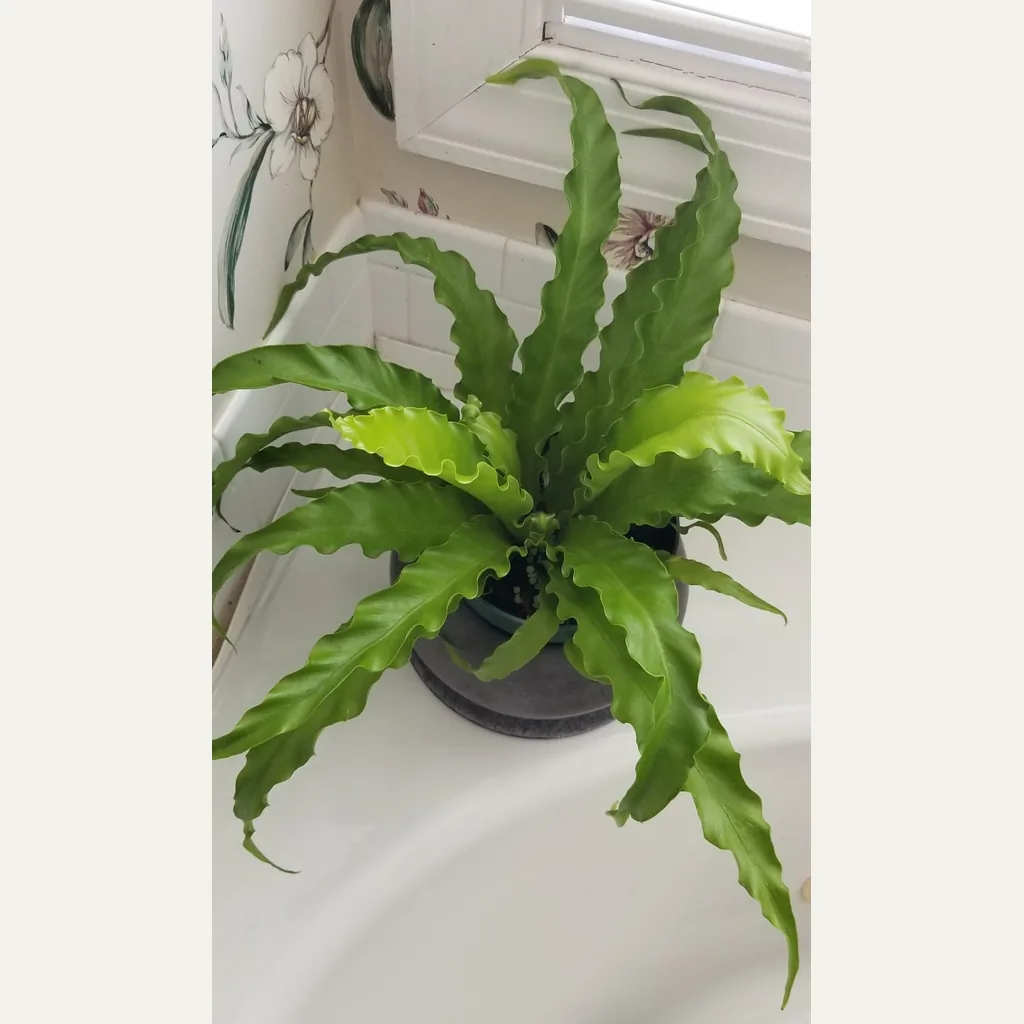
Bird’s nest fern has an easily recognized outline: long, glossy, undivided fronds spread around a central point, like a nest. Unlike ferns with finely divided foliage, its beauty lies in broad surfaces and dark midribs. It suits bright, sheltered places with enough room for the rosette to grow without being constantly brushed against.
Plant profile
Scientific name: Asplenium nidus.
Family: Aspleniaceae.
Life cycle: perennial.
Habit: a rosette-forming fern, often growing on trees in the wild.
Natural habitat: humid tropical forests.
Size: fronds may reach about 1.5 m in good conditions.
Light: indirect light and partial shade.
Potting mix: porous, with organic matter and good drainage.
Watering: maintain moisture without waterlogging.
Reproduction: by spores; it does not produce flowers.
Light and environment
Choose filtered natural light and shelter from drying drafts and direct heat. The plant appreciates humidity, but should not be kept in a closed, unventilated space. Indoors, watch the path of the sun during the day: a gentle morning position may receive strong afternoon sunshine.
The fronds are fragile. Avoid narrow passageways and positions where doors or curtains strike them. Leave a clear margin around the pot for the rosette to develop. Frost and severe cold are incompatible with its tropical needs.
Potting mix and water
An epiphyte grows on another plant for support without taking its food from that host. In nature, the nest shape collects fallen leaves, water and organic matter. In a pot, aim for moisture combined with air circulation around the roots, using a loose mix and a container that drains.
Water to moisten the mix without keeping it saturated. Direct water onto the mix near the pot rim rather than pouring it into the center of the rosette. Do not let the root ball dry out completely or leave the container standing in water. Before watering again, check moisture below the surface, not just its appearance. Feed lightly during growth, respecting the product’s dilution instructions. Extra fertilizer will not correct an unsuitable position.
Routine maintenance
Remove dead or damaged fronds carefully and inspect the undersides regularly. Mealybugs and scale insects may appear; identifying a problem before applying products avoids unnecessary treatment. The foliage is sensitive, so do not experiment with concentrated homemade mixtures.
Growth is usually slow. When buying, choose a plant with a healthy center and well-formed fronds. Do not expect a small specimen to fill its allotted space immediately.
How to propagate bird’s nest fern
Propagation from spores requires patience and cleanliness. Mature spores collected from the undersides of fronds are spread over the surface of moist, sterilized growing medium in a clean container in a sheltered place. This is not the same as rooting a cut leaf. For beginners, an established young plant makes cultivation simpler; do not cut through the center of the plant in an attempt to divide it.
Embrapa has also published a method for producing Asplenium nidus plants by germinating spores in vitro. That work concerns controlled laboratory conditions and should not be mistaken for an ordinary potting method at home.
Common questions
Why do the tips turn dry? Low humidity, prolonged drying of the mix and excess fertilizer are possibilities. Check these conditions before increasing watering: one brown tip does not reveal the cause.
Are brown lines on the underside a disease? Regular lines may be sori, the structures associated with spore production. They are part of fern reproduction and should not automatically be scraped away.
Does bird’s nest fern flower? No. Like other ferns, it reproduces by spores, not flowers and seeds.
Usamos cookies em nosso site para fornecer a melhor experiência de uso, lembrando suas preferências e visitas repetidas. Ao clicar em “Aceitar”, concorda com a utilização de TODOS os cookies.
Este site usa cookies para melhorar sua experiência enquanto você navega pelo site. Destes cookies, os cookies que são categorizados como necessários são armazenados no seu navegador, pois são essenciais para o

funcionamento das funcionalidades básicas do site. Também usamos cookies de terceiros que nos ajudam a analisar e entender como você usa este site. Esses cookies serão armazenados em seu navegador apenas com

o seu consentimento. Você também tem a opção de bloquear esses cookies. Porém, a desativação de alguns desses cookies pode afetar sua experiência de navegação.
Os cookies necessários são absolutamente essenciais para o funcionamento adequado do site. Esta categoria inclui apenas cookies que garantem funcionalidades básicas e recursos de segurança do site. Esses cookies não armazenam nenhuma informação pessoal.
Quaisquer cookies que possam não ser particularmente necessários para o funcionamento do site e sejam usados especificamente para coletar dados pessoais do usuário por meio de análises, anúncios e outros conteúdos incorporados são denominados cookies não necessários. É obrigatório obter o consentimento do usuário antes de executar esses cookies no seu site.