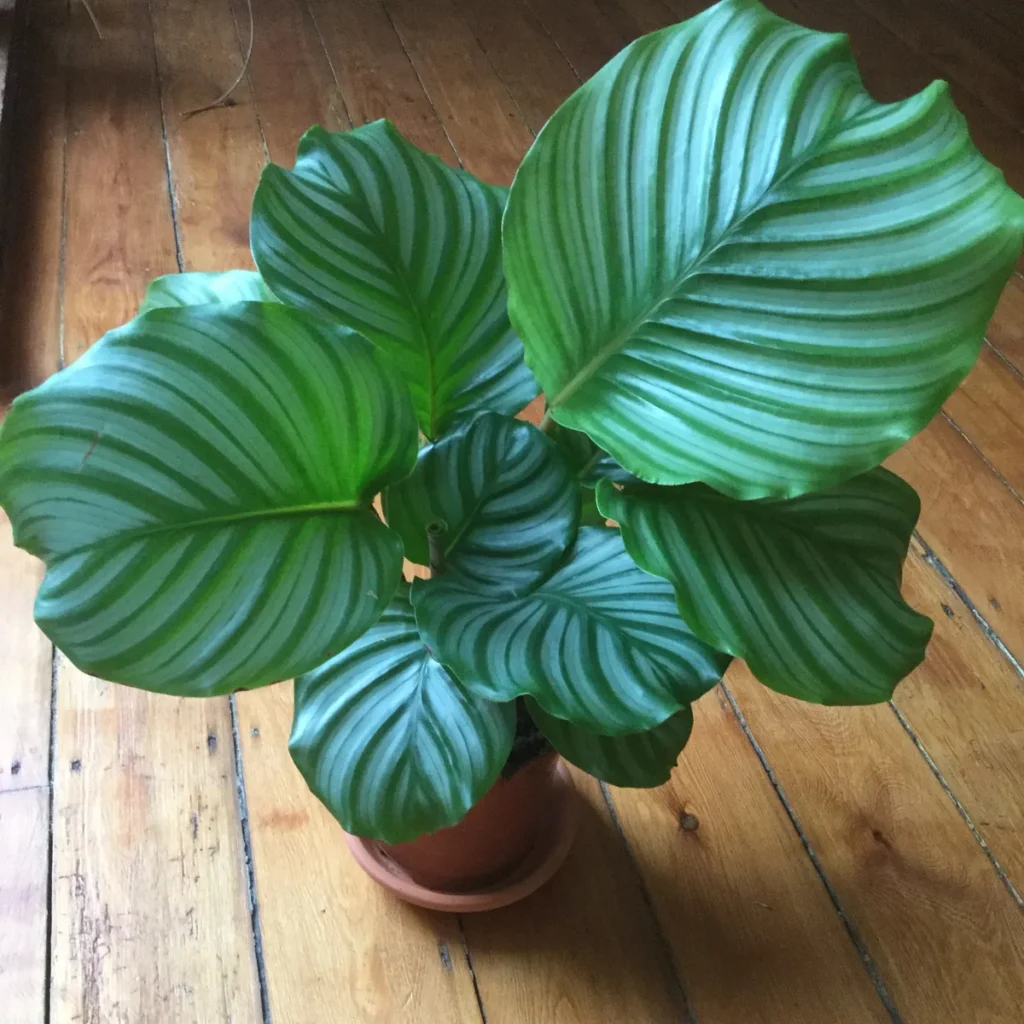
Rounded leaves with silvery-green bands make orbifolia a striking foliage plant. Growing it well means paying attention to water, air humidity and a stable environment.
Plant profile
Scientific name: Goeppertia orbifolia.
Former name still common in shops: Calathea orbifolia.
Family: Marantaceae.
Origin: eastern Brazil, according to Kew and Flora do Brasil.
Trade names: calathea orbifolia; also sold in Brazil as maranta orbifolia, although the species belongs to Goeppertia.
Approximate size: 60–90 cm.
Basic care
Grow it in filtered light and moist, never waterlogged, potting mix. Avoid cold drafts and strong sun. Dry air can damage leaf margins. NC State recommends rainwater or distilled water when the local water contributes to brown tips. Remove dust gently and propagate by division.
Environment and routine maintenance
The RHS also recognizes Calathea orbifolia as a synonym. The change of genus explains why labels and articles use different names; you do not need to buy another plant to own a Goeppertia.
Its profile recommends a consistently warm environment, from approximately 16°C upward, with high humidity and protection from drafts. It advises peat-free potting mix. Watering should follow growth, keeping the mix moist without saturating it. Advice to water less in winter assumes the plant’s activity has actually decreased.
Maintenance includes removing dead leaves when necessary. The RHS suggests monthly feeding with a balanced liquid fertilizer and lists rhizome division as a propagation method. Handle the plant carefully to preserve the roots and remaining foliage.
Are the flowers the main attraction? No. The foliage is the main ornamental feature, and flowers are uncommon in cultivation.
Which pests should you watch for? Whiteflies and mites are among the possible problems listed by the RHS. Look for signs on the undersides of leaves.
Humidity does not mean waterlogging
The air and the potting mix need different kinds of attention. Orbifolia appreciates humid surroundings, but its roots need drainage. Keep the mix moist during growth and discard water collected in the saucer or outer pot. As growth slows, adjust watering without letting the root ball dry out completely. Misting leaves has only a brief effect on air humidity; a humidifier may provide more consistent control in a dry room.
Brown tips: investigate before watering more
Dry tips do not identify a single cause. Alongside dry air and water quality, consider long gaps between waterings, waterlogged mix, excess fertilizer and salt buildup. Check for direct sun and drafts. Before adding more water, examine pot moisture and review recent care. Trimming a dry area may improve appearance, but does not solve the underlying cause.
Dividing the clump
To propagate, choose a period of active growth and separate sections with roots and several leaves. Work carefully without unnecessarily breaking up the root system. Pot each division separately and monitor establishment: warmth, humidity and moist mix without standing water help the plant resume growth. A detached leaf is not equivalent to a rooted division.
Common questions
Do dry tips mean it needs more water? Not always. Low humidity and water quality may also contribute.
Are Calathea and Goeppertia different plants here? Both names can refer to this species; Calathea orbifolia is a former name.
Sources
Royal Horticultural Society: Goeppertia orbifolia
North Carolina State University
Royal Botanic Gardens, Kew: accepted name and origin
Rio de Janeiro Botanical Garden: Flora do Brasil, Marantaceae
RHS: growing and dividing calatheas
Iowa State University: humidity for houseplants
Iowa State University: brown tips and leaf edges
University of California: houseplant problems
Photo: Fregisseur, CC BY-SA 4.0, via Wikimedia Commons and NC State Extension. Square crop and WebP compression, without upscaling.