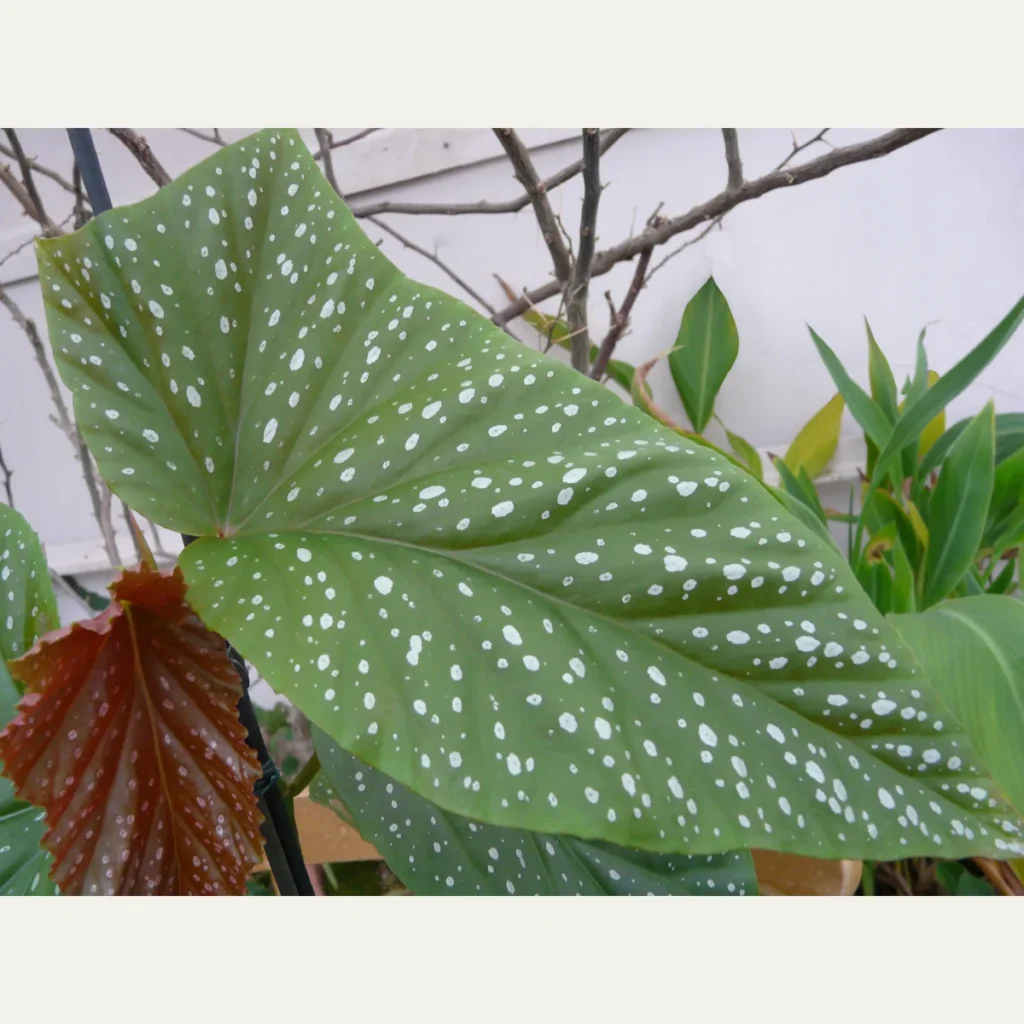
Begonia maculata, commonly known as polka dot begonia, combines upright stems with green leaves spotted silver-white and reddish undersides. It can also produce pale flowers in hanging clusters.
Plant profile
Scientific name:Begonia maculata.
Common names: polka dot begonia and spotted begonia.
Family: Begoniaceae.
Origin: Brazil.
Horticultural group: cane-stemmed begonias.
Approximate size: up to 1 m.
Growing conditions
Provide filtered light, protection from hot sun and a light, well-drained growing mix. Water moderately during growth, avoiding water accumulating in the pot. Stem cuttings produce new plants. Overlong stems can be pruned to renew the plant’s shape.
Cane stems and moisture
The RHS guide to indoor begonias distinguishes cane-stemmed plants from rex begonias and other groups. This matters: not every technique described for an ornamental-leaved begonia applies in the same way to B. maculata.
Good light encourages firm stems and flowers in cane begonias. Protect them from direct sun. The RHS gives 15–22°C as a favourable growing range for this group. Use it to help choose a position, not as a universal survival limit. Do not let the mix dry out completely or remain saturated; reduce watering as growth slows.
Follow the chosen fertiliser’s dose and frequency instructions. For propagation, the guide describes stem cuttings about 7–10 cm long, inserted into a freely draining mix and kept warm. This is different from simply burying any piece of leaf.
Pinching and controlling stems
Removing the growing tips of stems that need branching helps cane begonias become fuller. Excessively long stems can also be shortened. Use clean tools and observe the response before repeating the process. The aim is to organise growth, not indiscriminately cut all the foliage.
Cuttings: check the nodes too
Use only healthy sections without signs of pests or disease. Along with length, identify the nodes where leaves attach. General houseplant cutting advice recommends keeping at least two nodes, removing excess leaves but leaving two or three, and taking off any flowers. For begonias, the University of Florida recommends moist perlite or another clean propagation medium. Keep moist without waterlogging.
Silver spots or white powder?
The pale dots are part of the plant’s natural colouring and should not be removed. Powdery mildew can create powder-like white patches on either side of a leaf. This distinction helps inspection, but one visual change does not establish a cause: spots, rot and growing damage need their own assessment.
Inspection during routine care
Check leaf undersides, new growth and stems while caring for the pot. Mealybugs and scale insects, mites, thrips and whiteflies can affect begonias in this group. Maintain airflow between pots and keep pruning tools clean. If changes persist, photograph their progress and seek technical advice before choosing treatment.
Common questions
Are the pale spots natural? Yes, they are part of the foliage pattern. Recent changes, lesions or powder on the surface need a separate assessment.
Is it a tuberous begonia? The species has fibrous roots and cane-like stems.
Is it safe to eat? No. Begonias have toxic characteristics. Keep them out of reach of children and animals and wear gloves when handling.
Photograph: Fjvelsen / Wikimedia Commons, CC BY-SA 4.0. Full photograph preserved with the same neutral borders; reduced and compressed to a 1200 × 1200 px WebP without enlargement. Derivative shared under CC BY-SA 4.0.
Usamos cookies em nosso site para fornecer a melhor experiência de uso, lembrando suas preferências e visitas repetidas. Ao clicar em “Aceitar”, concorda com a utilização de TODOS os cookies.
Este site usa cookies para melhorar sua experiência enquanto você navega pelo site. Destes cookies, os cookies que são categorizados como necessários são armazenados no seu navegador, pois são essenciais para o

funcionamento das funcionalidades básicas do site. Também usamos cookies de terceiros que nos ajudam a analisar e entender como você usa este site. Esses cookies serão armazenados em seu navegador apenas com

o seu consentimento. Você também tem a opção de bloquear esses cookies. Porém, a desativação de alguns desses cookies pode afetar sua experiência de navegação.
Os cookies necessários são absolutamente essenciais para o funcionamento adequado do site. Esta categoria inclui apenas cookies que garantem funcionalidades básicas e recursos de segurança do site. Esses cookies não armazenam nenhuma informação pessoal.
Quaisquer cookies que possam não ser particularmente necessários para o funcionamento do site e sejam usados especificamente para coletar dados pessoais do usuário por meio de análises, anúncios e outros conteúdos incorporados são denominados cookies não necessários. É obrigatório obter o consentimento do usuário antes de executar esses cookies no seu site.