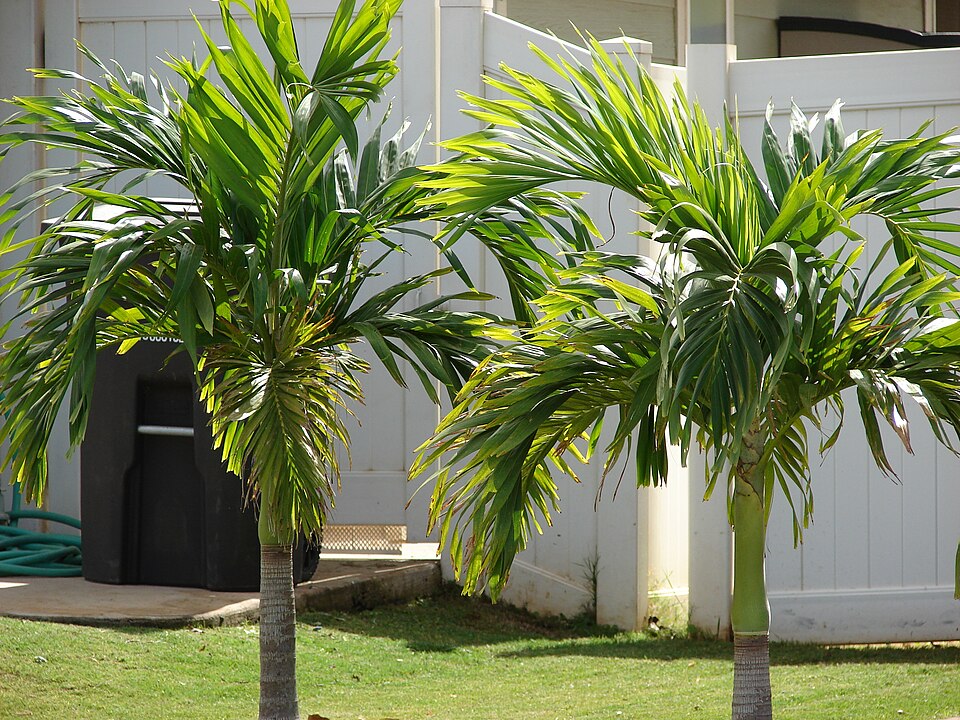
The Christmas palm, also called the Manila palm, brings the shape of a tropical palm to gardens that cannot accommodate a towering royal palm. Its accepted botanical name is Adonidia merrillii; the older name Veitchia merrillii still appears in nurseries and gardening articles. Checking that name matters, because advice about other palms in the genus Veitchia does not automatically apply to this species.
Origin and appearance
Kew records its native range from Sabah in Borneo to parts of the Philippines, including Palawan and Danjugan. It is not a palm native to Fiji. A smooth, slender trunk supports a green crownshaft, the sleeve-like section below the leaves, and a crown of arching, feather-shaped fronds.
The clusters of red fruit are another recognizable feature. The English name “Christmas palm” refers to a fruiting season described in northern-hemisphere cultivation; it is not a promise that every plant, in every country, will bear red fruit in December.
Compact does not mean miniature
Compared with many landscape palms, this species can suit smaller sites, but it still needs substantial room. UF/IFAS describes eventual heights of about 6–7.6 m. NParks records a wider range, reaching 15 m under its reference conditions. Plan for an adult palm, not the height of the specimen being sold.
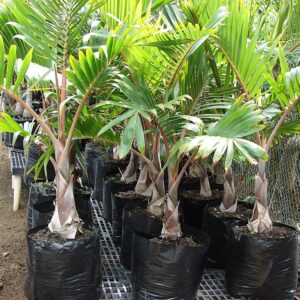
It is naturally single-stemmed. The familiar pairs or groups sold in one container are separate plants grown together, not a single palm that branches from the base. Crowding and uneven planting depth can affect the individuals differently; one may grow more slowly than its neighbors.
Sun, warmth and the right site
Choose a bright outdoor position in a suitable warm climate. NParks lists full sun and moderate water needs. Frost is a serious limitation, so a sheltered-looking corner does not by itself make an unsuitable winter climate safe for this palm.
Leave space between the mature crown and buildings, and think about where old leaves and fruit will fall. Beside a pool, terrace or entrance, an attractive silhouette also means future cleanup. If a plant must remain small indefinitely, it is better to select another species than plan to cut the top off this one.
Planting and watering
Start with a healthy nursery-grown plant of known identity. Keep its root ball at the appropriate ground level rather than burying the trunk. Check the surrounding soil’s drainage before planting: a pocket of amended soil cannot compensate for a site that stays waterlogged.
Water according to the root zone, rainfall and heat. Establishing plants need closer attention than palms already rooted into the garden. Moist, well-drained soil is different from constantly saturated soil, and a rigid schedule ignores that distinction. In a container, unobstructed drainage holes are essential; do not let the pot remain standing in collected water.
Avoid adding sulfur or other soil amendments simply because a general guide suggests changing the pH. Test the soil and seek local advice first. Fertilizer should address actual needs and be used according to its label, rather than added automatically whenever a leaf changes color.
Maintenance without excessive pruning
Old leaves detach naturally, a habit often called self-cleaning. That reduces routine pruning, but it does not eliminate the need to check the area beneath the crown. Leave healthy foliage in place and do not damage the growing point at the top of the trunk.
If the palm develops distorted new leaves, rapid yellowing or a declining crown, seek a diagnosis before choosing a product. Nutritional problems, root stress and diseases are not interchangeable. This species is susceptible to lethal yellowing in affected regions; do not diagnose it from a photograph alone or copy preventive treatment recommendations from another country.
Choosing it for the garden
Use the Manila palm where its mature scale and warm-climate requirements genuinely fit. Its regular silhouette can frame a sunny entrance or provide a focal point among lower planting. For a different structure, compare the three-ranked crown of the triangle palm, rather than assuming all tropical palms have the same needs.
References and photograph
Kew: Adonidia merrillii; NParks: Manila palm; UF/IFAS: Christmas Palm.
Photograph: Forest & Kim Starr, Adonidia merrillii in Maui, via Wikimedia Commons, CC BY 3.0. Wikimedia’s resized version is used without other alterations.