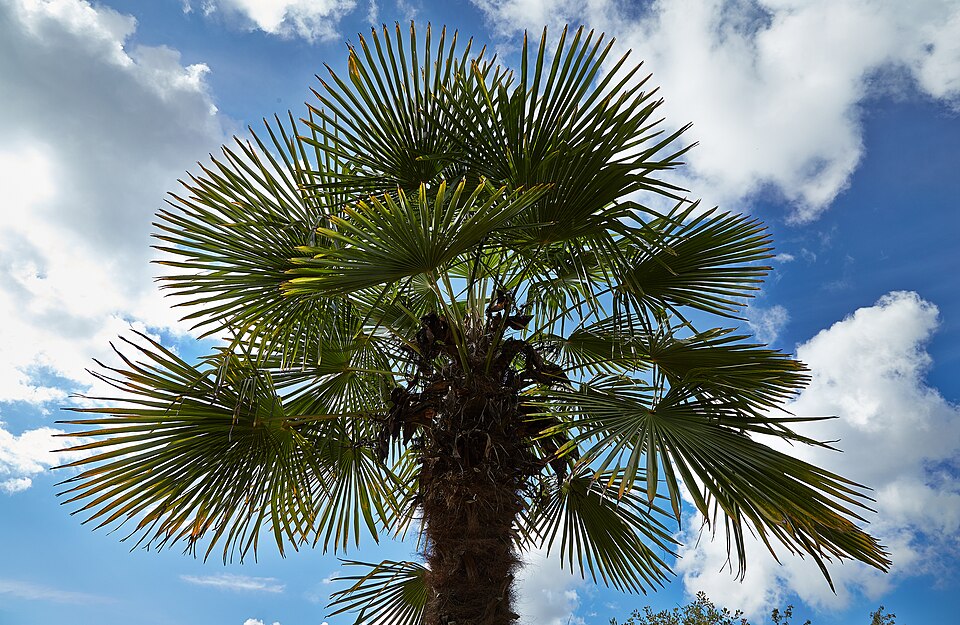
Windmill palm (Trachycarpus fortunei), also called Chusan palm, brings a fan-shaped crown and a shaggy, fibre-covered trunk to the garden. Its appeal is architectural: even without flowers, the upright stem and spreading leaves create a clear focal point.
It is better adapted to cool conditions than many familiar tropical palms, but that does not make it suitable for every climate or exposure. Choose the planting position for the adult palm, not just for the small specimen in its nursery pot.
What to know before buying
Kew records its native range from south-central China to northern Myanmar. The Himalayas appear among its introduced regions, so they should not simply be described as its original home. The accepted scientific name is the most useful label to check when purchasing a plant.
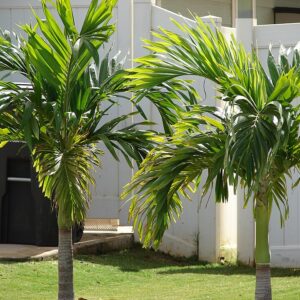
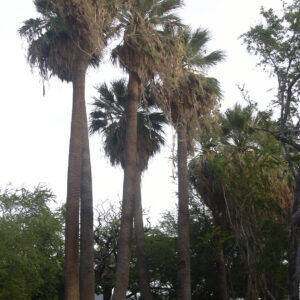
The foliage stays green throughout the year. Each leaf is divided into narrow segments that spread like the ribs of a fan. Fibres from old leaf sheaths remain around the solitary trunk, giving it the distinctive rough surface. Over many years, an outdoor specimen can become a tall palm rather than a compact shrub.
Male and female flowers normally occur on separate plants. Pollinated female plants can produce small dark fruits. Flowers and fruit are part of its life cycle, but the fan leaves and textured trunk are usually what make it attractive in a planting scheme.
Cold tolerance needs context
You may see a minimum temperature of −15°C quoted for this species. The Royal Horticultural Society places it in hardiness category H5, approximately −15 to −10°C under UK growing conditions. That rating is a guide, not a promise that every young plant or pot will survive such temperatures.
Duration of cold, exposure and wet roots all matter. Young plants and containers need particular care in winter. A sheltered site is more useful than relying on a single temperature figure. Strong, cold winds can damage the leaves even where the palm itself survives.
Light, soil and watering
Choose sun or light partial shade and a position protected from harsh winds. Leave enough clearance for the crown and keep it away from narrow passages where leaves would become an obstacle. A palm that must constantly be cut back is usually in the wrong place.
The soil should drain well. Before planting, notice whether water collects in the chosen spot after rain. Improving the growing area or choosing another position is more sensible than expecting a waterlogged hole to become suitable merely because fertilizer was added.
During establishment, monitor moisture and water when needed rather than allowing the root ball to dry repeatedly. An established palm can cope better with dry spells, but it is not a reason to ignore a long drought. In a container, check more often because the available root volume is limited.
Avoid standing water in saucers. If growth is poor, review drainage, light and root conditions before increasing fertilizer. Use a product suitable for palms according to its label instead of combining several fixed feeding schedules.
Using it in a garden design
The upright trunk can anchor a courtyard or a larger border. A simple composition gives the crown room to stand out; a dense collection of unrelated plants often hides its shape. Think about how the view will change as the trunk gains height.
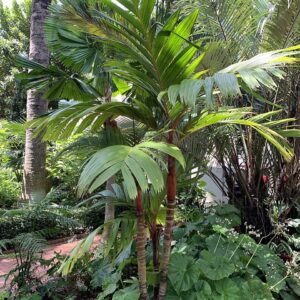
Choose companion plants for compatible light, moisture and climate requirements, not just for a tropical appearance. Shade-loving foliage and sun-loving succulents do not automatically belong in the same irrigation zone. Leave space for maintenance and keep neighbouring plants from crowding the young palm.
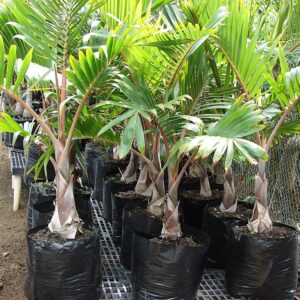
Small specimens can be grown in containers and may suit a very bright indoor position. A conservatory or similarly well-lit space is a more realistic option than a dark decorative corner. Plan ahead for the height and weight of the pot, and do not present the plant as a substitute for ventilation or an air purifier.
Maintenance and propagation
Do not cut the top off to control height: the palm’s growing point must be preserved. Remove dead lower leaves carefully when necessary rather than stripping healthy foliage. Check new plants and existing leaves for signs of pests before deciding on treatment.
Seeds are the practical starting point for propagation. Use correctly identified seed and a suitable seed-growing mix, keeping moisture controlled rather than saturating the container. Germination is variable; a rigid timetable is not a guarantee. Let seedlings develop a sound root system and adapt them gradually before planting out.
Buy nursery-grown plants, keep their identification and check local guidance before planting near natural areas. The best result comes from matching the species to the site, rather than trying to force it into conditions chosen only for appearance.
References and photograph
Kew: taxonomy and distribution; RHS: Trachycarpus fortunei; RHS: hardy palms; Oregon State University: windmill palm.
Photograph: C T Johansson, Trachycarpus fortunei, via Wikimedia Commons, CC BY 3.0. Reduced-resolution version; no crop or other edits.