An attractive nut does not tell the whole story of a tree. Before a new variety reaches an orchard, it must also show that it can yield well and cope with growing conditions. That is the challenge behind research by Embrapa Temperate Climate, in partnership with the Brazilian Pecan Institute (IBPecan).
According to an Embrapa report published on November 14, 2026, the project is following 101 pecan genetic materials. Of these, 22 were considered promising, and three are undergoing more advanced evaluation. This does not mean that new cultivars have already been released or are available from nurseries.
What are the researchers looking for?
The selection brings together productivity, tree health and nut quality. It also considers disease tolerance and kernel yield: the edible portion inside the shell. The aim is to identify material that could lead to cultivars suited to Brazilian growing conditions in the coming years.
Why does evaluation take time?
Research on trees does not end after one good harvest. As an example of the approach, the University of Georgia in the United States maintains pecan selections in experimental orchards and follows the yield and quality of individual trees over several years.
The university points out that no cultivar is perfect: each has strengths and limitations. Long-term monitoring helps separate a consistent trait from an isolated good result. However, recommendations developed in the United States should not automatically be transferred to Brazil.
Planting a pecan does not reproduce the same variety
There is another important distinction for plant enthusiasts. As University of Georgia Extension explains, a tree grown from a nut is not a copy of the tree that produced it. Its characteristics, including nut quality, can differ.
To multiply a cultivar while retaining its identity, growers use grafting: a piece of the selected tree is joined to another plant that supplies the roots. Pollination also matters when choosing cultivars, because a suitable combination of varieties may be needed for good production.
Why does this news matter?
The value lies in developing options tested for Brazil, rather than promising an immediate harvest. The essential distinction is this: promising material is still at the research stage; recommending a cultivar requires evidence gathered over time.
References
Embrapa: pecan research in Brazil · University of Georgia: cultivar evaluation · University of Georgia: seedlings, grafting and pollination.
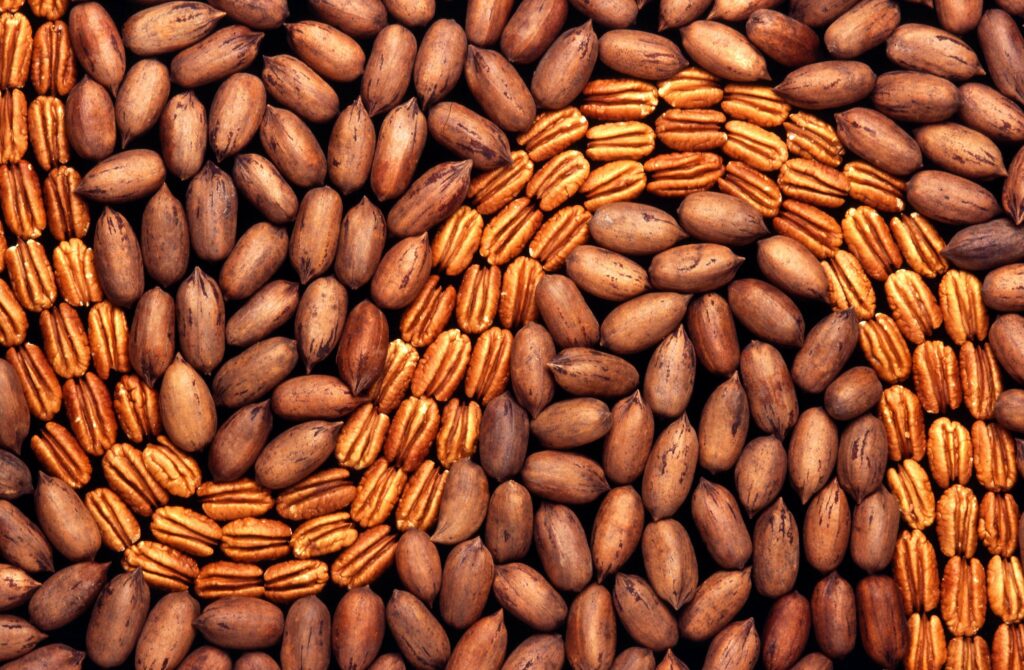
Illustrative cover photograph: Scott Bauer/USDA Agricultural Research Service, public domain, via Wikimedia Commons. It does not show the Embrapa experiment.
