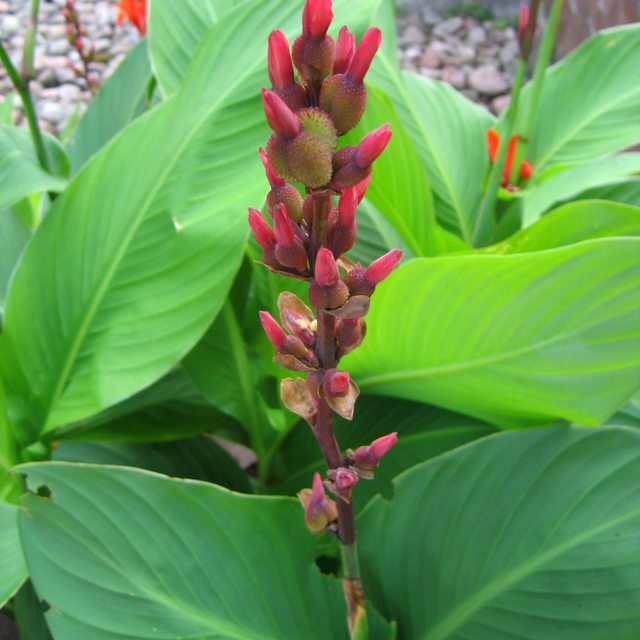
Canna indica makes a bold statement in the garden with broad leaves and flowering stems that rise above the clump. This herbaceous plant grows from rhizomes: storage stems, usually underground, from which roots and shoots emerge. Choose its position with light and space in mind. In a small bed, an unassuming young plant can eventually crowd out shorter neighbours.
Plant profile
Scientific name: Canna indica.
Common names: Indian shot and canna; in Brazil, cana-da-índia and biri. Names vary by region.
Family: Cannaceae.
Origin: tropical America, including Central America, South America and the Caribbean.
Habit: a clump-forming herbaceous perennial with rhizomes.
Size: can reach about 2 m; height varies with the form and growing conditions.
Leaves: broad and green, sometimes with bronze or purplish tones.
Flowers: usually red to orange, clustered at the tops of the stems.
Light: full sun preferred; tolerates some partial shade.
Soil: fertile, moist and well drained.
Propagation: rhizome division or seed.
Is it Canna indica or a garden hybrid?
Check the label before buying: many ornamental cannas are hybrids between species. Division preserves the characteristics of the parent plant. Before propagating, read the precautions about diseased plants below.
Height, flower colour and flower size vary among plants sold as cannas. Choose using reliable identification and the mature size supplied by the grower, not just a photograph of a flower. The photograph in this guide shows leaves and a flower cluster in bud, rather than an open display of flowers.
Where to plant: sunlight and room to spread
At the University of São Paulo garden in Ribeirão Preto, Brazil, canna grows in sunny beds. Its broad foliage and the new shoots emerging from the rhizome explain why it needs room sideways as well as overhead.
Use this habit when planning a bed: place it behind shorter plants or as a focal point without blocking a path. The university records flowering throughout the year, with a stronger display in spring and summer. That is a local observation, not a promise for every climate.
Starting a canna in a pot
A leafless rhizome: cover it lightly with potting mix to start growth, keeping any shoots that have already grown above the surface. Water sparingly at first, then increase watering as leaves and active growth develop. A dormant rhizome does not need the same treatment as a mature plant with a large leaf area.
A growing plant: choose a stable container and a sunny position sheltered from strong winds. Check drainage and monitor moisture. Growing in water requires suitable material: water cannas, many derived from Canna glauca, exist, but that recommendation does not automatically apply to every ornamental canna.
Watering, feeding and repotting
For Canna indica, aim for moist soil with good drainage. Water according to growth and how quickly the mix dries, rather than following a fixed number of days. Check that water can leave a pot; in a bed, take rainfall into account before turning on the hose.
Feeding should suit growing conditions and follow the product instructions, not a universal dose. If the plant has outgrown its container, plan to repot or divide it. Before adding fertiliser to tackle weak growth, check light, moisture and root space.
Removing spent flowers and managing cold weather
Remove faded flowers without cutting off unopened buds. When a flowering stem has no buds left, cut it back to the next side shoot, which may produce another flower cluster.
Where frost occurs, a potted plant can be moved to frost-free shelter. Lifting and storing rhizomes is a strategy for cold climates, not a yearly requirement everywhere. Adapt care to local winter conditions. Divide when growth resumes and the plant has a chance to recover, rather than immediately before frost. A single calendar month does not suit every region or hemisphere.
How to divide the rhizomes
1. Start with a healthy plant. Lift the clump carefully and expose enough of the rhizome to locate the buds, the points from which shoots grow. Do not confuse the fine roots with the storage stem.
2. Plan each cut. Keep two or three buds on each piece. Use a clean cutting tool and do not break the rhizome into small pieces with no growing points.
3. Keep firm material for replanting. Rotten parts must not go into the new batch. Label containers so that you can track the origin and recovery of each division.
4. Replant and observe. Follow the plants’ development before giving divisions away. A piece is not necessarily healthy simply because it has started to sprout.
Problems: what to check before treating
A deteriorating base or rotting rhizome: fungi and bacteria can be involved in rot. Do not merely hide damaged tissue under fresh soil. Examine the plant, separate affected specimens and never propagate from deteriorated rhizomes.
Irregular light and dark markings, weak growth or altered flowering: these signs need investigation. Photograph both young and old leaves and seek technical advice before applying a product. The next section explains precautions when a virus is suspected.
An overcrowded clump: renewing the planting may improve vigour, but it will not cure a disease already present in the material used for new plants.
Can a plant with a suspected virus be saved?
Do not distribute its divisions. Virus-affected cannas may show mottling, streaks, twisted leaves and reduced vigour. There is no treatment that eliminates a virus from the plant. Have the suspicion assessed; if confirmed, replace affected material with healthy rhizomes.
Keep new acquisitions separate while observing their health. This precaution is more useful than immediately adding every new plant to the collection.
Will seedlings be identical to the parent?
Not necessarily. Seedlings from hybrid cannas may have flowers that differ from the parent’s. Division is the usual way to reproduce a cultivar, provided the plant is healthy. That does not guarantee the identity of a plant sold only under a common name.
Sources
North Carolina State University; Royal Horticultural Society: Canna indica; Oklahoma State University: canna viruses; University of São Paulo: canna; RHS: growing cannas; Oklahoma State University: propagation; Texas A&M University: canna diseases; University of Massachusetts: canna viruses. General propagation guidance is presented without assuming that a temperate-climate calendar applies everywhere.
Photograph of Canna indica with a flower cluster in bud: Arz / Wikimedia Commons, CC BY-SA 3.0. Square crop, resizing and JPEG compression; adapted image shared under the same licence.
