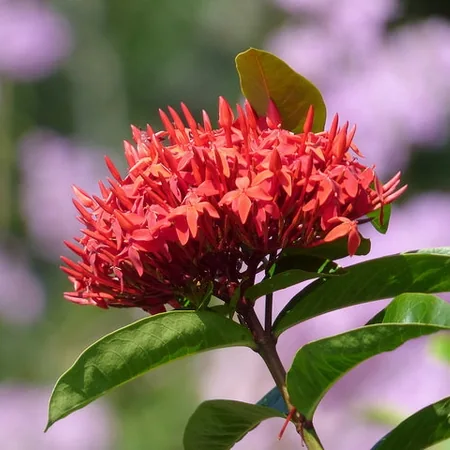
Ixora draws attention with rounded clusters of small flowers set against glossy green leaves. This tropical shrub works in groups or as a specimen plant. Before choosing one, check both its identity and the eventual size of its cultivar, or cultivated variety: the common name covers plants with different sizes and flower colours. For a well-planned display, mature height and pruning needs matter just as much as the flowers.
Plant profile
Scientific name: Ixora coccinea.
Common name: Ixora.
Family: Rubiaceae, the same botanical family as coffee.
Type: A perennial, evergreen shrub with woody branches.
Origin: Parts of India, Sri Lanka, Bangladesh and Indochina.
Size: Varies between cultivars; check whether the plant is a compact form or a larger-growing variety.
Leaves: Simple, firm-textured and glossy.
Flowers: Tubular flowers held in dense clusters at the ends of branches.
Colours: Cultivars may have red, orange, pink, yellow or white flowers.
Uses: Edging, hedges, specimen planting and containers, particularly with compact cultivars.
Propagation: Usually from cuttings.
Light, soil and room to grow
Plant in a sunny position to encourage flowers. Ixora tolerates some shade but flowers best with good sun exposure. The soil needs to be acidic, moist and well drained. Before planting a hedge, confirm the cultivar’s mature size: a small plant in a nursery pot is not necessarily a dwarf variety.
Do not choose its space solely for the flower colour. A large cultivar in a narrow bed needs repeated trimming, which reduces its floral display. Compact forms make container care easier.
Planting in a garden bed
1. Moisten the root ball and carefully remove the container. Avoid breaking apart roots that are already well arranged.
2. Loosen an area wider than the root ball. The planting hole should be no deeper than the roots.
3. Position the plant without burying the base of the stems. The top of the root ball should sit level with the soil surface.
4. Backfill, firm gently without over-compacting and water.
For the first few weeks, check moisture near the root ball, not just the surface appearance. Both insufficient water and poor drainage hinder establishment. If using organic mulch, keep it clear of the stem bases. Do not place concentrated fertiliser at the bottom of the hole to try to speed up establishment.
Watering and repotting
Check the growing medium before watering. Aim for moisture without saturation, avoiding swings between extreme dryness and waterlogging. Heat, wind and pot size affect water demand. Blocked drainage holes or compacted mix need attention, not more watering. When roots fill the container and growth loses vigour, consider repotting or refreshing the growing medium.
Yellow or blackened leaves: where to start
Yellowing young leaves: Ixora can develop chlorosis, or yellowing, in alkaline soil because iron and manganese become harder for the plant to obtain. Pay particular attention to plants beside concrete and foundations. Assess the soil before choosing amendments or fertilisers; leaf colour alone does not identify a product or dose. Our guide to yellow leaves on plants explains why checking the growing conditions comes first.
A black coating on leaves: Sooty mould may accompany aphids and scale insects. Look for insects on the leaves and branches instead of treating the blackening as the whole problem. Identification helps avoid unnecessary applications.
Pruning and flowering
If flowers are the priority, avoid continually trimming every shoot tip to maintain a rigid geometric shape. Plan for the shrub’s size when buying and make only the adjustments needed. If flowers are scarce, first review its sunlight and pruning history. Fertiliser cannot make up for too little light or repeated removal of flowering shoot tips.
How to propagate ixora from cuttings
Start with semi-ripe cuttings, which have a firm base and a still-young tip. Use healthy shoots and a clean, sharp tool:
1. Cut a section of shoot just below a node, the point where leaves emerge.
2. Remove lower leaves that would be buried, leaving some at the top.
3. Insert the base into a container of free-draining rooting mix. Water and let the excess escape.
4. Keep the cutting warm and bright, out of direct sunlight. A transparent cover may help retain humidity, but check it regularly to avoid overheating and excessive moisture.
5. Remove dead or diseased cuttings. Once they have rooted well, gradually acclimatise the young plants to their growing environment.
A new shoot does not prove that roots have formed. Check that a cutting has rooted and can support itself before planting it in a bed. In research at Brazil’s Federal University of Lavras, approximately 10 cm tip cuttings of dwarf ixora responded differently depending on the growing medium and environment. Assessment took place after 100 days. That experimental result is not a guaranteed timetable for a home garden.
Another Brazilian study, published by the Federal Institute of Minas Gerais, found good performance from semi-ripe cuttings in a mixture of sugarcane bagasse and vermiculite, without stimulants in that treatment. The practical lesson is to prioritise healthy material, a suitable medium and the right environment. Rooting hormone does not replace those conditions, and a recipe tested in a greenhouse does not automatically transfer to every cultivar or garden.
Common questions
Does ixora tolerate frost? It is frost-sensitive. In cold regions, a container allows it to be moved to suitable shelter. Indoors, it still needs plenty of light.
Does it flower all year? It can flower over extended periods under favourable conditions. That is not guaranteed in every climate. Observe its response to local weather, light and care.
Sources
Royal Botanic Gardens, Kew: accepted name and origin.
North Carolina State University: identification and cultivation.
University of Florida: ixora soil, size and pruning.
University of Florida: cold, flowering and signs of problems.
RHS: general shrub-planting technique.
RHS: preparing and caring for semi-ripe cuttings.
UFLA and collaborators: Brazilian research on rooting dwarf ixora.
Federal Institute of Minas Gerais: dwarf ixora rooting and growing-media study.
Photo: Alejandro Bayer Tamayo, via North Carolina State University, CC BY-SA 2.0. Square crop and WebP conversion without upscaling; adapted image distributed under the same licence.