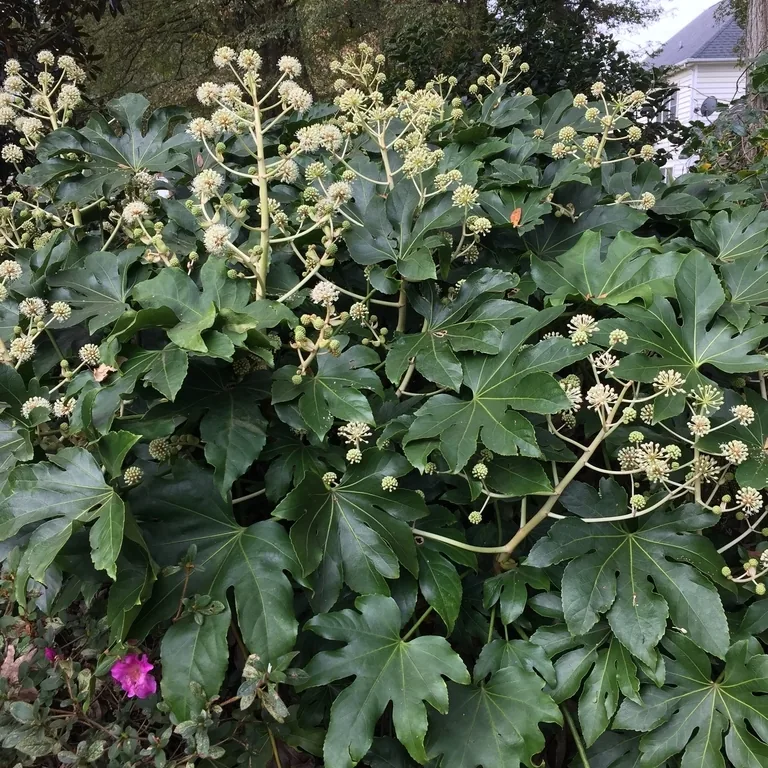
Fatsia, also called Japanese aralia, creates a focal point with large, glossy leaves divided into lobes like an open hand. Its tropical appearance suits shady gardens and sheltered patios. Although often sold as a houseplant, it is a shrub capable of substantial growth. Planning space from the start helps you enjoy its natural shape without frequent pruning.
Plant profile
Scientific name: Fatsia japonica.
Family: Araliaceae.
Origin: eastern Asia, including Japan and Korea.
Life cycle: perennial, with evergreen foliage.
Habit: rounded, spreading shrub.
Size: often 2–3 m in gardens, sometimes taller.
Light: partial shade or bright shade.
Soil: fertile, rich in organic matter and well drained.
Propagation: cuttings and seed.
Uses: a focal point in shade gardens and large containers.
Choosing a position
Choose a spot sheltered from strong winds, which can damage the leaves. Partial shade usually provides good growing conditions. Intense sun, especially combined with wind or insufficient water, can spoil the foliage. Before planting beside a wall or path, allow for the shrub’s future width.
Indoors, choose a bright, cool, ventilated room. Smaller cultivars may be more suitable than large-growing forms. Avoid pressing leaves against windows or furniture.
Soil, water and feeding
In the garden, incorporate organic matter when preparing the bed and maintain drainage. Newly planted specimens need careful watering while establishing. Adapted plants may tolerate drier periods, but a new plant does not yet have the same resilience.
In a pot, the water reserve is limited and requires more frequent checks. Test moisture below the surface before watering, and do not leave water standing in an outer decorative pot. Feed during growth according to the product instructions and container size. Avoid responding automatically to yellow leaves with fertiliser without investigating roots and moisture.
Maintenance and growth
Continuous pruning is unnecessary. Remove dead or damaged branches and plan any size reduction to preserve a balanced shape. Clean tools before cutting and inspect leaves and new growth for mealybugs and scale insects, aphids or mites.
Pale flowers appear in rounded clusters and may be followed by dark fruit. Timing varies with climate; European references should not be turned directly into a calendar for another region.
Propagating fatsia
Stem cuttings help preserve the features of variegated cultivars. Use healthy stems and clean tools, remove leaves from the section that will be buried, and insert the base into a well-drained propagation medium. Maintain moisture without saturating the mix. Rooting has no guaranteed deadline; transplant only after roots have formed.
Common questions
My fatsia is wilting. Does it need more water? Not necessarily. Too little and too much water can cause similar symptoms in potted plants. Feel the mix below the surface and check drainage holes and the outer pot before watering again. If the mix remains waterlogged, adding water may worsen the problem.
Can it stay in a small pot forever? The shrub naturally grows. Container cultivation requires monitoring roots, stability and available space.
Does every fatsia have green leaves? No. Alongside green forms, there are cultivars with white or yellowish markings.
Is it a food plant? Do not use it as food. NC State identifies it as non-toxic to dogs, cats and horses, but this is not permission to feed it to animals and does not replace veterinary advice if symptoms occur.
Sources
University of Florida: Fatsia japonica.
University of Arizona: Fatsia japonica.
University of Florida: propagation techniques.
Clemson Extension: watering houseplants.
North Carolina State University.
Royal Horticultural Society: growing fatsia.
Royal Horticultural Society: characteristics.
Photograph: Stacy Hodes, CC BY 4.0. Cropped to 1:1 and compressed to WebP without enlargement.