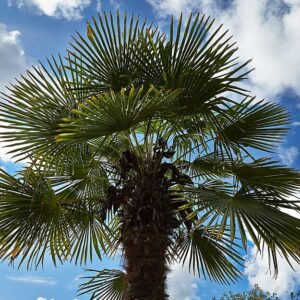
The Chinese fan palm (Livistona chinensis) is easy to recognise once you notice the leaf tips: they hang from the edge of each fan, giving the crown a fountain-like outline. A young plant can look compact, but choosing it for a garden requires more than admiring its foliage. Mature size, prickly leaf stalks and the possibility of spreading beyond cultivation all matter.
Know the palm you are choosing
This is a single-stemmed member of Arecaceae. Kew records its native range in East Asia, from Japan to China. The common name fountain palm refers to its hanging leaf segments, not to a need for permanently flooded soil.
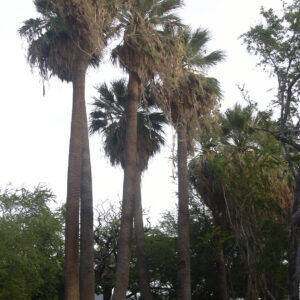
The NParks profile describes a dense canopy of green fan leaves and a solitary brown trunk. Allow for a tree rather than a permanent low accent: the RHS gives a mature height of 8–12 m and spread of 2.5–4 m. Actual size depends on growing conditions.
Check its environmental suitability first
In Florida, the UF/IFAS assessment calls for caution and management to prevent escape into natural areas. In Brazil, the National Museum’s Botanical Garden at UFRJ reports invasive behaviour within its own grounds. These are geographically specific observations, not evidence of a blanket ban throughout Brazil or every country.
Before buying, check local invasive-species guidance and planting rules. Near native vegetation or a sensitive watercourse, a locally suitable native palm may be a better decision. If this species is already present, watch for seedlings outside the intended bed and discuss responsible management with local horticultural or environmental advisers. Ornamental value does not cancel ecological risk.
Space, light and the planting site
Full sun or light shade can suit this palm. Do not turn that flexibility into a universal promise that a dark room will work. The RHS recommends bright conditions for container cultivation; a conservatory and a dim living room are very different environments.
Young leaf stalks carry spines. Keep them away from narrow walkways and places where children or people maintaining a pool will brush past. Do not rely on a generic “non-invasive roots” label to choose a distance from walls, pipes or pool structures: consider the mature crown, access for maintenance and the actual construction.
Use a site with suitable drainage. UF/IFAS planting guidance recommends accommodating the root ball without burying the palm deeper than it previously grew and does not recommend amending the backfill. For a young container plant, keep the root ball intact, position it upright, backfill carefully and water to settle the soil. Large specimens require professional handling.
Water and feeding without a rigid calendar
A newly planted palm needs attention while its roots establish. Check the soil as well as the weather; a fixed number of weekly waterings cannot account for rain, heat, drainage and container size. In a pot, excess water must be able to leave the drainage holes. The RHS recommends moist but well-drained conditions and less water during slower winter growth in protected cultivation.
Treat fertilising as a response to the growing conditions, not a way to force rapid growth. Follow a suitable product’s label and seek a diagnosis when foliage changes colour. Do not add lime, sulphur or extra fertiliser solely because an online guide lists an ideal pH or routine dose.
Pruning: keep a full, living crown
Remove fully dead leaves when needed, but keep healthy green fronds. UF/IFAS pruning advice also warns against removing yellowing leaves prematurely: they may still supply nutrients and help identify a deficiency. Avoid cutting the trunk or pulling attached leaves loose; hire a qualified professional for work at height.
The UF/IFAS species account notes that potassium deficiency can damage older leaves, and that this palm is not immune to serious diseases. Persistent decline, damage at the trunk base or rapid crown deterioration deserves assessment rather than automatic pesticide treatment. A tidy appearance is not a substitute for plant health.
Seeds and responsible propagation
This solitary palm is propagated by seed, not by dividing its trunk. The UFRJ profile describes germination from fresh seed, but nursery conditions and seed quality influence the result. Check local environmental suitability before producing more plants. Birds and small mammals can disperse its fruits, one reason garden seedlings deserve attention.
Cover photo: Cookie / Wikimedia Commons, CC BY-SA 3.0. Photographed at Huerto del Cura. Cropped version; the image remains under the same licence.