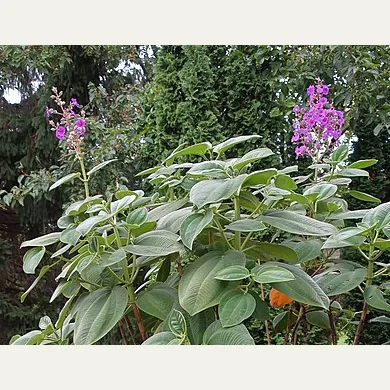
Known in cultivation as Tibouchina heteromalla, this species combines velvety leaves with violet flowers. The contrast between its foliage and blooms makes it a striking feature in garden beds and roomy containers.
Plant profile
Scientific name accepted by the Royal Botanic Gardens, Kew: Pleroma heteromallum (D.Don) D.Don.
Synonym: Tibouchina heteromalla (D.Don) Cogn.
Family: Melastomataceae.
Type: shrub.
Origin: South America, including Brazil.
Light: a sunny position.
Soil: moist and well drained.
Foliage, size and uses in the garden
The velvety leaves, with their prominent veins, remain attractive even without flowers. The flower clusters, called inflorescences, grow at the tips of the branches and carry violet, five-petalled flowers. Embrapa describes a well-branched shrub, usually 1–3 m tall; a floristic study by the Federal University of Juiz de Fora recorded specimens ranging from 0.5 to 4 m. Do not plan a bed around the size of the young plant alone.
Use this species as a focal point, in groups or in a spacious container. Rutgers University includes it among the focal plants used in container arrangements. Choose a position where the leaves and flowers can be seen without constant trimming to keep a path clear.
Sun, climate and choosing a location
For cultivation, choose full sun. Singapore’s National Parks Board recommends fertile, moist, well-drained soil. Although Brazilian research records the species in partially shaded habitats, this does not guarantee equally good flowering in a dark corner of the garden.
Embrapa warns that the plant is sensitive to severe frost. Where this is a risk, choose a sheltered position and plan protection for container-grown plants. Do not automatically apply advice from a tropical region to a garden with harsh winters. Local conditions should guide both planting and pruning.
Planting and transplanting
Moisten the root ball before removing the original pot. Plant in a hole wider than the roots, without burying the root collar, the point where the stem meets the roots. Backfill, firm gently and water. Avoid planting in waterlogged soil.
For container growing, choose a stable pot with drainage holes and room for growth. Consider repotting when the roots fill the pot or the growing medium loses its structure. Check moisture levels after rain as well.
How to adjust watering
The aim is to keep the root zone moist while allowing water to drain properly. The institutional plant profile indicates moderate water needs, not permanent waterlogging. Watering daily or weekly is not a universal rule: heat, wind, rain and container size all affect how quickly the growing medium dries. If in doubt, check it before adding more water.
Pruning and flowering
Embrapa places the main flowering period in spring and summer. Timing and intensity can vary by location, so it is worth recording when your plant forms buds and flowers. Because these appear at the ends of the branches, indiscriminate trimming of a plant in bud can remove the flowers that were about to open.
For routine maintenance, start with dead or damaged branches and those that spoil the shrub’s shape. If flowers or buds are present, postpone shaping until flowering has finished. In cold areas, wait until the risk of frost has passed before making cuts that encourage new growth. These are general principles for pruning evergreen shrubs, not a recommendation to cut the plant back by half every year.
After flowering, small capsules may form and release seeds when mature. They are part of the species’ life cycle, not edible fruit. For home propagation, the sources consulted provide more direct technical guidance on cuttings.
How to propagate from cuttings
Cuttings are the propagation method highlighted by Embrapa, which recommends taking them after flowering. Brazilian studies have also examined cuttings taken in different seasons. This does not remove the need to control water loss before roots have formed.
1. Choose young, healthy material. Take healthy shoots with a clean, sharp tool and remove any flowers or buds. As a research example, not a mandatory recipe for home use, a study by the Federal University of Paraná (UFPR) used juvenile shoots cut into small segments, called mini-cuttings, approximately 5 cm long, retaining one pair of leaves cut in half. Do not confuse this material with thick, old branches.
2. Set the cuttings to root. Use a container with drainage holes and a moist, porous growing medium. Insert the base, keeping the leaves clear of the growing medium and neighbouring cuttings. In the study published in Ornamental Horticulture, the mini-cuttings were planted in vermiculite and kept in a greenhouse.
3. Manage the rooting environment. General propagation guidance from the University of Nebraska recommends a transparent cover to help maintain humidity around the leaves. Place the cuttings in bright light, out of hot, direct sun. If there is heavy condensation, remove the cover temporarily to ventilate. Check the growing medium before watering again: it should not be saturated.
4. Move the plants after rooting. Transfer rooted cuttings to individual containers, keeping them at the same depth. Before planting in a bed, acclimatise them gradually: start with short periods in a sheltered spot and slowly increase exposure. Do not use timelines for other species to decide whether a young plant is ready.
Is a rooting hormone necessary? The 2019 study achieved high rooting rates without needing the growth regulators tested. It used mini-cuttings from plants maintained for that purpose and controlled conditions; the result does not promise a particular success rate at home. There is no reason to turn experimental doses into a home recipe.
Frequently asked questions
Has Tibouchina heteromalla changed its name? Pleroma heteromallum is the name currently accepted by Kew. Tibouchina heteromalla remains useful when looking for the species in nurseries and earlier publications.
Is it found only in Brazil? Not according to Kew’s current definition of the species, which includes other South American countries. Older references may give a more restricted distribution.
Why is it not flowering? First check the light levels, the plant’s usual flowering season and whether recent pruning removed tips with buds. Also confirm its identification: the Brazilian common name quaresmeira can refer to different species.
Can it stay in a small pot? Growing it in a pot does not stop it being a shrub. Allow space for the canopy and root growth, and monitor when it needs a larger container.
Sources consulted
Royal Botanic Gardens, Kew: scientific name and distribution
Embrapa: orelha-de-onça, flowering, cuttings and frost sensitivity
Federal University of Juiz de Fora: description and observed habitats, p. 107
Singapore National Parks Board: light, soil and cultivation of Pleroma heteromallum
Federal University of Paraná: research on rooting by Leandro Porto Latoh, 2019
Latoh, Gomes and Zuffellato-Ribas: mini-cutting study, Ornamental Horticulture, 2019
Rutgers University: arranging plants in containers
Royal Horticultural Society (RHS): general principles for planting shrubs
Royal Horticultural Society (RHS): general container care
University of Nebraska–Lincoln: preparing cuttings, rooting conditions and acclimatisation
Royal Horticultural Society (RHS): principles for pruning evergreen shrubs
Photo: cultivar413, CC BY 2.0. Cropped to retain the upper area and exclude Fuchsia, with neutral borders added for a 1:1 format; WebP compression, without upscaling.