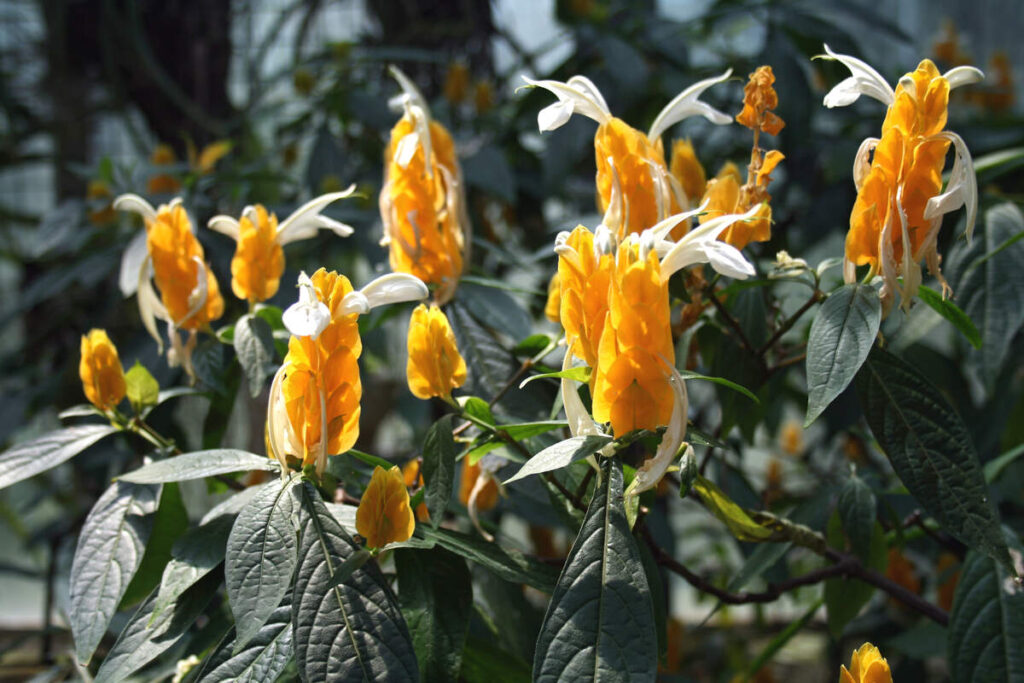
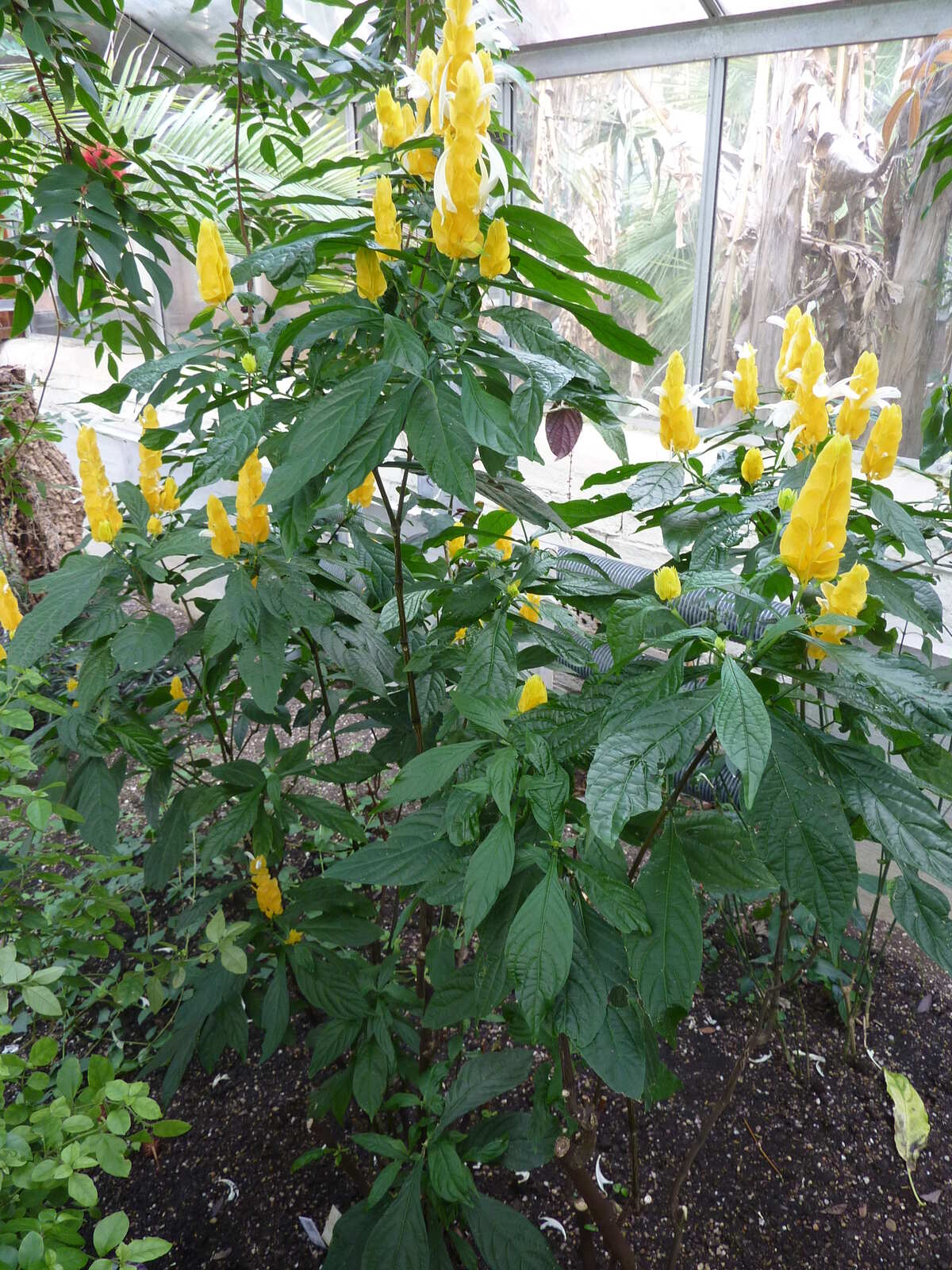
A golden shrimp plant is hard to overlook: upright yellow spikes stand above dark green leaves, with small white flowers emerging between them. Pachystachys lutea, also called lollipop plant or golden candle, brings that contrast to borders and large pots without becoming a tree.
It is a tropical shrub in the Acanthaceae family. Kew places its native range from Peru to northern Brazil. That does not mean every garden in Brazil, or elsewhere, offers suitable conditions: light, drainage and winter temperatures still determine how well it grows.
The yellow parts are not the flowers
The overlapping yellow structures are bracts: modified leaves surrounding the narrow, white flowers. They form a four-sided spike above the foliage. Look closely and you can see the individual flowers projecting from the yellow background, rather than a single large yellow bloom.
The University of São Paulo’s botanical garden describes visits by hummingbirds and butterflies, attracted by nectar. In warm conditions flowering can continue for much of the year; in cooler regions it is more seasonal. Mature plants may form small seed capsules, even though the fruit is not their ornamental attraction.
Choose the position before planting
Allow for a shrub around a metre tall, sometimes taller in favourable conditions. It works as a small hedge, in groups, or as a backdrop to lower plants. A container is useful when winter protection is needed. Do not choose a cramped permanent pot simply because the young plant is small.
Full sun to partial shade can work. In hot locations, morning sun with protection from the strongest afternoon heat is a sensible starting point. A very dark indoor corner is a poor place to expect sustained flowering. Protect the plant from frost; where winters are cold, treat it as a seasonal outdoor plant or move the pot to a bright, sheltered space.
Provide fertile soil that stays moderately moist but drains freely. In pots, drainage holes are essential. Check the growing medium before watering rather than following a fixed weekly timetable: a sunny container and a shaded bed will not dry at the same speed.
Avoid leaving the root ball waterlogged. During active growth and flowering, keep moisture reasonably even; when growth slows in cooler weather, water less. Feed during the growing season using a product appropriate for ornamental plants and its label instructions. More fertiliser is not a substitute for better light or drainage.
Pruning and propagation
Older stems can become bare near the base. Pinching growing tips encourages branching, while pruning helps renew a leggy plant. Schedule substantial pruning for the start of active growth rather than just before cold weather, and expect a pause while new shoots develop.
Softwood or semi-ripe stem cuttings are a practical way to propagate it. Use healthy material and clean tools, and keep cuttings in a suitable rooting medium with moisture but not stagnant water. A newly rooted cutting needs time to establish before being treated like a mature shrub.
Watch the leaves, not just the flowers
Check new plants and the undersides of leaves for aphids, whiteflies, scale insects, mealybugs and mites. Identify the problem before choosing treatment. Do not assume any garden insecticide is suitable, or that a product described as natural is harmless to pollinators. Follow the authorised uses and precautions on its label.
This is an ornamental growing guide, not a recommendation to eat the plant or prepare home remedies. The sources below do not establish a safe culinary use.
Usamos cookies em nosso site para fornecer a melhor experiência de uso, lembrando suas preferências e visitas repetidas. Ao clicar em “Aceitar”, concorda com a utilização de TODOS os cookies.
Este site usa cookies para melhorar sua experiência enquanto você navega pelo site. Destes cookies, os cookies que são categorizados como necessários são armazenados no seu navegador, pois são essenciais para o

funcionamento das funcionalidades básicas do site. Também usamos cookies de terceiros que nos ajudam a analisar e entender como você usa este site. Esses cookies serão armazenados em seu navegador apenas com

o seu consentimento. Você também tem a opção de bloquear esses cookies. Porém, a desativação de alguns desses cookies pode afetar sua experiência de navegação.
Os cookies necessários são absolutamente essenciais para o funcionamento adequado do site. Esta categoria inclui apenas cookies que garantem funcionalidades básicas e recursos de segurança do site. Esses cookies não armazenam nenhuma informação pessoal.
Quaisquer cookies que possam não ser particularmente necessários para o funcionamento do site e sejam usados especificamente para coletar dados pessoais do usuário por meio de análises, anúncios e outros conteúdos incorporados são denominados cookies não necessários. É obrigatório obter o consentimento do usuário antes de executar esses cookies no seu site.