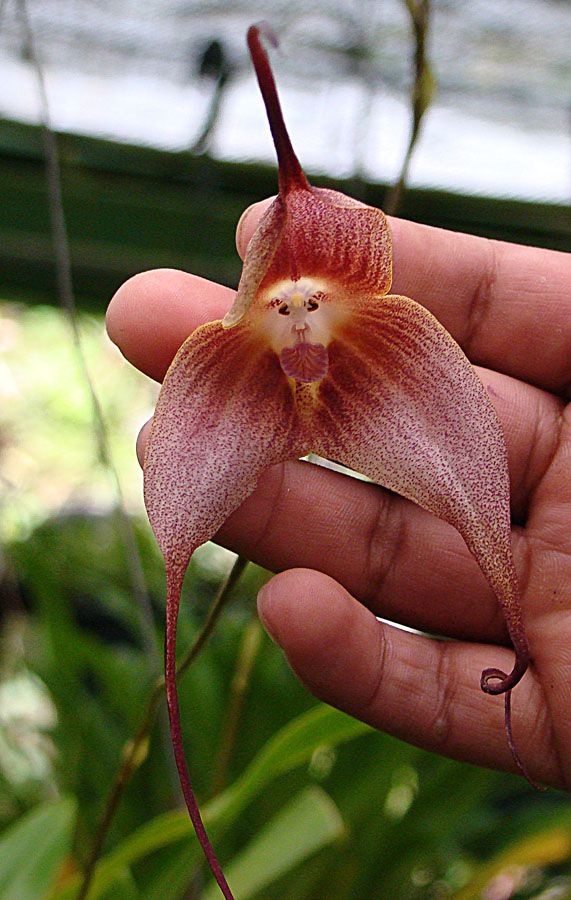
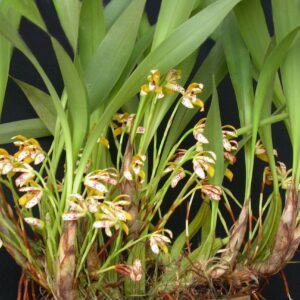
Some Dracula orchids seem to look back at us. The markings and shapes in their flowers can suggest a small face, which explains the popular name “monkey orchid”. That resemblance is a human interpretation, not a reliable way to identify a species. Before buying one, it is worth looking beyond the photograph and understanding the plant behind it.
Dracula is a genus, not one monkey-faced flower
Dracula simia is an accepted species native to southeastern Ecuador, according to Kew. Other members of the genus have different flowers, habitats and growing requirements. A picture of D. vampira, for example, should not be labelled as D. simia simply because both look unusual.
Keep the scientific name on the nursery label. Common names help us talk about a flower, but they can conceal important differences. A photograph shared without a source is a starting point for curiosity, not enough evidence for a purchase or a care plan.
The flower’s appearance has a purpose beyond resemblance
Research on Dracula lafleurii, described in a 2016 scientific paper, investigated how the flower resembles mushrooms in shape, colour and scent and attracts mushroom-associated flies. The researchers separated visual and scent signals using realistic three-dimensional models. This was work on a named species, not proof that every Dracula has exactly the same pollination system.
The University of Oregon’s account explains the role of the mushroom-like lip: a visiting fly can pick up a packet of pollen and carry it to another flower. What looks like a face to a person can communicate something very different to an insect. That is a more useful biological explanation than assuming the flower evolved to resemble a monkey.
A cool, humid habitat is not the same as a sealed wet box
Kew’s profile of D. vampira describes cool Ecuadorian cloud forests. At Kew, this species is grown on cork bark with moss around the roots, high humidity and shade. The example shows why the growing environment matters; it should not be copied as a universal recipe for every species or home.
Before obtaining a plant, check whether you can maintain suitable conditions during the hottest part of the year, not just on a comfortable day. Measure the space where the plant will live and discuss the exact species with a specialist nursery. An attractive terrarium is not automatically a suitable environment.
Leave space for the flowers and air for the roots
In Growing Draculas, published by the American Orchid Society, experienced grower Wolf Wanninger describes mesh pots and baskets that let downward-growing flower stems emerge. He also stresses air circulation and protection from direct sun, particularly in warm weather. Container choice is part of cultivation, not simply decoration.
Check how your container holds moisture and where its flower stems can grow. Do not pack it into an arrangement that blocks inspection or airflow. Watering should respond to the condition of the plant and medium, not an inflexible instruction to water a certain number of times each week.
Read the living plant before reaching for scissors
Do not remove a green flower stem merely because one flower has faded. Kew records sequential flowers on a single inflorescence in D. vampira. First establish whether the stem is still living and whether the species can flower again from it. The same caution applies to dividing a small plant: seek species-specific advice before an irreversible cut.
Choose nursery-propagated stock with clear identification. If the appeal is simply seeing an extraordinary bloom, a botanical collection can be a better introduction than buying a demanding orchid before its environment is ready. Appreciating the flower and understanding its habitat belong together.
Dracula vampira, a different species from the cover photograph. Eric Hunt, Wikimedia Commons, CC BY-SA 3.0; reduced image.
Explore another unusual orchid in our white egret orchid guide. Its seasonal requirements are different, a reminder not to treat all orchids alike.
Photograph credits
Cover: Dracula simia, photographed by Dick Culbert in cultivation in Panama. Original photograph, CC BY 2.0, used without visual alteration.
Usamos cookies em nosso site para fornecer a melhor experiência de uso, lembrando suas preferências e visitas repetidas. Ao clicar em “Aceitar”, concorda com a utilização de TODOS os cookies.
Este site usa cookies para melhorar sua experiência enquanto você navega pelo site. Destes cookies, os cookies que são categorizados como necessários são armazenados no seu navegador, pois são essenciais para o

funcionamento das funcionalidades básicas do site. Também usamos cookies de terceiros que nos ajudam a analisar e entender como você usa este site. Esses cookies serão armazenados em seu navegador apenas com

o seu consentimento. Você também tem a opção de bloquear esses cookies. Porém, a desativação de alguns desses cookies pode afetar sua experiência de navegação.
Os cookies necessários são absolutamente essenciais para o funcionamento adequado do site. Esta categoria inclui apenas cookies que garantem funcionalidades básicas e recursos de segurança do site. Esses cookies não armazenam nenhuma informação pessoal.
Quaisquer cookies que possam não ser particularmente necessários para o funcionamento do site e sejam usados especificamente para coletar dados pessoais do usuário por meio de análises, anúncios e outros conteúdos incorporados são denominados cookies não necessários. É obrigatório obter o consentimento do usuário antes de executar esses cookies no seu site.