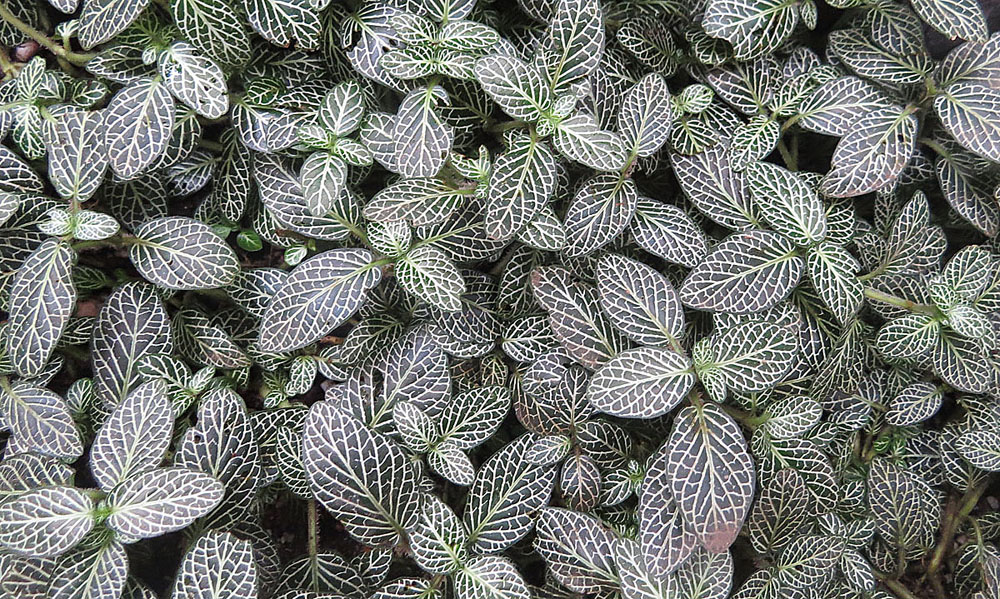
Nerve plant (Fittonia albivenis), also called mosaic plant, is grown for the fine network of coloured veins across its leaves. White, pink or red lines stand out against the green background, giving even a small pot plenty of visual interest. It is a low-growing plant, well suited to a tabletop where the leaf pattern can be seen up close.
This tropical South American species belongs to the Acanthaceae family. Kew records it as native to countries including Peru, Bolivia, Colombia, Ecuador, Venezuela and northern Brazil. Its spreading habit and preference for a sheltered, moist environment help explain both its appeal in terrariums and its difficulties in dry rooms.
A bright place without harsh sun
Place it in bright, indirect light. A position near a window, protected from the strongest rays, is usually more promising than either direct midday sun or a dark shelf. Too much sun can damage the leaves; a dim room should not be mistaken for the filtered light of a forest.
Keep it away from cold drafts and blasts of dry air. A bathroom or kitchen can work if it has suitable light, but the name of the room does not make it automatically suitable. Watch how the plant grows in the chosen position and adjust before leaves deteriorate.
Watering: moist does not mean waterlogged
Check the growing mix regularly and aim for steady, light moisture. When the surface starts to dry, water carefully and allow the excess to escape. The interval will change with the weather, container and growing conditions, so a fixed number of waterings each week is less useful than checking the pot.
Fittonia may wilt dramatically when it dries out and may recover after watering. That is not a care method to repeat deliberately, nor a guarantee that every collapsed plant will recover. If the mix is already wet, adding more water without checking the roots and stems can make matters worse.
Choose a pot with drainage holes and a mix that retains some moisture while allowing air around the roots. Its shallow roots do not need an oversized container. Empty saucers and decorative outer pots after watering instead of leaving the roots immersed.
Humidity and terrariums
A humid environment can make care easier, particularly in a dry home. A terrarium helps retain moisture, but it needs observation rather than automatic watering. Moisture already inside the container reduces the amount you need to add.
Do not put a closed glass container in direct sun. Inspect for deteriorating leaves and mould, and adjust ventilation and moisture if problems appear. A terrarium is a small growing environment, not a permanently sealed ornament that can be forgotten.
Keeping the foliage compact
Pinching soft stem tips encourages a fuller shape. Remove damaged leaves and inspect the stems and leaf undersides for pests. Yellowing, scorched edges or a sudden collapse are reasons to examine the conditions before reaching for fertilizer or pesticides.
Feed lightly during active growth using the label instructions for your chosen houseplant fertilizer. More is not better. A stressed plant with wet roots or inadequate light first needs the underlying problem corrected.
Making new plants from cuttings
Choose a healthy stem and cut below a node, the point where a pair of leaves joins the stem. Remove the lower leaves and place the lower part in a moist, suitable propagation mix. Keep it warm, in indirect light, without allowing the container to become saturated.
New growth is encouraging, but wait for an established root system before frequent handling or repotting. Rooting speed varies; there is no need to promise a fixed number of days or add homemade rooting mixtures. Healthy material and stable conditions are the starting point.
Using fittonia in a planting scheme
A single pot can highlight the leaf pattern without competing ornaments. In mixed containers, choose neighbours with similar light and moisture needs and leave room for their growth. Combining fittonia with a dry-growing cactus in the same substrate makes watering unnecessarily difficult.
Its small flowers are less conspicuous than its foliage. The everyday reward is the mosaic of leaves, best enjoyed in a place where you can notice changes and make small adjustments before a problem becomes serious.
Usamos cookies em nosso site para fornecer a melhor experiência de uso, lembrando suas preferências e visitas repetidas. Ao clicar em “Aceitar”, concorda com a utilização de TODOS os cookies.
Este site usa cookies para melhorar sua experiência enquanto você navega pelo site. Destes cookies, os cookies que são categorizados como necessários são armazenados no seu navegador, pois são essenciais para o

funcionamento das funcionalidades básicas do site. Também usamos cookies de terceiros que nos ajudam a analisar e entender como você usa este site. Esses cookies serão armazenados em seu navegador apenas com

o seu consentimento. Você também tem a opção de bloquear esses cookies. Porém, a desativação de alguns desses cookies pode afetar sua experiência de navegação.
Os cookies necessários são absolutamente essenciais para o funcionamento adequado do site. Esta categoria inclui apenas cookies que garantem funcionalidades básicas e recursos de segurança do site. Esses cookies não armazenam nenhuma informação pessoal.
Quaisquer cookies que possam não ser particularmente necessários para o funcionamento do site e sejam usados especificamente para coletar dados pessoais do usuário por meio de análises, anúncios e outros conteúdos incorporados são denominados cookies não necessários. É obrigatório obter o consentimento do usuário antes de executar esses cookies no seu site.