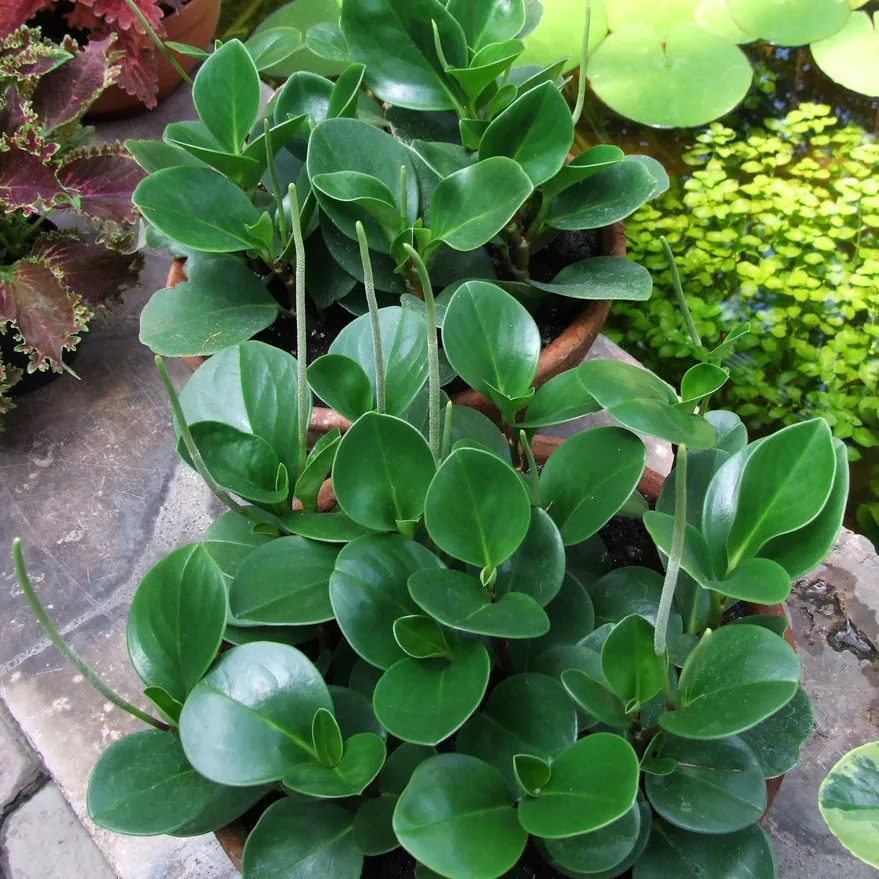
Peperomia obtusifolia, commonly called baby rubber plant, forms a small, branching plant with thick, glossy leaves. It is an option for pots on well-lit tables and shelves.
Plant profile
Scientific name: Peperomia obtusifolia.
Family: Piperaceae.
Native distribution: Florida to tropical America.
Size: approximately 15–60 cm, depending on conditions.
Basic care
It prefers indirect light and good drainage. Avoid intense sun on the leaves and overwatering. Check moisture before watering again instead of setting a rigid schedule. Waterlogging can cause yellowing and root rot. NC State lists leaf and stem cuttings as propagation methods.
Flowers, varieties and maintenance
This peperomia’s flowers do not resemble large garden blooms. The RHS describes narrow spikes with tiny pale flowers. If an elongated structure emerges from the foliage, look before removing it: it may be a normal flower spike.
The species profile says pruning is not usually necessary and recommends frost-free conditions and partial shade. Reported size varies between institutions and growing situations; use the profile’s figures as an approximate guide, not a guarantee of final dimensions.
Variegated forms have areas of different colors on the leaves. The RHS describes ‘Variegata’ with yellowish or yellow-green margins. For that cultivar, it recommends indirect light during growth, moderate watering and monthly balanced liquid fertilizer while active. Cuttings can be taken during favorable growing periods.
Is every yellow leaf variegated? No. Compare it with the pattern on other leaves and the cultivar’s identification, particularly if the change appeared recently.
How to decide when to water
The thick leaves store water, but peperomia should not undergo extreme drought. Feel the mix below the surface and compare the weight of the pot: if it is still damp inside and the pot is heavy, wait before watering again. Once the mix has lost much of its moisture, water slowly until water drains through the holes, then discard what collects in the outer pot. Watch the response and adjust the interval. A dry surface does not guarantee a dry bottom.
Use a container proportionate to the root system and a light mix that does not compact into a solid mass when wet. A hole in the bottom cannot compensate for mix that stays saturated for many days. Do not repot just because you bought the plant: assess root space, mix condition and drainage. When repotting, preserve a healthy root ball and avoid burying the stem bases deeper.
Yellow leaves, spots or wilting: where to start
Yellowing while the pot is still wet: stop automatic watering, check for water trapped in the outer pot and assess drainage. If the stem base is soft or the plant keeps declining, examine the roots. Dark, soft tissue indicates deterioration; adding fertilizer will not restore damaged roots.
Limp leaves with very dry mix: rehydrate the mix and let it drain without leaving the pot submerged. Compare this with root deterioration: either can cause loss of firmness. One leaf alone is not enough to establish the cause.
Spots after moving into strong sun: return the plant to protected light and watch new leaves. Inspect undersides and stem junctions for mealybugs and scale insects, mites and whiteflies. Keep a plant with suspected pests apart from the others and identify the problem before applying products. Do not use concentrated homemade mixtures or insecticides preventively.
Starting a plant from a stem cutting
The species can be propagated from leaves or stems. To start with a stem cutting, select a healthy tip with nodes, the points where leaves emerge. Make a clean cut, remove the leaves from the section to be buried and place the base in propagation mix in a small container with drainage. Keep the remaining leaves above the mix.
Provide indirect light, gentle warmth and enough moisture for rooting without saturating the pot. Do not mechanically apply an adult plant’s routine to an unrooted cutting. Avoid pulling it out to check progress; watch for new growth and transplant only once established. Label the cutting with its name and date to compare results without promising a fixed timetable.
Common questions
Does it tolerate low light? It may tolerate it for a while, particularly in green forms, but this is not the same as ideal conditions.
Is it a miniature rubber tree? No. Despite its English common name, it belongs to a different genus and family.
Usamos cookies em nosso site para fornecer a melhor experiência de uso, lembrando suas preferências e visitas repetidas. Ao clicar em “Aceitar”, concorda com a utilização de TODOS os cookies.
Este site usa cookies para melhorar sua experiência enquanto você navega pelo site. Destes cookies, os cookies que são categorizados como necessários são armazenados no seu navegador, pois são essenciais para o

funcionamento das funcionalidades básicas do site. Também usamos cookies de terceiros que nos ajudam a analisar e entender como você usa este site. Esses cookies serão armazenados em seu navegador apenas com

o seu consentimento. Você também tem a opção de bloquear esses cookies. Porém, a desativação de alguns desses cookies pode afetar sua experiência de navegação.
Os cookies necessários são absolutamente essenciais para o funcionamento adequado do site. Esta categoria inclui apenas cookies que garantem funcionalidades básicas e recursos de segurança do site. Esses cookies não armazenam nenhuma informação pessoal.
Quaisquer cookies que possam não ser particularmente necessários para o funcionamento do site e sejam usados especificamente para coletar dados pessoais do usuário por meio de análises, anúncios e outros conteúdos incorporados são denominados cookies não necessários. É obrigatório obter o consentimento do usuário antes de executar esses cookies no seu site.