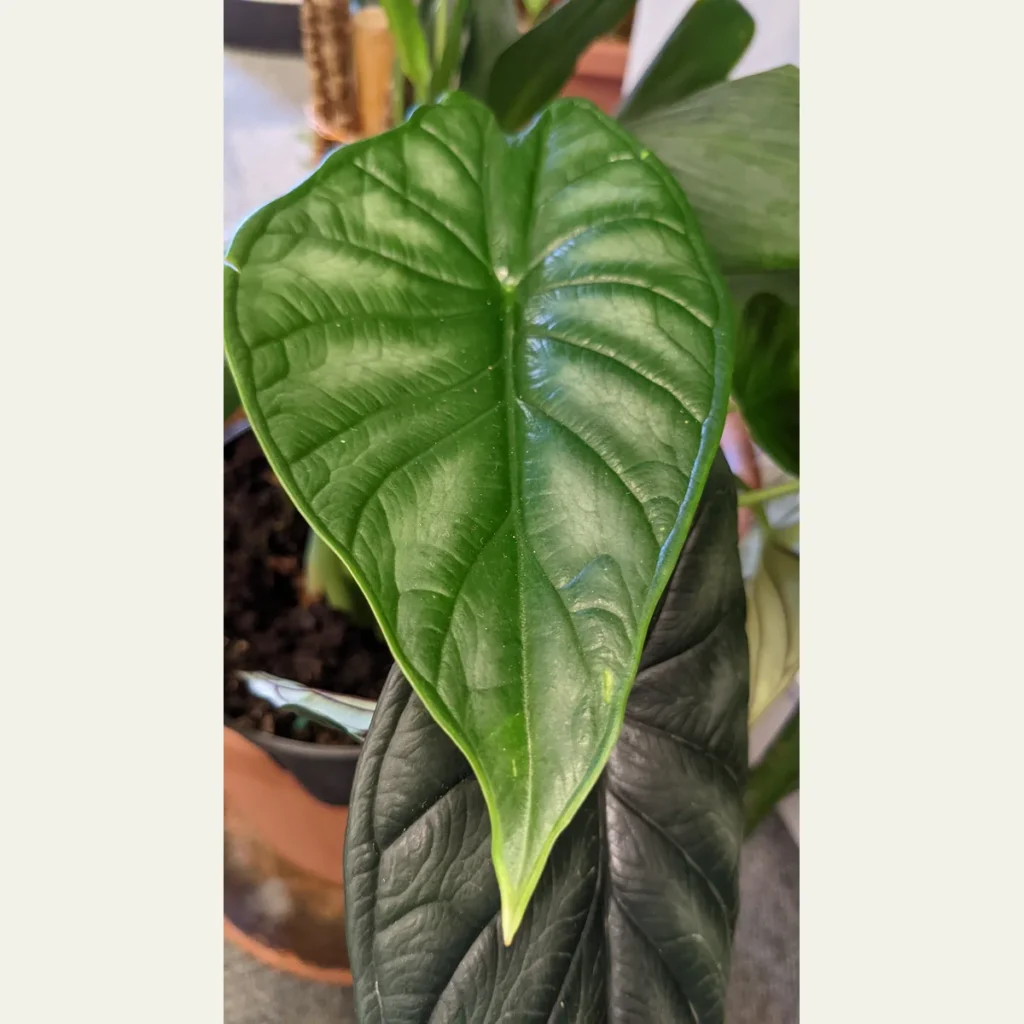
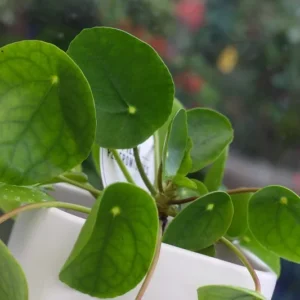
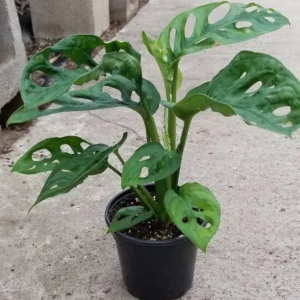
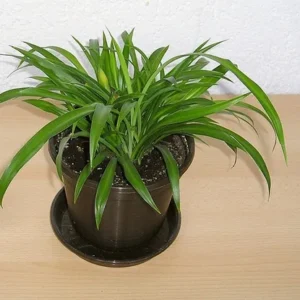
Alocasia baginda is a compact species prized for thick leaves and the contrast between their veins and surface. Commercial names are no substitute for botanical identification.
Plant profile
Scientific name:Alocasia baginda.
Family: Araceae.
Origin: Borneo, in the Kalimantan region.
Described size: approximately 25–30 cm.
Growing conditions
As general guidance for alocasias, provide warmth, humid air and plentiful indirect light. Use a freely draining mix and avoid harsh sun and cold draughts. Adjust watering to activity: when growth slows, water demand may fall too. Do not keep the pot waterlogged.
Identification and repotting
Kew accepts Alocasia baginda as a species and distinguishes it from relatives with similarly thick leaves. Resemblance to Alocasia melo or other compact alocasias does not make their names interchangeable. When buying, choose a plant with reliable identification and information about its cultivated origin.
The RHS growing guide for alocasias recommends repotting into a container only slightly larger, avoiding excessive growing medium around the roots. A houseplant mix can have suitable mineral material added to improve drainage. There is no need to repot every newly bought plant immediately; assess its development first.
When choosing a plant, look for leaves without major damage and check for pests. Protect it from cold during transport. These are genus-level recommendations, not a performance trial specifically for A. baginda.
Must it lose all its leaves in winter? Do not treat this as inevitable in every climate. The RHS describes dormancy in alocasias under temperate conditions; observe how your own plant actually responds.
Yellow leaves: look at the whole picture
One yellow leaf does not identify a cause. North Carolina State University’s guidance for the genus links yellowing to too little or too much water and unsuitable light. Before changing watering, inspect the mix, drainage and recent environmental changes. Wilting in still-moist soil is not a reason to add water automatically.
If suspected trouble makes root inspection necessary, check their texture: healthy roots are firm, whereas damaged roots may be dark and soft. This general houseplant guidance helps assessment, but is not a species-specific diagnosis and does not mean removing the plant from its pot at every inspection.
Checking pests and new arrivals
Look underneath leaves and near the leaf stalks. Alocasias can develop mites, aphids and mealybugs or scale insects. Pale stippling with fine webbing suggests mites; white cotton-like clusters may indicate mealybugs. Identify the problem before choosing treatment.
Inspect a new plant frequently during the first few weeks. If you find pest signs, keep it separate and wash your hands after handling. Gently cleaning leaves with water may help, provided the foliage can dry quickly. These are general houseplant measures, not a recipe exclusive to this species.
Propagation by offsets
According to NC State, alocasias can be propagated by separating side shoots or offsets. This is guidance for the genus.
When dividing houseplants, each section should retain healthy leaves, stem and roots. Loosen the root ball carefully and separate only pieces that have all these structures. Replant in a container proportionate to the new plant, using fresh mix, water to settle it and keep in indirect light. Wait a few weeks before feeding so the roots can recover. These general steps from Iowa State University are not presented as a trial specifically for A. baginda.
Common questions
Is every Alocasia baginda called “Dragon Scale”? No. NC State lists “Dragon Scale” as a cultivar. Do not automatically apply the name to every member of the species; confirm the plant’s identification.
Does the advice suit every plant sold as alocasia? Not necessarily. The cited growing advice is general to the genus, and species and cultivars may respond differently.
Is it toxic? Alocasias contain calcium oxalate crystals. Avoid ingestion, keep away from children and pets, and wear gloves when handling.
Photograph: Cs california / Wikimedia Commons, CC BY-SA 4.0. Full photograph preserved with the same neutral borders; reduced and compressed to a 1200 × 1200 px WebP without enlargement. Derivative shared under CC BY-SA 4.0.
Usamos cookies em nosso site para fornecer a melhor experiência de uso, lembrando suas preferências e visitas repetidas. Ao clicar em “Aceitar”, concorda com a utilização de TODOS os cookies.
Este site usa cookies para melhorar sua experiência enquanto você navega pelo site. Destes cookies, os cookies que são categorizados como necessários são armazenados no seu navegador, pois são essenciais para o

funcionamento das funcionalidades básicas do site. Também usamos cookies de terceiros que nos ajudam a analisar e entender como você usa este site. Esses cookies serão armazenados em seu navegador apenas com

o seu consentimento. Você também tem a opção de bloquear esses cookies. Porém, a desativação de alguns desses cookies pode afetar sua experiência de navegação.
Os cookies necessários são absolutamente essenciais para o funcionamento adequado do site. Esta categoria inclui apenas cookies que garantem funcionalidades básicas e recursos de segurança do site. Esses cookies não armazenam nenhuma informação pessoal.
Quaisquer cookies que possam não ser particularmente necessários para o funcionamento do site e sejam usados especificamente para coletar dados pessoais do usuário por meio de análises, anúncios e outros conteúdos incorporados são denominados cookies não necessários. É obrigatório obter o consentimento do usuário antes de executar esses cookies no seu site.