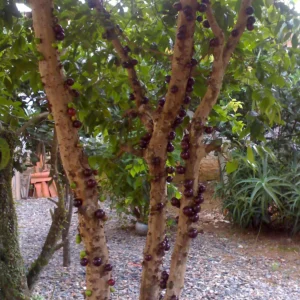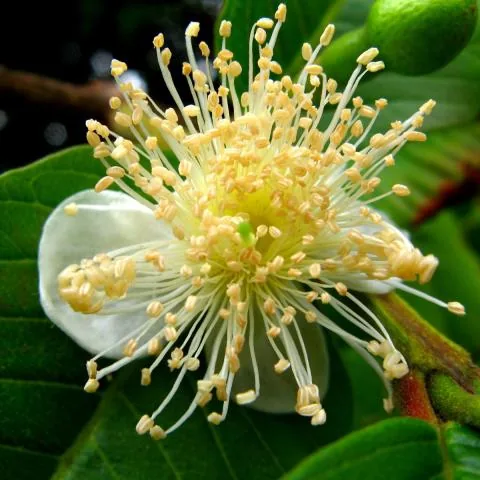
Guava combines fruit production with ornamental interest in a backyard. Opposite leaves, distinctive bark and pale flowers help identify the plant, but the fruit varies considerably between cultivated types. Flesh color, flavor and the best stage for eating should not be assumed from the common name alone.
Plant profile
Scientific name: Psidium guajava L.
Family: Myrtaceae.
Origin: tropical America.
Habit: a small tree, depending on training and conditions.
Leaves: simple and opposite, ranging from elliptical to elongated.
Light: full sun.
Propagation: seeds and vegetative methods using plant parts, such as stems.
Kew places Psidium guajava in the genus Psidium and the myrtle family. Singapore’s NParks describes trees reaching about 10 m (33 ft), while other sources give smaller sizes under managed cultivation. Allow garden space according to the plant you choose and its maintenance, not the size of its nursery pot.
Choosing the plant and planting site
Choose a sunny place and avoid areas where water remains standing. NParks describes moderate water needs. The University of Florida emphasizes that tolerating a short flooding episode does not make continuously waterlogged soil suitable.
Check local environmental recommendations too. UF/IFAS now advises caution with guava in central and southern Florida so that it does not escape cultivation. Suitability in one region is not a recommendation to introduce it everywhere.
At the nursery, assess the plant’s overall condition and ask how it was propagated. Seed-grown plants may differ from the tree that produced the fruit. If you want a particular cultivar, its identity and propagation history are more useful than choosing simply by height.
Planting and container growing
Check the plant’s source, inspect the leaves and examine root development before buying. Emater-DF recommends certified nurseries and an open site without shade from walls or trees. Its planting season for Brazil’s Federal District should not automatically be applied elsewhere.
Remove the container without breaking the root ball, a precaution emphasized by Incaper. Prepare enough space to accommodate it and stabilize the plant without pressing against the trunk. If a stake is needed, avoid ties that constrict the stem.
For a pot-grown guava, plan ongoing maintenance too. Check that drainage holes remain clear and water leaves the container after watering. Assess moisture before watering again. The pot must fit the root ball and allow growth; a stated volume alone does not guarantee fruit. If water stops soaking in or the root ball dries extremely quickly, assess the mix and available root space before adding more water or fertilizer.
Care after planting
Protect the trunk from damage during garden maintenance. The University of Florida warns about injuries from lawn mowers and trimmers, as well as excess irrigation associated with lawn care. Keep the area around the trunk organized so tools do not strike it.
Organic mulch can help conserve moisture and reduce competition from weeds. Keep it clear of the trunk. Feeding should reflect the soil and the tree’s needs rather than simply repeating the treatment given to the surrounding lawn.
Protecting guavas from fruit flies
Incaper describes bagging fruit while still small, generally 1.5–3 cm (0.6–1.2 in) across. Choose undamaged fruit, place each one in a purpose-made fruit-protection bag and secure the opening around the stalk without tightening it excessively. Suitable paper or nonwoven fabric provides a physical barrier; check for tears and loose fastenings. Do not wait until the fruit is ripe.
Avoid improvised sealed plastic bags. Besides trapping moisture, plastic can increase the risk of heat damage and fruit drop in hot conditions. Bagging does not restore fruit that has already been attacked. Watch fallen fruit and changes in new shoots too. Photograph symptoms and obtain identification from a local adviser before choosing a treatment.
Pruning and a lack of fruit: what to check
ESALQ’s maintenance advice includes removing dead, broken and diseased branches and reducing crossing branches and growth toward the center of the canopy. Identify the branch and the purpose of each cut first. Do not turn a cleanup prune into drastic reduction of the entire tree.
If your guava is not producing, first distinguish between a tree that does not flower and one that loses flowers or young fruit. Check its origin and age, shade, pruning history and water consistency. This helps separate juvenile growth from care problems. Take those observations to the nursery or an extension adviser; extra fertilizer without a diagnosis does not explain the cause. If foliage also changes color, see our guide to yellow leaves and their possible causes.
Common questions
Will a seed reproduce the exact guava I ate? There is no guarantee. To retain cultivar characteristics, ask the nursery about vegetative propagation and plant identification.
Does every guava turn yellow when ready to eat? No single rule fits all types. References distinguish different flesh colors and eating stages. Confirm the harvest stage for your cultivar.
When should I schedule pruning and harvest? Consider the cultivar and local climate. Use regional guidance instead of importing another country’s calendar.
Sources
Emater-DF: choosing a plant and growing guava (Portuguese)
Incaper: guava planting, training and management, 2024 (Portuguese PDF)
ESALQ/USP: pruning and fruit protection (Portuguese)
Singapore National Parks Board (NParks)
Royal Botanic Gardens, Kew
University of Florida: growing guide and updated environmental assessment
University of Florida: technical growing manual
Photo: mauroguanandi, CC BY 2.0. Cropped to 1:1 and converted to WebP, without upscaling.