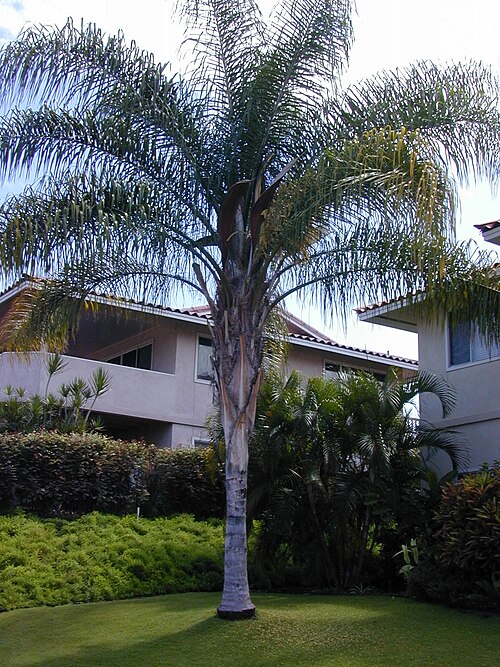
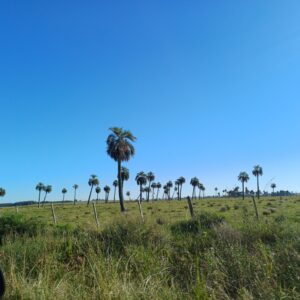
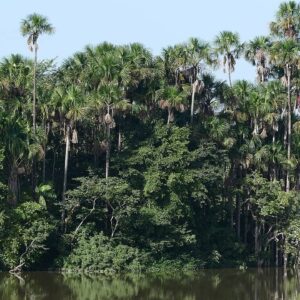
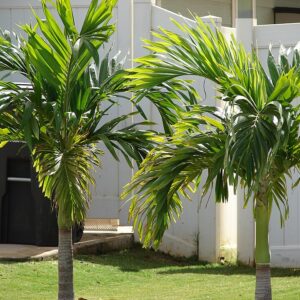
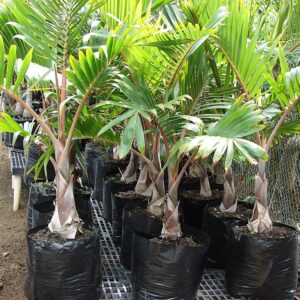
Known as jerivá in Brazil, Syagrus romanzoffiana is the queen palm: a tall, single-trunked palm with arching, feather-like leaves. It belongs to the Arecaceae family and is native to parts of Brazil, Paraguay, Uruguay and northeastern Argentina, according to Kew. It is an outdoor landscape tree, not a compact palm to choose for a small room.
Size, flowers and fruit
Embrapa describes specimens reaching 10–25 metres, with a ringed trunk and long, divided leaves. Mature fruits are yellow-orange with sweet, fibrous pulp. Birds and other animals feed on them, making the palm useful to wildlife within suitable native habitats.
Flowering and fruiting dates are not a universal calendar. Embrapa monitored palms in Paraná: those observations describe that location and period, rather than guaranteeing the same season in every garden. Plan around the conditions where you live.
Choosing a place
Allow generous space for the mature crown and think about what will be underneath it. Fallen fruit needs cleaning up on paths and patios. UF/IFAS also notes that dead leaves do not reliably fall off on their own. These practical details matter more than the size of a young nursery plant.
Cold winters and alkaline soils can cause problems. A plant that survives in one sheltered garden may struggle in another, so ask a local nursery about its suitability before buying. Outside its native range, check environmental guidance as well: the current UF/IFAS assessment calls for caution and prevention of escape in Florida. This is a regional assessment, not a worldwide prohibition.
Maintenance without overpruning
UF/IFAS advises retaining leaves until they are completely dead and avoiding trunk injuries. Yellowing or distorted foliage may reflect nutrient problems, but appearances alone do not identify the cause. Seek a diagnosis before adding fertilisers indiscriminately. Work high in a mature crown is a job for a qualified professional.
Propagation is by seed. Germination can be uneven and take several months, so a fixed promise of one to three months is misleading. Buy nursery-grown plants rather than collecting material from protected areas.
Can the fruit be eaten?
The edible part discussed here is the ripe pulp. Research involving Embrapa scientists has analysed its nutritional composition, but a nutrient analysis is not evidence that eating it treats disease. Correct identification and hygienic preparation remain essential. This is not a recommendation to eat the seeds or use the palm medicinally.
Usamos cookies em nosso site para fornecer a melhor experiência de uso, lembrando suas preferências e visitas repetidas. Ao clicar em “Aceitar”, concorda com a utilização de TODOS os cookies.
Este site usa cookies para melhorar sua experiência enquanto você navega pelo site. Destes cookies, os cookies que são categorizados como necessários são armazenados no seu navegador, pois são essenciais para o

funcionamento das funcionalidades básicas do site. Também usamos cookies de terceiros que nos ajudam a analisar e entender como você usa este site. Esses cookies serão armazenados em seu navegador apenas com

o seu consentimento. Você também tem a opção de bloquear esses cookies. Porém, a desativação de alguns desses cookies pode afetar sua experiência de navegação.
Os cookies necessários são absolutamente essenciais para o funcionamento adequado do site. Esta categoria inclui apenas cookies que garantem funcionalidades básicas e recursos de segurança do site. Esses cookies não armazenam nenhuma informação pessoal.
Quaisquer cookies que possam não ser particularmente necessários para o funcionamento do site e sejam usados especificamente para coletar dados pessoais do usuário por meio de análises, anúncios e outros conteúdos incorporados são denominados cookies não necessários. É obrigatório obter o consentimento do usuário antes de executar esses cookies no seu site.