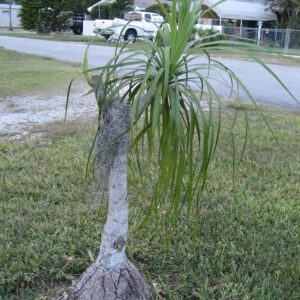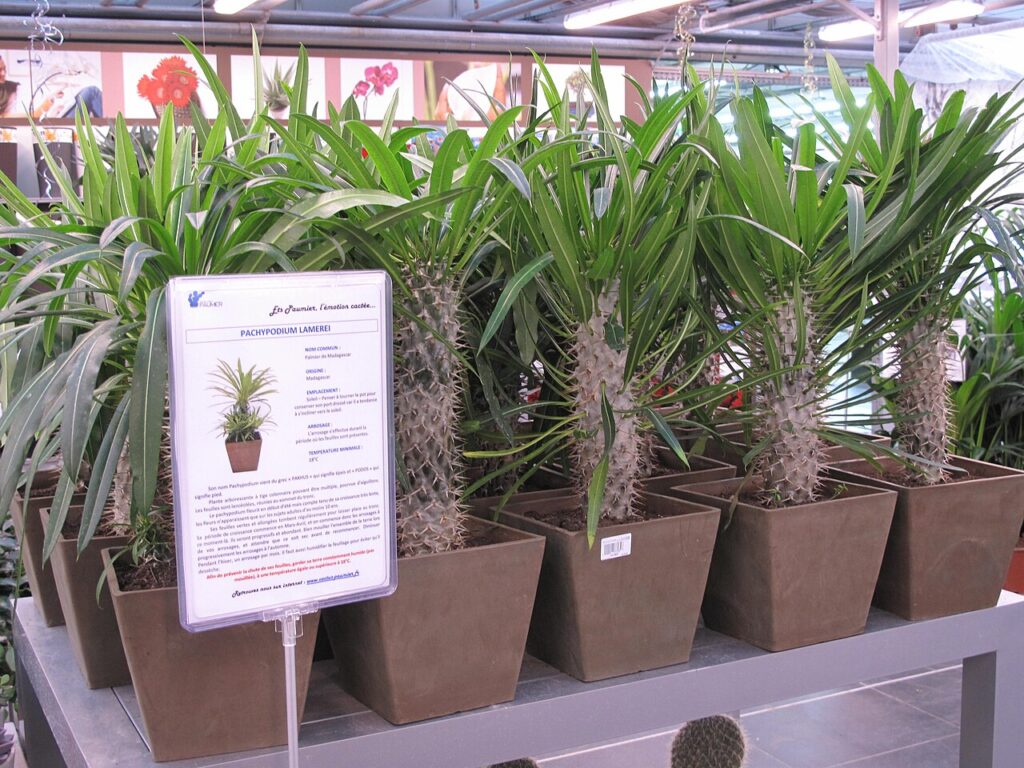
A silver-grey stem, sharp spines and a tuft of leaves give the Madagascar palm (Pachypodium lamerei) a striking silhouette. The name is misleading: it is a succulent in the dogbane family, Apocynaceae, not a true palm. Understanding that difference changes how you choose its position, water it and handle it.
A succulent built around its stem
Kew recognises Pachypodium lamerei as a species native to Madagascar. Its thick stem stores water. The University of Oxford profile describes spines reaching about 5 cm and explains that the plant can shed its leaves while its stem remains active. A bare crown during dormancy is therefore not, by itself, a reason to water more.
The leaves are narrow and simple, not feather-like palm fronds. HortFlora describes glossy green leaf blades and white flowers. Plan for a substantial succulent shrub or small tree rather than assuming that a nursery-sized specimen will stay small forever.
Safety comes before placement
The French National Museum of Natural History warns that its sap is toxic. Do not ingest any part or treat it as a medicinal plant. Avoid contact with sap when handling damaged stems. Its sharp spines are a separate physical hazard, also noted by NParks.
Keep it away from children, pets, busy passages and seating where someone could brush against it. Port St. Lucie Botanical Gardens specifically recommends avoiding foot traffic. Use protective equipment when moving or repotting it, and do not grip the spiny stem with bare hands. If accidental exposure or ingestion occurs, seek appropriate medical or veterinary advice rather than trying a home remedy.
Light, warmth and drainage
NParks recommends full sun and low water needs. In practice, choose the growing position before buying: a bright, protected terrace or sunny greenhouse is different from a dim interior. Acclimatise a plant gradually when moving it from a shaded nursery to stronger sunlight.
Cold protection matters. The French museum describes the species as frost-sensitive and suited to warm conditions. If winter is cold, use a container that can be moved to a suitable protected place. Do not rely on a sheltered wall alone as a guarantee against frost.
For pots, the RHS recommends cactus compost and full light. A drainage hole is essential: no potting mix can compensate for a sealed outer container filled with water. Choose a stable pot suited to the root system, not an oversized reservoir of damp compost. Leave room to handle the plant without injury.
Water according to growth, not habit
RHS guidance distinguishes moderate watering during active growth from a dry resting period. Do not copy northern-hemisphere calendar months blindly: observe the plant and your local season. Check the medium before watering and empty collected water from the saucer. Leaf loss should prompt a check of temperature, light and moisture, not an automatic extra drink.
During growth, use an appropriate low-nitrogen fertiliser according to its label. More fertiliser does not make unsuitable light or wet roots safe. A softening stem or persistent decline needs investigation; do not keep adding water or products in the hope that one will solve the problem.
Growth, flowers and propagation
Mature plants may produce fragrant white flowers with a yellow centre, but flowering is not guaranteed in a household pot. The French museum describes slow growth, so avoid promises of a fixed annual increase or a particular flowering age.
Seeds are one propagation route; the RHS also lists stem-tip cuttings. Because cutting exposes sap and creates a wound vulnerable to poor handling, it is not a necessary beginner task. Ask an experienced succulent grower before attempting it. Routine pruning is generally unnecessary. Buy nursery-propagated plants from a reliable source rather than collecting wild specimens.
The reward is an unusual plant whose shape can stand on its own. Give it a bright, safe position and respect the difference between an actively growing succulent and one at rest. That is more useful than a complicated timetable of interventions.
Cover photo: Tangopaso / Wikimedia Commons, public domain. Nursery specimens identified by their botanical label; reduced-size version.