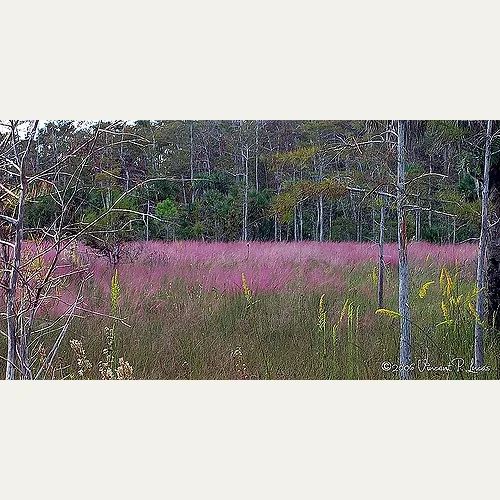
Pink muhly grass forms clumps of fine leaves and inflorescences, airy clusters of flowers that create a pink mist effect. Planted in groups, it brings movement and texture to the garden.
Plant profile
Scientific name: Muhlenbergia capillaris (Lam.) Trin.
Family: Poaceae.
Life cycle: perennial grass.
Approximate size: 60 to 90 cm; the flower heads can add to its height.
Origin: North America and nearby regions of Central America and the Caribbean.
Light: full sun.
Where to plant and how much space to leave
North Carolina State University recommends plenty of sun for the best floral display and well-drained soil. The plant tolerates heat, humidity, drought and poor soil.
As a planting-design guide, the University of Florida (UF/IFAS) suggests spacing plants approximately 60 to 90 cm apart. Adjust this to the width of the plants you buy and the effect you want. Keep the plumes visible rather than hiding them behind shrubs; planting in groups highlights the movement of the stems.
Planting young plants: step by step
To plant a rooted young plant, follow Clemson University’s general guidance for perennials: prepare a hole to accommodate the root ball, gently loosen any circling roots and keep the base at the same level as in its container. Backfill around it, firm the soil and water thoroughly. During the first few weeks, monitor moisture in the root ball, where the roots are still concentrated.
Watering and feeding
UF/IFAS Extension in Pasco County recommends regular watering until the plant is established and highlights its drought tolerance after that stage. A newly planted specimen and a mature clump should not automatically receive the same care. Check the soil before watering again and take rainfall into account; avoid a fixed schedule that ignores the weather.
The same extension service reports that fertiliser is usually unnecessary in the soils of the Florida region it describes. This is not a prescription for every soil in Brazil. Before adding fertiliser, assess the plant’s growth and the conditions in the bed; a soil test can help identify its actual needs.
Growing in a pot
The UK’s Royal Horticultural Society (RHS) lists the species as suitable for containers and recommends a well-drained, loam-based potting mix in a position with plenty of light.
Choose a container with drainage holes and check that they remain clear. Drought tolerance in the garden does not mean the plant can do without watering in a limited volume of potting mix. When planning a balcony planting, consider the width of both the clump and its flower stems.
Flowering and changes in colour
The pink colour comes from the flower heads and does not remain on the plant all year. North American references describe autumn flowering, followed by beige plumes that still have ornamental interest. That calendar describes a different hemisphere from Brazil; in Brazil, observe the local cycle before assigning fixed flowering months.
A small young plant, a clump outside its flowering season and a different commercial selection will not necessarily look like the photograph. To assess the result, record the light it receives, the planting date and the development of its stems throughout the cycle, rather than expecting constant pink colour.
Tidying and rejuvenation pruning
Pruning does not have to mean a drastic annual cut. The UF/IFAS guide to ornamental grasses distinguishes removing dry tips and spent stems from more intensive pruning. Tidy the plant according to its appearance and preserve healthy green growth. If you need to rejuvenate a very dry clump, plan the cut before shoots emerge for the new growth phase. Look at the base for small green tips and new leaves lengthening among the old ones: these are signs that growth is resuming. If they are already growing, preserve them rather than cutting the whole clump back over them. Avoid severe pruning before winter dormancy in places where it occurs.
How to propagate by division
The RHS lists seeds and division as propagation methods. For division, favour the beginning of the local active-growth period, recognised by new shoots emerging at the base of the clump.
Mississippi State University describes the general procedure: lift the clump with a substantial portion of its roots, identify the growing points and separate it into sections that retain both roots and shoots. Replant at the previous depth and water until established. Avoid leaving the divisions out of the soil while you prepare their new location.
If an ageing clump has a dry centre and living edges, division may help rejuvenate it. The University of Minnesota’s guide to grasses recommends using the living sections and discarding the dead centre. This is general guidance for clump-forming grasses, not proof that every dry centre has the same cause.
Problems and warning signs
NC State mentions mealybugs in North Carolina. That does not establish that they are present in your garden: identify the problem locally.
If the plant loses vigour rapidly, examine its base, leaves and soil before applying products. Note whether the damage affects the whole clump or only part of it, whether insects are visible and whether water drains away. Take photographs and a record of the care it has received to a nursery or a professional to help identify the cause.
Frequently asked questions
Can it be used as a lawn that people walk on? The use described in this guide is ornamental, in clumps, borders or mass plantings. Do not plan the bed as an area where people will walk over the plants.
Do I need to cut off all the plumes as soon as they turn beige? There is no need to remove structures immediately if you still find them attractive. Decide according to appearance and the need for tidying, while preserving new shoots.
Should I expect every young plant to have exactly the same pink colour? Do not use a photograph of one variety as a guarantee for another. Confirm the scientific name and commercial selection when buying.
Photo: leppyone, CC BY 2.0. Neutral margins added for a square format, without cropping or enlargement; WebP compression.